


 癌症的基本特征包括细胞增殖、血管生成、迁移、凋亡逃避机制和细胞永生等。找到癌症发生过程中这些通路的关键标记物和对应的抗体用于检测至关重要。
 为您推荐一个泛素化位点预测神器——泛素化分析工具,可以为您的蛋白的泛素化位点作出预测和评分。
 细胞自噬受体图形绘图工具为你的蛋白的细胞受体结合位点作出预测和评分,识别结合到自噬通路中的蛋白是非常重要的,便于让我们理解自噬在正常生理、病理过程中的作用,如发育、细胞分化、神经退化性疾病、压力条件下、感染和癌症。
ELF4 Antibody (N-term) 精选
Affinity Purified Rabbit Polyclonal Antibody (Pab)
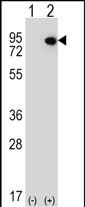
- 产品详情
- 文献引用 : 1
- 实验流程
- 背景知识
Application 
| WB, E |
|---|---|
| Primary Accession | Q99607 |
| Other Accession | NP_001412.1, NP_001120669.1 |
| Reactivity | Human, Mouse |
| Predicted | Bovine, Canine, Rabbit |
| Host | Rabbit |
| Clonality | Polyclonal |
| Isotype | Rabbit IgG |
| Calculated MW | 70730 Da |
| Antigen Region | 161-188 aa |
| Gene ID | 2000 |
|---|---|
| Other Names | ETS-related transcription factor Elf-4, E74-like factor 4, Myeloid Elf-1-like factor, ELF4 {ECO:0000312|EMBL:CAI428821} |
| Target/Specificity | This ELF4 antibody is generated from rabbits immunized with a KLH conjugated synthetic peptide between 161-188 amino acids from the N-terminal region of human ELF4. |
| Dilution | WB~~1:1000 E~~Use at an assay dependent concentration. |
| Format | Purified polyclonal antibody supplied in PBS with 0.09% (W/V) sodium azide. This antibody is purified through a protein A column, followed by peptide affinity purification. |
| Storage | Maintain refrigerated at 2-8°C for up to 2 weeks. For long term storage store at -20°C in small aliquots to prevent freeze-thaw cycles. |
| Precautions | ELF4 Antibody (N-term) is for research use only and not for use in diagnostic or therapeutic procedures. |
For Research Use Only. Not For Use In Diagnostic Procedures.
| Name | ELF4 {ECO:0000312|EMBL:CAI42882.1} |
|---|---|
| Function | Transcriptional activator that binds to DNA sequences containing the consensus 5'-WGGA-3'. Transactivates promoters of the hematopoietic growth factor genes CSF2, IL3, IL8, and of the bovine lysozyme gene. Acts synergistically with RUNX1 to transactivate the IL3 promoter (By similarity). Transactivates the PRF1 promoter in natural killer (NK) cells and CD8+ T cells (PubMed:34326534). Plays a role in the development and function of NK and NK T-cells and in innate immunity. Controls the proliferation and homing of CD8+ T-cells via the Kruppel-like factors KLF4 and KLF2 (By similarity). Controls cell senescence in a p53-dependent manner. Can also promote cellular transformation through inhibition of the p16 pathway. Is a transcriptional regulator of inflammation, controlling T-helper 17 (Th17) cells and macrophage inflammatory responses. Required for sustained transcription of anti-inflammatory genes, including IL1RN (PubMed:34326534, PubMed:35266071). Is a negative regulator of pro- inflammatory cytokines expression including IL17A, IL1B, IL6, TNFA and CXCL1 (PubMed:34326534, PubMed:35266071). Down-regulates expression of TREM1, a cell surface receptor involved in the amplification of inflammatory responses (By similarity) (PubMed:34326534, PubMed:35266071). |
| Cellular Location | Nucleus, PML body. Note=Accumulation into PML nuclear bodies is mediated by PML |
| Tissue Location | Abundantly expressed in the placenta and in a variety of myeloid leukemia cell lines. Moderate levels of expression in heart, lung, spleen, thymus, peripheral blood lymphocytes, ovary and colon. Lower levels of expression in Jurkat T-cells and other T-cell lines and no expression in brain. |

Provided below are standard protocols that you may find useful for product applications.
BACKGROUND
The protein encoded by this gene is a transcriptional activator that binds and activates the promoters of the CSF2, IL3, IL8, and PRF1 genes. The encoded protein is involved in natural killer cell development and function, innate immunity, and induction of cell cycle arrest in naive CD8+ cells. Two transcript variants encoding the same protein have been found for this gene.
REFERENCES
Yamada, T., et al. Nat. Immunol. 10(6):618-626(2009)
Sugiyama, N., et al. Mol. Cell Proteomics 6(6):1103-1109(2007)
Moore, S.D., et al. Leuk. Res. 30(8):1037-1042(2006)
Liu, Y., et al. Mol. Cell. Biol. 26(8):3114-3123(2006)
Koga, T., et al. FEBS Lett. 579(13):2811-2816(2005)

终于等到您。ABCEPTA(百远生物)抗体产品。
点击下方“我要评价 ”按钮提交您的反馈信息,您的反馈和评价是我们最宝贵的财富之一,
我们将在1-3个工作日内处理您的反馈信息。
如有疑问,联系:0512-88856768 tech-china@abcepta.com.


