


 癌症的基本特征包括细胞增殖、血管生成、迁移、凋亡逃避机制和细胞永生等。找到癌症发生过程中这些通路的关键标记物和对应的抗体用于检测至关重要。
 为您推荐一个泛素化位点预测神器——泛素化分析工具,可以为您的蛋白的泛素化位点作出预测和评分。
 细胞自噬受体图形绘图工具为你的蛋白的细胞受体结合位点作出预测和评分,识别结合到自噬通路中的蛋白是非常重要的,便于让我们理解自噬在正常生理、病理过程中的作用,如发育、细胞分化、神经退化性疾病、压力条件下、感染和癌症。
PRMT5 Antibody (N-term) 精选
Affinity Purified Rabbit Polyclonal Antibody (Pab)
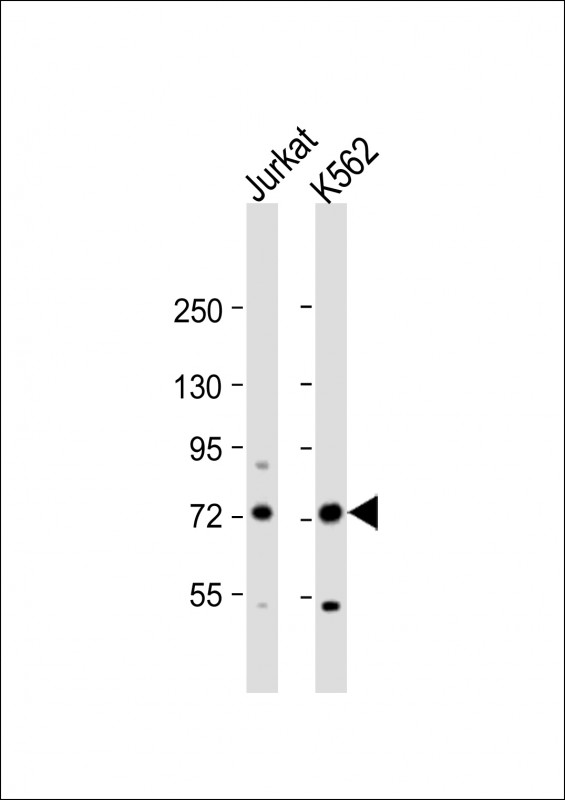
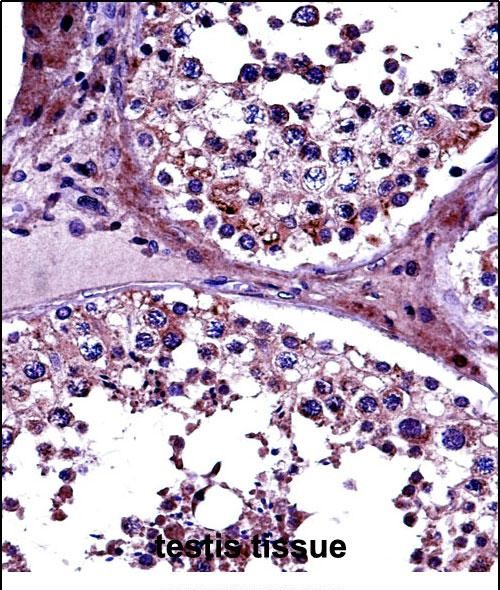
- 产品详情
- 实验流程
- 背景知识
Application 
| IHC-P, WB, E |
|---|---|
| Primary Accession | O14744 |
| Other Accession | Q4R5M3, A7YW45, NP_006100.2, NP_001034708.1 |
| Reactivity | Human |
| Predicted | Bovine, Monkey, Mouse, Rat, Canine, Rabbit |
| Host | Rabbit |
| Clonality | Polyclonal |
| Isotype | Rabbit IgG |
| Calculated MW | 72684 Da |
| Antigen Region | 76-104 aa |
| Gene ID | 10419 |
|---|---|
| Other Names | Protein arginine N-methyltransferase 5, 211-, 72 kDa ICln-binding protein, Histone-arginine N-methyltransferase PRMT5, Jak-binding protein 1, Shk1 kinase-binding protein 1 homolog, SKB1 homolog, SKB1Hs, Protein arginine N-methyltransferase 5, N-terminally processed, PRMT5, HRMT1L5, IBP72, JBP1, SKB1 |
| Target/Specificity | This PRMT5 antibody is generated from rabbits immunized with a KLH conjugated synthetic peptide between 76-104 amino acids from the N-terminal region of human PRMT5. |
| Dilution | IHC-P~~1:100~500 WB~~1:1000 E~~Use at an assay dependent concentration. |
| Format | Purified polyclonal antibody supplied in PBS with 0.09% (W/V) sodium azide. This antibody is purified through a protein A column, followed by peptide affinity purification. |
| Storage | Maintain refrigerated at 2-8°C for up to 2 weeks. For long term storage store at -20°C in small aliquots to prevent freeze-thaw cycles. |
| Precautions | PRMT5 Antibody (N-term) is for research use only and not for use in diagnostic or therapeutic procedures. |
For Research Use Only. Not For Use In Diagnostic Procedures.
| Name | PRMT5 |
|---|---|
| Synonyms | HRMT1L5, IBP72, JBP1, SKB1 |
| Function | Arginine methyltransferase that can both catalyze the formation of omega-N monomethylarginine (MMA) and symmetrical dimethylarginine (sDMA), with a preference for the formation of MMA (PubMed:10531356, PubMed:11152681, PubMed:11747828, PubMed:12411503, PubMed:15737618, PubMed:17709427, PubMed:20159986, PubMed:20810653, PubMed:21081503, PubMed:21258366, PubMed:21917714, PubMed:22269951, PubMed:33762328). Specifically mediates the symmetrical dimethylation of arginine residues in the small nuclear ribonucleoproteins Sm D1 (SNRPD1) and Sm D3 (SNRPD3); such methylation being required for the assembly and biogenesis of snRNP core particles (PubMed:11747828, PubMed:12411503, PubMed:17709427). Methylates SUPT5H and may regulate its transcriptional elongation properties (PubMed:12718890). May methylate the N-terminal region of MBD2 (PubMed:16428440). Mono- and dimethylates arginine residues of myelin basic protein (MBP) in vitro. May play a role in cytokine-activated transduction pathways. Negatively regulates cyclin E1 promoter activity and cellular proliferation. Methylates histone H2A and H4 'Arg-3' during germ cell development (By similarity). Methylates histone H3 'Arg-8', which may repress transcription (By similarity). Methylates the Piwi proteins (PIWIL1, PIWIL2 and PIWIL4), methylation of Piwi proteins being required for the interaction with Tudor domain-containing proteins and subsequent localization to the meiotic nuage (By similarity). Methylates RPS10 (PubMed:20159986). Attenuates EGF signaling through the MAPK1/MAPK3 pathway acting at 2 levels. First, monomethylates EGFR; this enhances EGFR 'Tyr-1197' phosphorylation and PTPN6 recruitment, eventually leading to reduced SOS1 phosphorylation (PubMed:21258366, PubMed:21917714). Second, methylates RAF1 and probably BRAF, hence destabilizing these 2 signaling proteins and reducing their catalytic activity (PubMed:21917714). Required for induction of E-selectin and VCAM-1, on the endothelial cells surface at sites of inflammation. Methylates HOXA9 (PubMed:22269951). Methylates and regulates SRGAP2 which is involved in cell migration and differentiation (PubMed:20810653). Acts as a transcriptional corepressor in CRY1- mediated repression of the core circadian component PER1 by regulating the H4R3 dimethylation at the PER1 promoter (By similarity). Methylates GM130/GOLGA2, regulating Golgi ribbon formation (PubMed:20421892). Methylates H4R3 in genes involved in glioblastomagenesis in a CHTOP- and/or TET1-dependent manner (PubMed:25284789). Symmetrically methylates POLR2A, a modification that allows the recruitment to POLR2A of proteins including SMN1/SMN2 and SETX. This is required for resolving RNA-DNA hybrids created by RNA polymerase II, that form R- loop in transcription terminal regions, an important step in proper transcription termination (PubMed:26700805). Along with LYAR, binds the promoter of gamma-globin HBG1/HBG2 and represses its expression (PubMed:25092918). Symmetrically methylates NCL (PubMed:21081503). Methylates p53/TP53; methylation might possibly affect p53/TP53 target gene specificity (PubMed:19011621). Involved in spliceosome maturation and mRNA splicing in prophase I spermatocytes through the catalysis of the symmetrical arginine dimethylation of SNRPB (small nuclear ribonucleoprotein-associated protein) and the interaction with tudor domain-containing protein TDRD6 (By similarity). Acts as a negative regulator of cGAS-STING signaling by mediating methylation of CGAS, preventing DNA-binding ability of CGAS (PubMed:33762328). |
| Cellular Location | Cytoplasm. Nucleus. Chromosome. Golgi apparatus. Note=Localizes to promoter regions of target genes on chromosomes (PubMed:33376131). Localizes to methylated chromatin (PubMed:16428440). |
| Tissue Location | Ubiquitous.. |
Provided below are standard protocols that you may find useful for product applications.
BACKGROUND
Arginine methyltransferase that can both catalyze the formation of omega-N monomethylarginine (MMA) and symmetrical dimethylarginine (sDMA), with a preference for the formation of MMA. Specifically mediates the symmetrical dimethylation of arginine residues in the small nuclear ribonucleoproteins Sm D1 (SNRPD1) and Sm D3 (SNRPD3); such methylation being required for the assembly and biogenesis of snRNP core particles. Methylates SUPT5H. Mono-and dimethylates arginine residues of myelin basic protein (MBP) in vitro. Plays a role in the assembly of snRNP core particles. May play a role in cytokine-activated transduction pathways. Negatively regulates cyclin E1 promoter activity and cellular proliferation. May regulate the SUPT5H transcriptional elongation properties. May be part of a pathway that is connected to a chloride current, possibly through cytoskeletal rearrangement. Methylates histone H2A and H4 'Arg-3' during germ cell development. Methylates histone H3 'Arg-8', which may repress transcription. Methylates the Piwi proteins (PIWIL1, PIWIL2 and PIWIL4), methylation of Piwi proteins being required for the interaction with Tudor domain-containing proteins and subsequent localization to the meiotic nuage. Methylates RPS10.
REFERENCES
Aggarwal, P., et al. Cancer Cell 18(4):329-340(2010)
Rank, G., et al. Blood 116(9):1585-1592(2010)
Cesaro, E., et al. J. Biol. Chem. 284(47):32321-32330(2009)
Zhao, Q., et al. Nat. Struct. Mol. Biol. 16(3):304-311(2009)
Bruns, A.F., et al. Biol. Chem. 390(1):59-65(2009)

终于等到您。ABCEPTA(百远生物)抗体产品。
点击下方“我要评价 ”按钮提交您的反馈信息,您的反馈和评价是我们最宝贵的财富之一,
我们将在1-3个工作日内处理您的反馈信息。
如有疑问,联系:0512-88856768 tech-china@abcepta.com.


