


 癌症的基本特征包括细胞增殖、血管生成、迁移、凋亡逃避机制和细胞永生等。找到癌症发生过程中这些通路的关键标记物和对应的抗体用于检测至关重要。
 为您推荐一个泛素化位点预测神器——泛素化分析工具,可以为您的蛋白的泛素化位点作出预测和评分。
 细胞自噬受体图形绘图工具为你的蛋白的细胞受体结合位点作出预测和评分,识别结合到自噬通路中的蛋白是非常重要的,便于让我们理解自噬在正常生理、病理过程中的作用,如发育、细胞分化、神经退化性疾病、压力条件下、感染和癌症。
SHMT1 Antibody (N-term) 精选
Affinity Purified Rabbit Polyclonal Antibody (Pab)
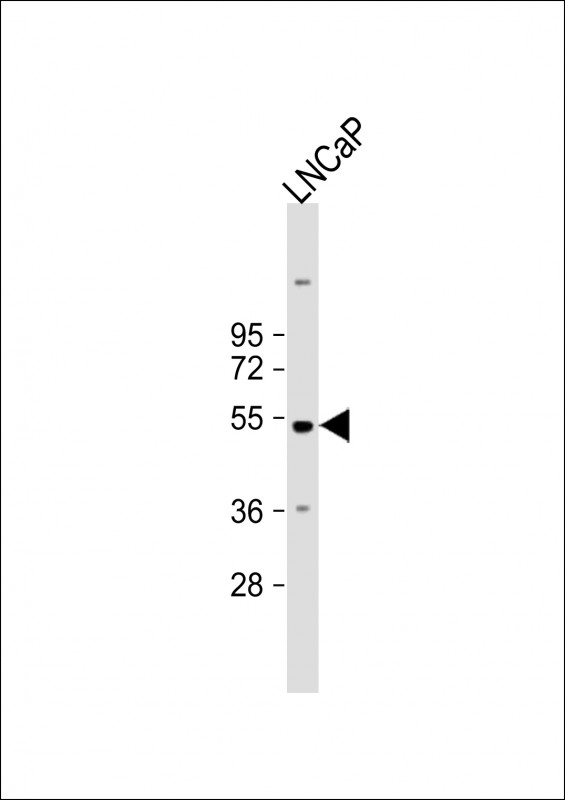
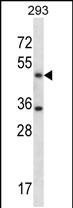
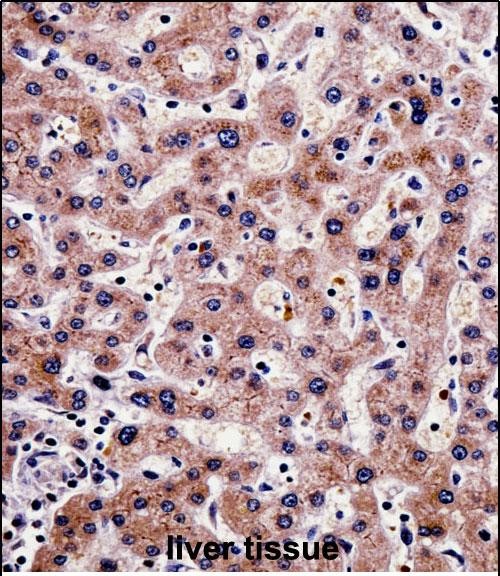
- 产品详情
- 文献引用 : 1
- 实验流程
- 背景知识
Application 
| WB, IHC-P, E |
|---|---|
| Primary Accession | P34896 |
| Other Accession | Q5E9P9, NP_004160.3, NP_683718.1 |
| Reactivity | Human |
| Predicted | Bovine, Mouse, Rat, Canine, Rabbit |
| Host | Rabbit |
| Clonality | Polyclonal |
| Isotype | Rabbit IgG |
| Calculated MW | 53083 Da |
| Antigen Region | 19-47 aa |
| Gene ID | 6470 |
|---|---|
| Other Names | Serine hydroxymethyltransferase, cytosolic, SHMT, Glycine hydroxymethyltransferase, Serine methylase, SHMT1 |
| Target/Specificity | This SHMT1 antibody is generated from rabbits immunized with a KLH conjugated synthetic peptide between 19-47 amino acids from the N-terminal region of human SHMT1. |
| Dilution | WB~~1:1000 IHC-P~~1:100~500 E~~Use at an assay dependent concentration. |
| Format | Purified polyclonal antibody supplied in PBS with 0.09% (W/V) sodium azide. This antibody is purified through a protein A column, followed by peptide affinity purification. |
| Storage | Maintain refrigerated at 2-8°C for up to 2 weeks. For long term storage store at -20°C in small aliquots to prevent freeze-thaw cycles. |
| Precautions | SHMT1 Antibody (N-term) is for research use only and not for use in diagnostic or therapeutic procedures. |
For Research Use Only. Not For Use In Diagnostic Procedures.
| Name | SHMT1 (HGNC:10850) |
|---|---|
| Function | Pyridoxal phosphate (PLP)-dependent enzyme that catalyzes the reversible conversion of serine and tetrahydrofolate (THF) to glycine and 5,10-methylene THF, serving as a critical component of the folate cycle and facilitating one-carbon biosynthetic reactions essential for methionine, purine, and pyrimidine synthesis (PubMed:24698160, PubMed:30035852, PubMed:38996576). While its central activity involves serine cleavage, the detailed catalytic mechanisms remain under study, including both retro-aldol cleavage of the PLP-serine C(alpha)-C(beta) bond followed by formaldehyde condensation with THF, and alternative nucleophilic displacement mechanisms of the C(alpha) atom of PLP-serine aldimine involving THF's N5 atom (By similarity). Also catalyzes the cleavage of various 3-hydroxy amino acids, such as L-allo-threonine, L- threonine and 3-phenylserine, forming glycine and the corresponding aldehyde through a retro-aldol process; additionally, it catalyzes the formation of 5-formyltetrahydrofolate from 5,10- methenyltetrahydrofolate (PubMed:38615009). Also functions as a hydroxytrimethyllysine aldolase (HTMLA) catalyzing the second step of the carnitine biosynthesis pathway and exhibits substrate preference with the erythro (S,S) configuration, and more efficiency with L-allo- threonine (PubMed:38615009). In the nucleus, first functions as a lamin-binding scaffold protein that is essential for assembling the de novo thymidylate synthesis complex by co-localizing DHFR and TYMS with the nuclear lamina and anchoring the complex to DNA replication sites (PubMed:22235121). Subsequently, provides one-carbon substrates, specifically (6R)-5,10-methylene-5,6,7,8-tetrahydrofolate, in situ for de novo dTMP synthesis to sustain DNA replication and repair during cell proliferation (PubMed:30035852). Importantly, possesses RNA- binding capability, forming complexes that selectively regulate SHMT2 mRNA translation and dynamically modulate cytosolic and mitochondrial serine and glycine concentrations, thus influencing cellular metabolic status (PubMed:38996576). |
| Cellular Location | Cytoplasm. Nucleus. Note=Nuclear translocation is RAN- dependent and is independent from both the oligomerization state and the catalytic activity (PubMed:30035852). In the cytoplasm, SHMT1 degradation is facilitated by 'Lys-48'-linked ubiquitination, whereas in the nucleus, 'Lys-63'-linked ubiquitination prevents degradation (PubMed:22194612). Predominantly sumoylated and localized to the nucleus in S phase cells and remains in the nucleus during the G2/M phase of the cell cycle (PubMed:17446168). Sumoylation occurs at the nuclear pore and is linked to nuclear import (PubMed:17446168). As a component of the de novo thymidylate synthesis complex, localizes specifically to replication forks during DNA synthesis (PubMed:22235121). |

Provided below are standard protocols that you may find useful for product applications.
BACKGROUND
This gene encodes the cellular form of serine hydroxymethyltransferase, a pyridoxal phosphate-containing enzyme that catalyzes the reversible conversion of serine and tetrahydrofolate to glycine and 5,10-methylene tetrahydrofolate. This reaction provides one carbon units for synthesis of methionine, thymidylate, and purines in the cytoplasm. This gene is located within the Smith-Magenis syndrome region on chromosome 17. Alternative splicing of this gene results in 2 transcript variants encoding 2 different isoforms. Additional transcript variants have been described, but their biological validity has not been determined.
REFERENCES
Porter, K.E., et al. Environ. Res. 110(6):580-587(2010)
Summers, C.M., et al. Birth Defects Res. Part A Clin. Mol. Teratol. 88(8):679-688(2010)
Vijayakrishnan, J., et al. Haematologica 95(8):1405-1414(2010)
Levine, A.J., et al. Cancer Epidemiol. Biomarkers Prev. 19(7):1812-1821(2010)
Jugessur, A., et al. PLoS ONE 5 (7), E11493 (2010) :

终于等到您。ABCEPTA(百远生物)抗体产品。
点击下方“我要评价 ”按钮提交您的反馈信息,您的反馈和评价是我们最宝贵的财富之一,
我们将在1-3个工作日内处理您的反馈信息。
如有疑问,联系:0512-88856768 tech-china@abcepta.com.


