


 癌症的基本特征包括细胞增殖、血管生成、迁移、凋亡逃避机制和细胞永生等。找到癌症发生过程中这些通路的关键标记物和对应的抗体用于检测至关重要。
 为您推荐一个泛素化位点预测神器——泛素化分析工具,可以为您的蛋白的泛素化位点作出预测和评分。
 细胞自噬受体图形绘图工具为你的蛋白的细胞受体结合位点作出预测和评分,识别结合到自噬通路中的蛋白是非常重要的,便于让我们理解自噬在正常生理、病理过程中的作用,如发育、细胞分化、神经退化性疾病、压力条件下、感染和癌症。
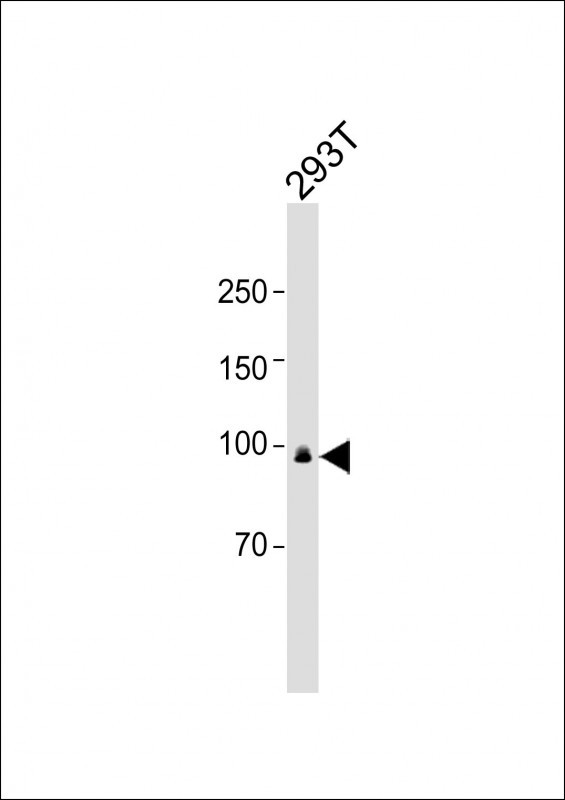
LRRC8A Antibody(C-term) 精选
Affinity Purified Rabbit Polyclonal Antibody (Pab)
- 产品详情
- 实验流程
- 背景知识
Application 
| WB, E |
|---|---|
| Primary Accession | Q8IWT6 |
| Other Accession | Q4V8I7, Q80WG5, NP_062540.2 |
| Reactivity | Human, Mouse |
| Predicted | Mouse, Rat, Bovine, Canine, Chicken |
| Host | Rabbit |
| Clonality | Polyclonal |
| Isotype | Rabbit IgG |
| Calculated MW | 94199 Da |
| Antigen Region | 782-810 aa |
| Gene ID | 56262 |
|---|---|
| Other Names | Volume-regulated anion channel subunit LRRC8A, Leucine-rich repeat-containing protein 8A, Swelling protein 1, LRRC8A, KIAA1437, LRRC8, SWELL1 |
| Target/Specificity | This LRRC8A antibody is generated from rabbits immunized with a KLH conjugated synthetic peptide between 782-810 amino acids from the C-terminal region of human LRRC8A. |
| Dilution | WB~~1:1000 E~~Use at an assay dependent concentration. |
| Format | Purified polyclonal antibody supplied in PBS with 0.05% (V/V) Proclin 300. This antibody is purified through a protein A column, followed by peptide affinity purification. |
| Storage | Maintain refrigerated at 2-8°C for up to 2 weeks. For long term storage store at -20°C in small aliquots to prevent freeze-thaw cycles. |
| Precautions | LRRC8A Antibody(C-term) is for research use only and not for use in diagnostic or therapeutic procedures. |
For Research Use Only. Not For Use In Diagnostic Procedures.
| Name | LRRC8A {ECO:0000303|PubMed:22532330, ECO:0000312|HGNC:HGNC:19027} |
|---|---|
| Function | Essential component of the volume-regulated anion channel (VRAC, also named VSOAC channel), an anion channel required to maintain a constant cell volume in response to extracellular or intracellular osmotic changes (PubMed:24725410, PubMed:24790029, PubMed:26530471, PubMed:26824658, PubMed:28193731, PubMed:29769723). The VRAC channel conducts iodide better than chloride and can also conduct organic osmolytes like taurine (PubMed:24725410, PubMed:24790029, PubMed:26530471, PubMed:26824658, PubMed:28193731, PubMed:30095067). Mediates efflux of amino acids, such as aspartate and glutamate, in response to osmotic stress (PubMed:28193731). LRRC8A and LRRC8D are required for the uptake of the drug cisplatin (PubMed:26530471). In complex with LRRC8C or LRRC8E, acts as a transporter of immunoreactive cyclic dinucleotide GMP-AMP (2'-3'-cGAMP), an immune messenger produced in response to DNA virus in the cytosol: mediates both import and export of 2'-3'-cGAMP, thereby promoting transfer of 2'-3'-cGAMP to bystander cells (PubMed:33171122). In contrast, complexes containing LRRC8D inhibit transport of 2'-3'-cGAMP (PubMed:33171122). Required for in vivo channel activity, together with at least one other family member (LRRC8B, LRRC8C, LRRC8D or LRRC8E); channel characteristics depend on the precise subunit composition (PubMed:24790029, PubMed:26824658, PubMed:28193731). Can form functional channels by itself (in vitro) (PubMed:26824658). Involved in B-cell development: required for the pro-B cell to pre-B cell transition (PubMed:14660746). Also required for T-cell development (By similarity). Required for myoblast differentiation: VRAC activity promotes membrane hyperpolarization and regulates insulin-stimulated glucose metabolism and oxygen consumption (By similarity). Also acts as a regulator of glucose-sensing in pancreatic beta cells: VRAC currents, generated in response to hypotonicity- or glucose-induced beta cell swelling, depolarize cells, thereby causing electrical excitation, leading to increase glucose sensitivity and insulin secretion (PubMed:29371604). Also plays a role in lysosome homeostasis by forming functional lysosomal VRAC channels in response to low cytoplasmic ionic strength condition: lysosomal VRAC channels are necessary for the formation of large lysosome-derived vacuoles, which store and then expel excess water to maintain cytosolic water homeostasis (PubMed:31270356, PubMed:33139539). Acts as a key factor in NLRP3 inflammasome activation by modulating itaconate efflux and mitochondria function (PubMed:39909992). |
| Cellular Location | Cell membrane; Multi-pass membrane protein. Lysosome membrane; Multi-pass membrane protein. Note=Mainly localizes to the cell membrane, with some intracellular localization to lysosomes |
| Tissue Location | Expressed in brain, kidney, ovary, lung, liver, heart, and fetal brain and liver. Found at high levels in bone marrow; lower levels are detected in peripheral blood cells. Expressed on T- cells as well as on B-lineage cells. |
Provided below are standard protocols that you may find useful for product applications.
BACKGROUND
This gene encodes a protein belonging to the leucine-rich repeat family of proteins, which are involved in diverse biological processes, including cell adhesion, cellular trafficking, and hormone-receptor interactions. This family member is a putative four-pass transmembrane protein that plays a role in B cell development. Defects in this gene cause autosomal dominant non-Bruton type agammaglobulinemia, an immunodeficiency disease resulting from defects in B cell maturation. Multiple alternatively spliced transcript variants, which encode the same protein, have been identified for this gene.
REFERENCES
Olsen, J.V., et al. Cell 127(3):635-648(2006)
Smits, G., et al. Mol. Immunol. 41(5):561-562(2004)
Kubota, K., et al. FEBS Lett. 564 (1-2), 147-152 (2004) :
Sawada, A., et al. J. Clin. Invest. 112(11):1707-1713(2003)
Conley, M.E. J. Clin. Invest. 112(11):1636-1638(2003)

终于等到您。ABCEPTA(百远生物)抗体产品。
点击下方“我要评价 ”按钮提交您的反馈信息,您的反馈和评价是我们最宝贵的财富之一,
我们将在1-3个工作日内处理您的反馈信息。
如有疑问,联系:0512-88856768 tech-china@abcepta.com.


