


 癌症的基本特征包括细胞增殖、血管生成、迁移、凋亡逃避机制和细胞永生等。找到癌症发生过程中这些通路的关键标记物和对应的抗体用于检测至关重要。
 为您推荐一个泛素化位点预测神器——泛素化分析工具,可以为您的蛋白的泛素化位点作出预测和评分。
 细胞自噬受体图形绘图工具为你的蛋白的细胞受体结合位点作出预测和评分,识别结合到自噬通路中的蛋白是非常重要的,便于让我们理解自噬在正常生理、病理过程中的作用,如发育、细胞分化、神经退化性疾病、压力条件下、感染和癌症。
Mouse Runx1 Antibody (C-term) 精选
Purified Rabbit Polyclonal Antibody (Pab)
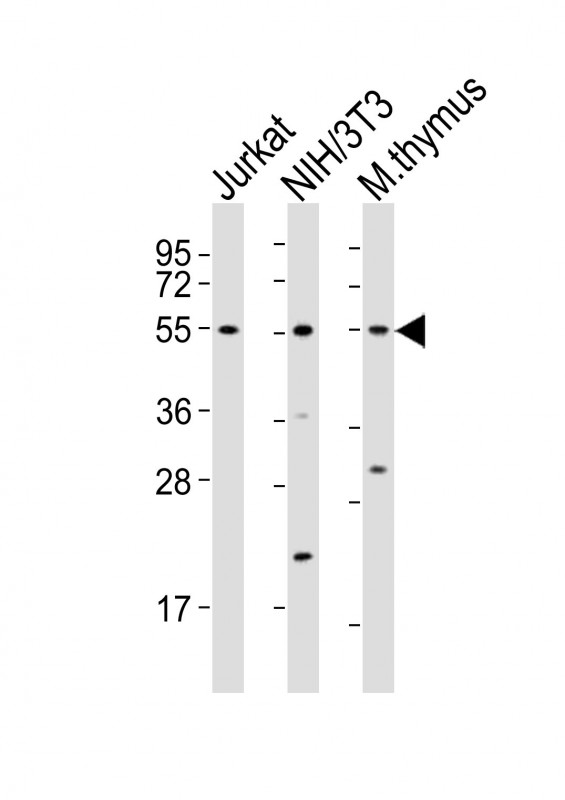
- 产品详情
- 实验流程
- 背景知识
Application 
| WB, E |
|---|---|
| Primary Accession | Q03347 |
| Reactivity | Human, Rat, Mouse |
| Predicted | Bovine, Canine, Rabbit, Chicken |
| Host | Rabbit |
| Clonality | polyclonal |
| Isotype | Rabbit IgG |
| Calculated MW | 48610 Da |
| Other Names | Runt-related transcription factor 1, Acute myeloid leukemia 1 protein, Core-binding factor subunit alpha-2, CBF-alpha-2, Oncogene AML-1, Polyomavirus enhancer-binding protein 2 alpha B subunit, PEA2-alpha B, PEBP2-alpha B, SL3-3 enhancer factor 1 alpha B subunit, SL3/AKV core-binding factor alpha B subunit, Runx1, Aml1, Cbfa2, Pebp2ab |
|---|---|
| Target/Specificity | This Mouse Runx1 antibody is generated from a rabbit immunized with a KLH conjugated synthetic peptide between 426-459 amino acids from the C-terminal region of Mouse Runx1. |
| Dilution | WB~~1:2000 E~~Use at an assay dependent concentration. |
| Format | Purified polyclonal antibody supplied in PBS with 0.09% (W/V) sodium azide. This antibody is purified through a protein A column, followed by peptide affinity purification. |
| Storage | Maintain refrigerated at 2-8°C for up to 2 weeks. For long term storage store at -20°C in small aliquots to prevent freeze-thaw cycles. |
| Precautions | Mouse Runx1 Antibody (C-term) is for research use only and not for use in diagnostic or therapeutic procedures. |
For Research Use Only. Not For Use In Diagnostic Procedures.
| Name | Runx1 |
|---|---|
| Synonyms | Aml1, Cbfa2, Pebp2ab |
| Function | Forms the heterodimeric complex core-binding factor (CBF) with CBFB. RUNX members modulate the transcription of their target genes through recognizing the core consensus binding sequence 5'- TGTGGT-3', or very rarely, 5'-TGCGGT-3', within their regulatory regions via their runt domain, while CBFB is a non-DNA-binding regulatory subunit that allosterically enhances the sequence-specific DNA-binding capacity of RUNX. The heterodimers bind to the core site of a number of enhancers and promoters, including murine leukemia virus, polyomavirus enhancer, T-cell receptor enhancers, LCK, IL3 and GM-CSF promoters (Probable). Essential for the development of normal hematopoiesis. Acts synergistically with ELF4 to transactivate the IL-3 promoter and with ELF2 to transactivate the BLK promoter. Inhibits KAT6B-dependent transcriptional activation (By similarity). Involved in lineage commitment of immature T cell precursors. CBF complexes repress ZBTB7B transcription factor during cytotoxic (CD8+) T cell development. They bind to RUNX-binding sequence within the ZBTB7B locus acting as transcriptional silencer and allowing for cytotoxic T cell differentiation (PubMed:18258917). CBF complexes binding to the transcriptional silencer is essential for recruitment of nuclear protein complexes that catalyze epigenetic modifications to establish epigenetic ZBTB7B silencing (PubMed:23481257). Controls the anergy and suppressive function of regulatory T-cells (Treg) by associating with FOXP3. Activates the expression of IL2 and IFNG and down-regulates the expression of TNFRSF18, IL2RA and CTLA4, in conventional T-cells (PubMed:17377532). Positively regulates the expression of RORC in T- helper 17 cells (PubMed:21151104). |
| Cellular Location | Nucleus. |
| Tissue Location | Isoform 4 is expressed at high levels in thymus, spleen and T-cell lines and at lower levels in myeloid cell lines and nonhematopoietic cells. Isoform 5 is expressed ubiquitously in lumbar vertebrae, brain, kidney, heart, muscle, ovary and osteoblast-like cell line MC3T3-E1 |
Provided below are standard protocols that you may find useful for product applications.
BACKGROUND
CBF binds to the core site, 5'-PYGPYGGT-3', of a number of enhancers and promoters, including murine leukemia virus, polyomavirus enhancer, T-cell receptor enhancers, LCK, IL-3 and GM-CSF promoters. Essential for the development of normal hematopoiesis. Isoform 4 shows higher binding activities for target genes and binds TCR-beta-E2 and RAG-1 target site with threefold higher affinity than other isoforms. It is less effective in the context of neutrophil terminal differentiation. Acts synergistically with ELF4 to transactivate the IL-3 promoter and with ELF2 to transactivate the BLK promoter. Inhibits KAT6B- dependent transcriptional activation (By similarity).
REFERENCES
Bae S.-C.,et al.Oncogene 8:809-814(1993).
Bae S.-C.,et al.Mol. Cell. Biol. 14:3242-3252(1994).
Calabi F.,et al.Submitted (APR-1996) to the EMBL/GenBank/DDBJ databases.
Tsuji K.,et al.Biochem. Biophys. Res. Commun. 274:171-176(2000).
Fujita Y.,et al.Biochem. Biophys. Res. Commun. 281:1248-1255(2001).

终于等到您。ABCEPTA(百远生物)抗体产品。
点击下方“我要评价 ”按钮提交您的反馈信息,您的反馈和评价是我们最宝贵的财富之一,
我们将在1-3个工作日内处理您的反馈信息。
如有疑问,联系:0512-88856768 tech-china@abcepta.com.


