


 癌症的基本特征包括细胞增殖、血管生成、迁移、凋亡逃避机制和细胞永生等。找到癌症发生过程中这些通路的关键标记物和对应的抗体用于检测至关重要。
 为您推荐一个泛素化位点预测神器——泛素化分析工具,可以为您的蛋白的泛素化位点作出预测和评分。
 细胞自噬受体图形绘图工具为你的蛋白的细胞受体结合位点作出预测和评分,识别结合到自噬通路中的蛋白是非常重要的,便于让我们理解自噬在正常生理、病理过程中的作用,如发育、细胞分化、神经退化性疾病、压力条件下、感染和癌症。
USP12 Antibody (C-term) 精选
Purified Rabbit Polyclonal Antibody (Pab)
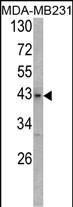
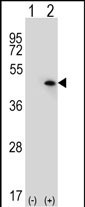
- 产品详情
- 实验流程
- 背景知识
Application 
| WB, E |
|---|---|
| Primary Accession | O75317 |
| Other Accession | P62069, P62068, A5WWB0, Q9D9M2, A4FUN7, A5D9H7, Q5M981, Q52KZ6, NP_872294 |
| Reactivity | Human |
| Predicted | Mouse, Zebrafish, Bovine, Xenopus, Rat, Canine, Rabbit, Chicken |
| Host | Rabbit |
| Clonality | Polyclonal |
| Isotype | Rabbit IgG |
| Calculated MW | 42858 Da |
| Antigen Region | 315-345 aa |
| Gene ID | 219333 |
|---|---|
| Other Names | Ubiquitin carboxyl-terminal hydrolase 12, Deubiquitinating enzyme 12, Ubiquitin thioesterase 12, Ubiquitin-hydrolyzing enzyme 1, Ubiquitin-specific-processing protease 12, USP12, UBH1, USP12L1 |
| Target/Specificity | This USP12/USP46 antibody is generated from rabbits immunized with a KLH conjugated synthetic peptide between 315-345 amino acids from the C-terminal region of human USP12/USP46. |
| Dilution | WB~~1:1000 E~~Use at an assay dependent concentration. |
| Format | Purified polyclonal antibody supplied in PBS with 0.09% (W/V) sodium azide. This antibody is prepared by Saturated Ammonium Sulfate (SAS) precipitation followed by dialysis against PBS. |
| Storage | Maintain refrigerated at 2-8°C for up to 2 weeks. For long term storage store at -20°C in small aliquots to prevent freeze-thaw cycles. |
| Precautions | USP12 Antibody (C-term) is for research use only and not for use in diagnostic or therapeutic procedures. |
For Research Use Only. Not For Use In Diagnostic Procedures.
| Name | USP12 |
|---|---|
| Synonyms | UBH1, USP12L1 |
| Function | Deubiquitinating enzyme that plays various roles in the regulation of the immune response and inflammation (PubMed:19075014, PubMed:27373336). During TCR engagement and activation, translocates into the cytoplasm and deubiquitinates its substrates LAT and TRAT1 and prevents their lysosome-dependent degradation to stabilize the TCR signaling complex at the plasma membrane (PubMed:26811477). Plays an essential role in the selective LPS-induced macrophage response through the activation of NF-kappa-B pathway (PubMed:28063927). In addition, promotes that antiviral immune response through targeting DNA sensor IFI16 to inhibit its proteasome-dependent degradation (PubMed:37410794). Participates in the interferon signaling pathway and antiviral response independently of its deubiquitinase activity by maintaining nuclear phosphorylated STAT1 levels via inhibition of its CREBBP-mediated acetylation and subsequent dephosphorylation (PubMed:31899788). Plays an intrinsic role in promoting the differentiation, activation and proliferation of CD4(+) T-cell by activating the NF-kappa-B signaling pathway through deubiquitinating and stabilizing B-cell lymphoma/leukemia 10/BCL10 (By similarity). In myeloid-derived suppressor cells promotes the activation of the NF- kappa-B via deubiquitination and stabilization of RELA (By similarity). Regulates the 'Lys-63'-linked polyubiquitin chains of BAX and thereby modulates the mitochondrial apoptotic process (PubMed:36361894). Negative regulator of NOTCH signaling that specifically deubiquitinates non-activated NOTCH receptors to target them for lysosomal degradation; deubiquitination of NOTCH stimulates its transport form late endosomes to lysosomes (PubMed:22778262). Protects neurons against HTT/huntingtin-induced polyglutamine expansion-dependent neurodegeneration through regulation of autophagic flux (PubMed:30266909). This function is independent of deubiquitinase activity or of other components of the USP12-WDR20-WDR48 deubiquitinating complex (By similarity). In complex with WDR48, acts as a potential tumor suppressor by positively regulating PHLPP1 stability (PubMed:24145035). |
| Cellular Location | Nucleus. Cytoplasm. Cell membrane. Note=Translocates from the nucleus to the cytosol on TCR stimulation, while it translocates into the nucleus in IFN signaling. USP12/WDR20/WDR48 complex is localized mainly to the plasma membrane (PubMed:30466959). |
Provided below are standard protocols that you may find useful for product applications.
BACKGROUND
Modification of target proteins by ubiquitin participates in a wide array of biological functions. Proteins destined for degradation or processing via the 26 S proteasome are coupled to multiple copies of ubiquitin. However, attachment of ubiquitin or ubiquitin-related molecules may also result in changes in subcellular distribution or modification of protein activity. An additional level of ubiquitin regulation, deubiquitination, is catalyzed by proteases called deubiquitinating enzymes, which fall into four distinct families. Ubiquitin C-terminal hydrolases, ubiquitin-specific processing proteases (USPs),1 OTU-domain ubiquitin-aldehyde-binding proteins, and Jab1/Pad1/MPN-domain-containing metallo-enzymes. Among these four families, USPs represent the most widespread and represented deubiquitinating enzymes across evolution. USPs tend to release ubiquitin from a conjugated protein. They display similar catalytic domains containing conserved Cys and His boxes but divergent N-terminal and occasionally C-terminal extensions, which are thought to function in substrate recognition, subcellular localization, and protein-protein interactions.
REFERENCES
Hansen-Hagge, T.E., et al., Genomics 49(3):411-418 (1998).

终于等到您。ABCEPTA(百远生物)抗体产品。
点击下方“我要评价 ”按钮提交您的反馈信息,您的反馈和评价是我们最宝贵的财富之一,
我们将在1-3个工作日内处理您的反馈信息。
如有疑问,联系:0512-88856768 tech-china@abcepta.com.


