


 癌症的基本特征包括细胞增殖、血管生成、迁移、凋亡逃避机制和细胞永生等。找到癌症发生过程中这些通路的关键标记物和对应的抗体用于检测至关重要。
 为您推荐一个泛素化位点预测神器——泛素化分析工具,可以为您的蛋白的泛素化位点作出预测和评分。
 细胞自噬受体图形绘图工具为你的蛋白的细胞受体结合位点作出预测和评分,识别结合到自噬通路中的蛋白是非常重要的,便于让我们理解自噬在正常生理、病理过程中的作用,如发育、细胞分化、神经退化性疾病、压力条件下、感染和癌症。
GYG1 Antibody (C-Term) 精选
Purified Rabbit Polyclonal Antibody (Pab)
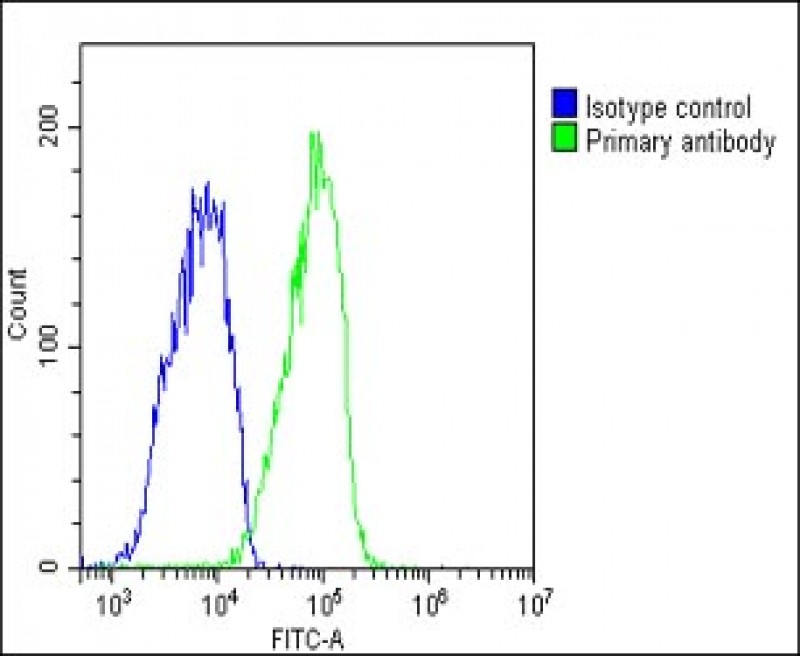
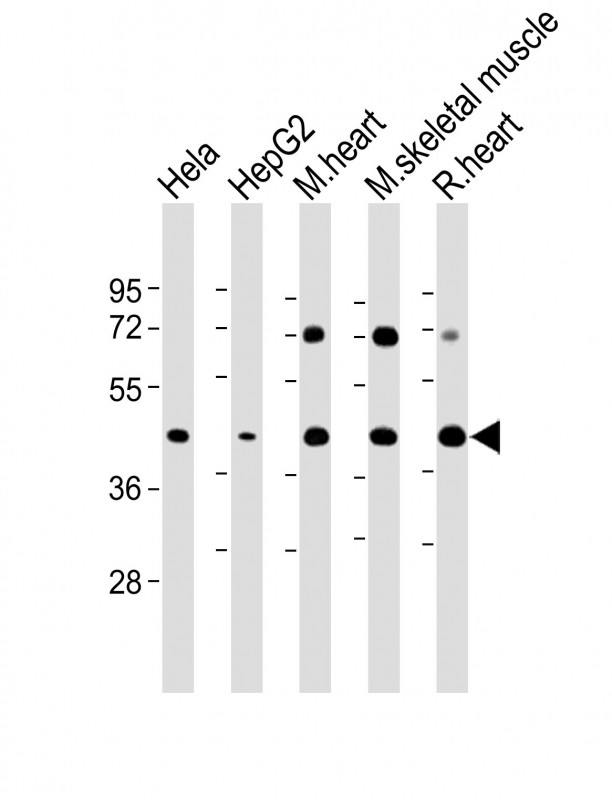
- 产品详情
- 实验流程
- 背景知识
Application 
| WB, FC, E |
|---|---|
| Primary Accession | P46976 |
| Other Accession | Q9R062, O08730 |
| Reactivity | Human, Mouse, Rat |
| Predicted | Bovine, Canine, Rabbit |
| Host | Rabbit |
| Clonality | polyclonal |
| Isotype | Rabbit IgG |
| Calculated MW | 39384 Da |
| Gene ID | 2992 |
|---|---|
| Other Names | Glycogenin-1, GN-1, GN1, 2.4.1.186, GYG1, GYG |
| Target/Specificity | This GYG1 antibody is generated from a rabbit immunized with a KLH conjugated synthetic peptide between 314-347 amino acids from human GYG1. |
| Dilution | WB~~1:2000 FC~~1:25 E~~Use at an assay dependent concentration. |
| Format | Purified polyclonal antibody supplied in PBS with 0.09% (W/V) sodium azide. This antibody is purified through a protein A column, followed by peptide affinity purification. |
| Storage | Maintain refrigerated at 2-8°C for up to 2 weeks. For long term storage store at -20°C in small aliquots to prevent freeze-thaw cycles. |
| Precautions | GYG1 Antibody (C-Term) is for research use only and not for use in diagnostic or therapeutic procedures. |
For Research Use Only. Not For Use In Diagnostic Procedures.
| Name | GYG1 (HGNC:4699) |
|---|---|
| Function | Glycogenin participates in the glycogen biosynthetic process along with glycogen synthase and glycogen branching enzyme. It catalyzes the formation of a short alpha (1,4)-glucosyl chain covalently attached via a glucose 1-O-tyrosyl linkage to internal tyrosine residues and these chains act as primers for the elongation reaction catalyzed by glycogen synthase. |
| Cellular Location | Cytoplasm {ECO:0000250|UniProtKB:P13280}. Nucleus {ECO:0000250|UniProtKB:P13280}. Note=Localizes to glycogen granules (glycosomes) in the cytoplasm (By similarity). Cytosolic localization is dependent on the actin cytoskeleton (By similarity) {ECO:0000250|UniProtKB:C4R941, ECO:0000250|UniProtKB:P13280} |
| Tissue Location | Highly expressed in skeletal muscle and heart, with lower levels in brain, lung, kidney and pancreas |
Provided below are standard protocols that you may find useful for product applications.
BACKGROUND
Self-glucosylates, via an inter-subunit mechanism, to form an oligosaccharide primer that serves as substrate for glycogen synthase.
REFERENCES
Barbetti F.,et al.Biochem. Biophys. Res. Commun. 220:72-77(1996).
Lomako J.,et al.Genomics 33:519-522(1996).
Leffers H.,et al.Submitted (JUN-1994) to the EMBL/GenBank/DDBJ databases.
van Maanen M.-H.,et al.Gene 234:217-226(1999).
Zhai L.,et al.Gene 242:229-235(2000).

终于等到您。ABCEPTA(百远生物)抗体产品。
点击下方“我要评价 ”按钮提交您的反馈信息,您的反馈和评价是我们最宝贵的财富之一,
我们将在1-3个工作日内处理您的反馈信息。
如有疑问,联系:0512-88856768 tech-china@abcepta.com.


