


 癌症的基本特征包括细胞增殖、血管生成、迁移、凋亡逃避机制和细胞永生等。找到癌症发生过程中这些通路的关键标记物和对应的抗体用于检测至关重要。
 为您推荐一个泛素化位点预测神器——泛素化分析工具,可以为您的蛋白的泛素化位点作出预测和评分。
 细胞自噬受体图形绘图工具为你的蛋白的细胞受体结合位点作出预测和评分,识别结合到自噬通路中的蛋白是非常重要的,便于让我们理解自噬在正常生理、病理过程中的作用,如发育、细胞分化、神经退化性疾病、压力条件下、感染和癌症。
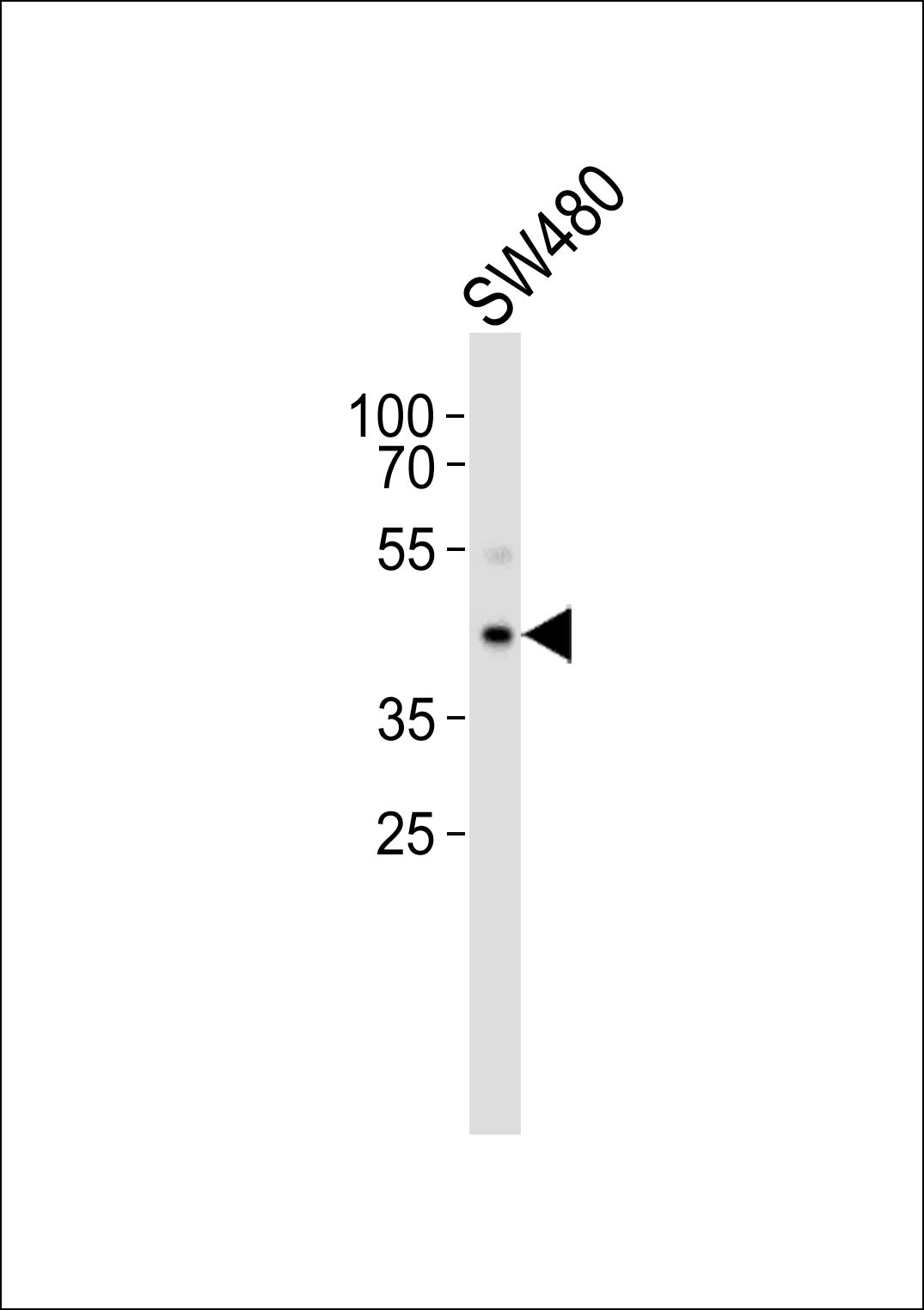
POU4F1 Antibody
Purified Rabbit Polyclonal Antibody (Pab)
- 产品详情
- 实验流程
- 背景知识
Application 
| WB |
|---|---|
| Primary Accession | Q01851 |
| Reactivity | Human, Mouse, Rat |
| Host | Rabbit |
| Clonality | polyclonal |
| Calculated MW | 42697 Da |
| Gene ID | 5457 |
|---|---|
| Other Names | POU domain, class 4, transcription factor 1, Brain-specific homeobox/POU domain protein 3A, Brain-3A, Brn-3A, Homeobox/POU domain protein RDC-1, Oct-T1, POU4F1, BRN3A, RDC1 |
| Dilution | WB~~1:1000 |
| Format | Rabbit IgG in phosphate buffered saline (without Mg2+ and Ca2+), pH 7.4, 150mM NaCl, 0.09% (W/V) sodium azide and 50% glycerol. |
| Storage Conditions | -20℃ |
For Research Use Only. Not For Use In Diagnostic Procedures.
| Name | POU4F1 (HGNC:9218) |
|---|---|
| Function | Multifunctional transcription factor with different regions mediating its different effects. Acts by binding (via its C-terminal domain) to sequences related to the consensus octamer motif 5'- ATGCAAAT-3' in the regulatory regions of its target genes. Regulates the expression of specific genes involved in differentiation and survival within a subset of neuronal lineages. It has been shown that activation of some of these genes requires its N-terminal domain, maybe through a neuronal-specific cofactor. Activates BCL2 expression and protects neuronal cells from apoptosis (via the N-terminal domain). Induces neuronal process outgrowth and the coordinate expression of genes encoding synaptic proteins. Exerts its major developmental effects in somatosensory neurons and in brainstem nuclei involved in motor control. Stimulates the binding affinity of the nuclear estrogene receptor ESR1 to DNA estrogen response element (ERE), and hence modulates ESR1-induced transcriptional activity. May positively regulate POU4F2 and POU4F3. Regulates dorsal root ganglion sensory neuron specification and axonal projection into the spinal cord. Plays a role in TNFSF11-mediated terminal osteoclast differentiation. Negatively regulates its own expression interacting directly with a highly conserved autoregulatory domain surrounding the transcription initiation site. |
| Cellular Location | Nucleus. Cytoplasm {ECO:0000250|UniProtKB:P17208} |
| Tissue Location | Expressed in the brain and the retina. Present in the developing brain, spinal cord and eye. |
Provided below are standard protocols that you may find useful for product applications.
BACKGROUND
Probable transcription factor which may play a role in the regulation of specific gene expression within a subset of neuronal lineages. May play a role in determining or maintaining the identities of a small subset of visual system neurons.
REFERENCES
Bhargava A.K.,et al.Proc. Natl. Acad. Sci. U.S.A. 90:10260-10264(1993).
Xiang M.,et al.J. Neurosci. 15:4762-4785(1995).
Dunham A.,et al.Nature 428:522-528(2004).
Mural R.J.,et al.Submitted (JUL-2005) to the EMBL/GenBank/DDBJ databases.
Collum R.G.,et al.Nucleic Acids Res. 20:4919-4925(1992).

终于等到您。ABCEPTA(百远生物)抗体产品。
点击下方“我要评价 ”按钮提交您的反馈信息,您的反馈和评价是我们最宝贵的财富之一,
我们将在1-3个工作日内处理您的反馈信息。
如有疑问,联系:0512-88856768 tech-china@abcepta.com.


