


 癌症的基本特征包括细胞增殖、血管生成、迁移、凋亡逃避机制和细胞永生等。找到癌症发生过程中这些通路的关键标记物和对应的抗体用于检测至关重要。
 为您推荐一个泛素化位点预测神器——泛素化分析工具,可以为您的蛋白的泛素化位点作出预测和评分。
 细胞自噬受体图形绘图工具为你的蛋白的细胞受体结合位点作出预测和评分,识别结合到自噬通路中的蛋白是非常重要的,便于让我们理解自噬在正常生理、病理过程中的作用,如发育、细胞分化、神经退化性疾病、压力条件下、感染和癌症。
Anti-GPR159 Antibody
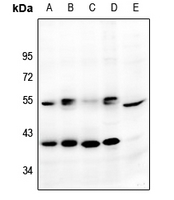
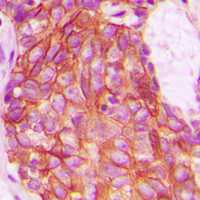
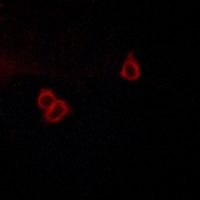
- 产品详情
- 实验流程
Application 
| WB, IF/IC |
|---|---|
| Primary Accession | P25106 |
| Reactivity | Human, Mouse, Rat, Dog |
| Host | Rabbit |
| Clonality | Polyclonal |
| Calculated MW | 41493 Da |
| Gene ID | 57007 |
|---|---|
| Other Names | CMKOR1; CXCR7; GPR159; RDC1; Atypical chemokine receptor 3; C-X-C chemokine receptor type 7; CXC-R7; CXCR-7; Chemokine orphan receptor 1; G-protein coupled receptor 159; G-protein coupled receptor RDC1 homolog; RDC-1 |
| Target/Specificity | KLH-conjugated synthetic peptide encompassing a sequence within the C-term region of human GPR159. The exact sequence is proprietary. |
| Dilution | WB~~WB (1/500 - 1/1000) IF/IC~~N/A |
| Format | Liquid in 0.42% Potassium phosphate, 0.87% Sodium chloride, pH 7.3, 30% glycerol, and 0.01% sodium azide. |
| Storage | Store at -20 °C.Stable for 12 months from date of receipt |
For Research Use Only. Not For Use In Diagnostic Procedures.
| Name | ACKR3 (HGNC:23692) |
|---|---|
| Function | Atypical chemokine receptor that controls chemokine levels and localization via high-affinity chemokine binding that is uncoupled from classic ligand-driven signal transduction cascades, resulting instead in chemokine sequestration, degradation, or transcytosis. Also known as interceptor (internalizing receptor) or chemokine-scavenging receptor or chemokine decoy receptor. Acts as a receptor for chemokines CXCL11 and CXCL12/SDF1 (PubMed:16107333, PubMed:19255243, PubMed:19380869, PubMed:20161793, PubMed:22300987). Chemokine binding does not activate G protein-mediated signal transduction but instead induces beta-arrestin recruitment, leading to ligand internalization and activation of MAPK signaling pathway (PubMed:16940167, PubMed:18653785, PubMed:20018651). Required for regulation of CXCR4 protein levels in migrating interneurons, thereby adapting their chemokine responsiveness (PubMed:16940167, PubMed:18653785). In glioma cells, transduces signals via MEK/ERK pathway, mediating resistance to apoptosis. Promotes cell growth and survival (PubMed:16940167, PubMed:20388803). Not involved in cell migration, adhesion or proliferation of normal hematopoietic progenitors but activated by CXCL11 in malignant hemapoietic cells, leading to phosphorylation of ERK1/2 (MAPK3/MAPK1) and enhanced cell adhesion and migration (PubMed:17804806, PubMed:18653785, PubMed:19641136, PubMed:20887389). Plays a regulatory role in CXCR4-mediated activation of cell surface integrins by CXCL12 (PubMed:18653785). Required for heart valve development (PubMed:17804806). Regulates axon guidance in the oculomotor system through the regulation of CXCL12 levels (PubMed:31211835). Acts as a receptor for SHLP2, mediating its effects on activation of proopiomelanocortin neurons in the arcuate nucleus of the hypothalamus which leads to suppression of food intake and increased energy expenditure (PubMed:37468558). |
| Cellular Location | Cell membrane; Multi-pass membrane protein. Early endosome. Recycling endosome. Note=Predominantly localizes to endocytic vesicles, and upon stimulation by the ligand is internalized via clathrin-coated pits in a beta-arrestin-dependent manner. Once internalized, the ligand dissociates from the receptor, and is targeted to degradation while the receptor is recycled back to the cell membrane. |
| Tissue Location | Expressed in monocytes, basophils, B-cells, umbilical vein endothelial cells (HUVEC) and B-lymphoblastoid cells Lower expression detected in CD4+ T-lymphocytes and natural killer cells. In the brain, detected in endothelial cells and capillaries, and in mature neurons of the frontal cortex and hippocampus. Expressed in tubular formation in the kidney. Highly expressed in astroglial tumor endothelial, microglial and glioma cells. Expressed at low levels in normal CD34+ progenitor cells, but at very high levels in several myeloid malignant cell lines. Expressed in breast carcinomas but not in normal breast tissue (at protein level). |
Research Areas
Application Protocols
Provided below are standard protocols that you may find useful for product applications.
REFERENCES
Sreedharan S.P.,et al.Proc. Natl. Acad. Sci. U.S.A. 88:4986-4990(1991).
Oates E.L.,et al.Submitted (OCT-1996) to the EMBL/GenBank/DDBJ databases.
Bi A.,et al.Submitted (OCT-1997) to the EMBL/GenBank/DDBJ databases.
Martin A.L.,et al.Submitted (JUN-2006) to the EMBL/GenBank/DDBJ databases.
Ota T.,et al.Nat. Genet. 36:40-45(2004).

终于等到您。ABCEPTA(百远生物)抗体产品。
点击下方“我要评价 ”按钮提交您的反馈信息,您的反馈和评价是我们最宝贵的财富之一,
我们将在1-3个工作日内处理您的反馈信息。
如有疑问,联系:0512-88856768 tech-china@abcepta.com.
¥ 1,250.00
Cat# AP51136


