


 癌症的基本特征包括细胞增殖、血管生成、迁移、凋亡逃避机制和细胞永生等。找到癌症发生过程中这些通路的关键标记物和对应的抗体用于检测至关重要。
 为您推荐一个泛素化位点预测神器——泛素化分析工具,可以为您的蛋白的泛素化位点作出预测和评分。
 细胞自噬受体图形绘图工具为你的蛋白的细胞受体结合位点作出预测和评分,识别结合到自噬通路中的蛋白是非常重要的,便于让我们理解自噬在正常生理、病理过程中的作用,如发育、细胞分化、神经退化性疾病、压力条件下、感染和癌症。
Anti-p300 Antibody
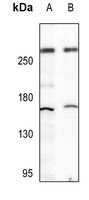
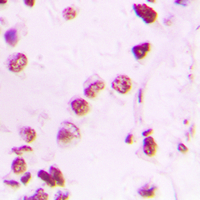
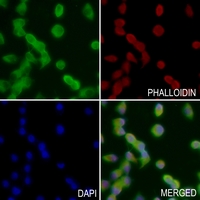
- 产品详情
- 实验流程
Application 
| WB, IHC, IF/IC |
|---|---|
| Primary Accession | Q09472 |
| Reactivity | Human, Mouse, Rat, Pig, Chicken, Bovine, Dog |
| Host | Rabbit |
| Clonality | Polyclonal |
| Calculated MW | 264161 Da |
| Gene ID | 2033 |
|---|---|
| Other Names | P300; Histone acetyltransferase p300; p300 HAT; E1A-associated protein p300 |
| Target/Specificity | KLH-conjugated synthetic peptide encompassing a sequence within the N-term region of human p300. The exact sequence is proprietary. |
| Dilution | WB~~WB (1/500 - 1/1000) IHC~~1:100~500 IF/IC~~N/A |
| Format | Liquid in 0.42% Potassium phosphate, 0.87% Sodium chloride, pH 7.3, 30% glycerol, and 0.01% sodium azide. |
| Storage | Store at -20 °C.Stable for 12 months from date of receipt |
For Research Use Only. Not For Use In Diagnostic Procedures.
| Name | EP300 {ECO:0000303|PubMed:15706485, ECO:0000312|HGNC:HGNC:3373} |
|---|---|
| Function | Functions as a histone acetyltransferase and regulates transcription via chromatin remodeling (PubMed:23415232, PubMed:23934153, PubMed:40240600, PubMed:8945521). Acetylates all four core histones in nucleosomes (PubMed:23415232, PubMed:23934153, PubMed:8945521). Histone acetylation gives an epigenetic tag for transcriptional activation (PubMed:23415232, PubMed:23934153, PubMed:8945521). Mediates acetylation of histone H3 at 'Lys-122' (H3K122ac), a modification that localizes at the surface of the histone octamer and stimulates transcription, possibly by promoting nucleosome instability (PubMed:23415232). Mediates acetylation of histone H3 at 'Lys-18' and 'Lys-27' (H3K18ac and H3K27ac, respectively) (PubMed:21131905, PubMed:23911289). Also able to acetylate histone lysine residues that are already monomethylated on the same side chain to form N6-acetyl-N6-methyllysine (Kacme), an epigenetic mark of active chromatin associated with increased transcriptional initiation (PubMed:37731000). Catalyzes formation of histone H4 acetyl-methylated at 'Lys-5' and 'Lys-12' (H4K5acme and H4K12acme, respectively) (PubMed:37731000). In response to DNA damage, catalyzes acetylation of histone H1 at 'Lys-75' (H1K75ac) following histone H1 deamidation by CTPS1, increasing chromatin accessibility to facilitate the recruitment of DNA repair proteins (PubMed:40240600). Also functions as acetyltransferase for non-histone targets, such as ALX1, HDAC1, PRDM16, PRMT1, SIRT2, STAT3, ZNF76 or GLUL (PubMed:12929931, PubMed:15653507, PubMed:16285960, PubMed:16337145, PubMed:16762839, PubMed:18722353, PubMed:18782771, PubMed:26990986). Acetylates 'Lys-131' of ALX1 and acts as its coactivator (PubMed:12929931). Acetylates SIRT2 and is proposed to indirectly increase the transcriptional activity of p53/TP53 through acetylation and subsequent attenuation of SIRT2 deacetylase function (PubMed:18722353). Following DNA damage, forms a stress-responsive p53/TP53 coactivator complex with JMY which mediates p53/TP53 acetylation, thereby increasing p53/TP53-dependent transcription and apoptosis (PubMed:11511361, PubMed:15448695). Promotes chromatin acetylation in heat shock responsive HSP genes during the heat shock response (HSR), thereby stimulating HSR transcription (PubMed:18451878). Acetylates HDAC1 leading to its inactivation and modulation of transcription (PubMed:16762839). Acetylates 'Lys-247' of EGR2 (By similarity). Acts as a TFAP2A-mediated transcriptional coactivator in presence of CITED2 (PubMed:12586840). Plays a role as a coactivator of NEUROD1-dependent transcription of the secretin and p21 genes and controls terminal differentiation of cells in the intestinal epithelium. Promotes cardiac myocyte enlargement (PubMed:14752053). Can also mediate transcriptional repression. Acetylates FOXO1 and enhances its transcriptional activity (PubMed:15890677). Acetylates STAT3 at different sites, promoting both STAT3 dimerization and activation and recruitment to chromatin (PubMed:15653507, PubMed:16285960, PubMed:18782771). Acetylates BCL6 which disrupts its ability to recruit histone deacetylases and hinders its transcriptional repressor activity (PubMed:12402037). Participates in CLOCK or NPAS2-regulated rhythmic gene transcription; exhibits a circadian association with CLOCK or NPAS2, correlating with increase in PER1/2 mRNA and histone H3 acetylation on the PER1/2 promoter (PubMed:14645221). Acetylates MTA1 at 'Lys-626' which is essential for its transcriptional coactivator activity (PubMed:16617102). Acetylates XBP1 isoform 2; acetylation increases protein stability of XBP1 isoform 2 and enhances its transcriptional activity (PubMed:20955178). Acetylates PCNA; acetylation promotes removal of chromatin-bound PCNA and its degradation during nucleotide excision repair (NER) (PubMed:24939902). Acetylates MEF2D (PubMed:21030595). Acetylates and stabilizes ZBTB7B protein by antagonizing ubiquitin conjugation and degradation, this mechanism may be involved in CD4/CD8 lineage differentiation (PubMed:20810990). Acetylates GABPB1, impairing GABPB1 heterotetramerization and activity (By similarity). Acetylates PCK1 and promotes PCK1 anaplerotic activity (PubMed:30193097). Acetylates RXRA and RXRG (PubMed:17761950). Acetylates isoform M2 of PKM (PKM2), promoting its homodimerization and conversion into a protein kinase (PubMed:24120661). Acetylates RPTOR in response to leucine, leading to activation of the mTORC1 complex (PubMed:30197302, PubMed:32561715). Acetylates RICTOR, leading to activation of the mTORC2 complex (PubMed:22084251). Mediates cAMP-gene regulation by binding specifically to phosphorylated CREBBP (PubMed:8917528). In addition to protein acetyltransferase, can use different acyl-CoA substrates, such as (2E)-butenoyl-CoA (crotonyl-CoA), butanoyl-CoA (butyryl-CoA), 2- hydroxyisobutanoyl-CoA (2-hydroxyisobutyryl-CoA), lactoyl-CoA, propanoyl-CoA (propionyl-CoA) or isonicotinyl-CoA, and is able to mediate protein crotonylation, butyrylation, 2-hydroxyisobutyrylation, lactylation, propionylation or isonicotinylation, respectively (PubMed:17267393, PubMed:25818647, PubMed:29775581, PubMed:31645732, PubMed:34545082). Acts as a histone crotonyltransferase; crotonylation marks active promoters and enhancers and confers resistance to transcriptional repressors (PubMed:25818647). Histone crotonyltransferase activity is dependent on the concentration of (2E)- butenoyl-CoA (crotonyl-CoA) substrate and such activity is weak when (2E)-butenoyl-CoA (crotonyl-CoA) concentration is low (PubMed:25818647). Also acts as a histone butyryltransferase; butyrylation marks active promoters (PubMed:17267393). Catalyzes histone lactylation in macrophages by using lactoyl-CoA directly derived from endogenous or exogenous lactate, leading to stimulates gene transcription (PubMed:31645732). Acts as a protein-lysine 2- hydroxyisobutyryltransferase; regulates glycolysis by mediating 2- hydroxyisobutyrylation of glycolytic enzymes (PubMed:29775581). Functions as a transcriptional coactivator for SMAD4 in the TGF-beta signaling pathway (PubMed:25514493). |
| Cellular Location | Cytoplasm. Nucleus. Chromosome Note=Localizes to active chromatin: Colocalizes with histone H3 acetylated and/or crotonylated at 'Lys-18' (H3K18ac and H3K18cr, respectively) (PubMed:25818647). In the presence of ALX1 relocalizes from the cytoplasm to the nucleus. Colocalizes with ROCK2 in the nucleus (PubMed:12929931). Localizes to sites of DNA damage (PubMed:25593309). |
Research Areas
Application Protocols
Provided below are standard protocols that you may find useful for product applications.
REFERENCES
Eckner R.,et al.Genes Dev. 8:869-884(1994).
Dunham I.,et al.Nature 402:489-495(1999).
Mural R.J.,et al.Submitted (JUL-2005) to the EMBL/GenBank/DDBJ databases.
Chaffanet M.,et al.Genes Chromosomes Cancer 28:138-144(2000).
Lundblad J.R.,et al.Nature 374:85-88(1995).

终于等到您。ABCEPTA(百远生物)抗体产品。
点击下方“我要评价 ”按钮提交您的反馈信息,您的反馈和评价是我们最宝贵的财富之一,
我们将在1-3个工作日内处理您的反馈信息。
如有疑问,联系:0512-88856768 tech-china@abcepta.com.
¥ 1,250.00
Cat# AP51188


