


 癌症的基本特征包括细胞增殖、血管生成、迁移、凋亡逃避机制和细胞永生等。找到癌症发生过程中这些通路的关键标记物和对应的抗体用于检测至关重要。
 为您推荐一个泛素化位点预测神器——泛素化分析工具,可以为您的蛋白的泛素化位点作出预测和评分。
 细胞自噬受体图形绘图工具为你的蛋白的细胞受体结合位点作出预测和评分,识别结合到自噬通路中的蛋白是非常重要的,便于让我们理解自噬在正常生理、病理过程中的作用,如发育、细胞分化、神经退化性疾病、压力条件下、感染和癌症。
Anti-KAT7 Antibody
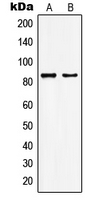
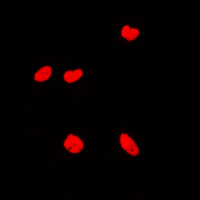
- 产品详情
- 实验流程
Application 
| WB, IP, IF/IC |
|---|---|
| Primary Accession | O95251 |
| Reactivity | Human, Mouse, Rat, Zebrafish, Pig, Chicken, Bovine, Dog |
| Host | Rabbit |
| Clonality | Polyclonal |
| Calculated MW | 70642 Da |
| Gene ID | 11143 |
|---|---|
| Other Names | HBO1; HBOa; MYST2; Histone acetyltransferase KAT7; Histone acetyltransferase binding to ORC1; Lysine acetyltransferase 7; MOZ, YBF2/SAS3, SAS2 and TIP60 protein 2; MYST-2 |
| Target/Specificity | KLH-conjugated synthetic peptide encompassing a sequence within the center region of human KAT7. The exact sequence is proprietary. |
| Dilution | WB~~WB (1/500 - 1/1000) IP~~N/A IF/IC~~N/A |
| Format | Liquid in 0.42% Potassium phosphate, 0.87% Sodium chloride, pH 7.3, 30% glycerol, and 0.01% sodium azide. |
| Storage | Store at -20 °C.Stable for 12 months from date of receipt |
For Research Use Only. Not For Use In Diagnostic Procedures.
| Name | KAT7 {ECO:0000303|PubMed:31767635, ECO:0000312|HGNC:HGNC:17016} |
|---|---|
| Function | Catalytic subunit of histone acetyltransferase HBO1 complexes, which specifically mediate acetylation of histone H3 at 'Lys-14' (H3K14ac), thereby regulating various processes, such as gene transcription, protein ubiquitination, immune regulation, stem cell pluripotent and self-renewal maintenance and embryonic development (PubMed:16387653, PubMed:21753189, PubMed:24065767, PubMed:26620551, PubMed:31767635, PubMed:31827282). Some complexes also catalyze acetylation of histone H4 at 'Lys-5', 'Lys-8' and 'Lys-12' (H4K5ac, H4K8ac and H4K12ac, respectively), regulating DNA replication initiation, regulating DNA replication initiation (PubMed:10438470, PubMed:19187766, PubMed:20129055, PubMed:24065767). Specificity of the HBO1 complexes is determined by the scaffold subunit: complexes containing BRPF scaffold (BRPF1, BRD1/BRPF2 or BRPF3) direct KAT7/HBO1 specificity towards H3K14ac, while complexes containing JADE (JADE1, JADE2 and JADE3) scaffold direct KAT7/HBO1 specificity towards histone H4 (PubMed:19187766, PubMed:20129055, PubMed:24065767, PubMed:26620551). H3K14ac promotes transcriptional elongation by facilitating the processivity of RNA polymerase II (PubMed:31827282). Acts as a key regulator of hematopoiesis by forming a complex with BRD1/BRPF2, directing KAT7/HBO1 specificity towards H3K14ac and promoting erythroid differentiation (PubMed:21753189). H3K14ac is also required for T-cell development (By similarity). KAT7/HBO1-mediated acetylation facilitates two consecutive steps, licensing and activation, in DNA replication initiation: H3K14ac facilitates the activation of replication origins, and histone H4 acetylation (H4K5ac, H4K8ac and H4K12ac) facilitates chromatin loading of MCM complexes, promoting DNA replication licensing (PubMed:10438470, PubMed:11278932, PubMed:18832067, PubMed:19187766, PubMed:20129055, PubMed:21856198, PubMed:24065767, PubMed:26620551). Acts as a positive regulator of centromeric CENPA assembly: recruited to centromeres and mediates histone acetylation, thereby preventing centromere inactivation mediated by SUV39H1, possibly by increasing histone turnover/exchange (PubMed:27270040). Involved in nucleotide excision repair: phosphorylation by ATR in response to ultraviolet irradiation promotes its localization to DNA damage sites, where it mediates histone acetylation to facilitate recruitment of XPC at the damaged DNA sites (PubMed:28719581). Acts as an inhibitor of NF-kappa-B independently of its histone acetyltransferase activity (PubMed:16997280). |
| Cellular Location | Nucleus. Chromosome. Chromosome, centromere. Cytoplasm, cytosol {ECO:0000250|UniProtKB:Q5SVQ0}. Note=Associates with replication origins specifically during the G1 phase of the cell cycle (PubMed:18832067, PubMed:20129055). Localizes to transcription start sites (PubMed:21753189, PubMed:24065767). Localizes to ultraviolet- induced DNA damage sites following phosphorylation by ATR (PubMed:28719581). Localizes to centromeres in G1 phase (PubMed:27270040). |
| Tissue Location | Ubiquitously expressed, with highest levels in testis. |
Research Areas
Application Protocols
Provided below are standard protocols that you may find useful for product applications.
REFERENCES
Iizuka M.,et al.J. Biol. Chem. 274:23027-23034(1999).
Sharma M.,et al.J. Biol. Chem. 275:35200-35208(2000).
Jian J.,et al.Submitted (APR-1999) to the EMBL/GenBank/DDBJ databases.
Borrow J.,et al.Submitted (DEC-1999) to the EMBL/GenBank/DDBJ databases.
Ota T.,et al.Nat. Genet. 36:40-45(2004).

终于等到您。ABCEPTA(百远生物)抗体产品。
点击下方“我要评价 ”按钮提交您的反馈信息,您的反馈和评价是我们最宝贵的财富之一,
我们将在1-3个工作日内处理您的反馈信息。
如有疑问,联系:0512-88856768 tech-china@abcepta.com.
¥ 1,250.00
Cat# AP51295


