


 癌症的基本特征包括细胞增殖、血管生成、迁移、凋亡逃避机制和细胞永生等。找到癌症发生过程中这些通路的关键标记物和对应的抗体用于检测至关重要。
 为您推荐一个泛素化位点预测神器——泛素化分析工具,可以为您的蛋白的泛素化位点作出预测和评分。
 细胞自噬受体图形绘图工具为你的蛋白的细胞受体结合位点作出预测和评分,识别结合到自噬通路中的蛋白是非常重要的,便于让我们理解自噬在正常生理、病理过程中的作用,如发育、细胞分化、神经退化性疾病、压力条件下、感染和癌症。
Anti-Nav-pan Antibody
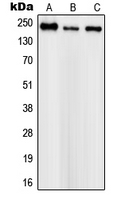
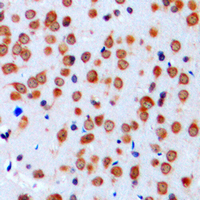
- 产品详情
- 实验流程
Application 
| WB, IHC |
|---|---|
| Primary Accession | P35498 |
| Other Accession | Q99250, Q9NY46, P35499, Q14524, Q9UQD0, Q15858, Q9Y5Y9, Q9UI33 |
| Reactivity | Human, Mouse, Rat |
| Host | Rabbit |
| Clonality | Polyclonal |
| Calculated MW | 228972 Da |
| Gene ID | 6323 |
|---|---|
| Other Names | SCN1A; NAC1; SCN1; Sodium channel protein type 1 subunit alpha; Sodium channel protein brain I subunit alpha; Sodium channel protein type I subunit alpha; Voltage-gated sodium channel subunit alpha Nav1.1; SCN2A; NAC2; SCN2A1; SCN2A2; Sodium channel protein type 2 subunit alpha; HBSC II; Sodium channel protein brain II subunit alpha; Sodium channel protein type II subunit alpha; Voltage-gated sodium channel subunit alpha Nav1.2; SCN3A; KIAA1356; NAC3; Sodium channel protein type 3 subunit alpha; Sodium channel protein brain III subunit alpha; Sodium channel protein type III subunit alpha; Voltage-gated sodium channel subtype III; Voltage-gated sodium channel subunit alpha Nav1.3; SCN4A; Sodium channel protein type 4 subunit alpha; SkM1; Sodium channel protein skeletal muscle subunit alpha; Sodium channel protein type IV subunit alpha; Voltage-gated sodium channel subunit alpha Nav1.4; SCN5A; Sodium channel protein type 5 subunit alpha; HH1; Sodium channel protein cardiac muscle subunit alpha; Sodium channel protein type V subunit alpha; Voltage-gated sodium channel subunit alpha Nav1.5; SCN8A; MED; Sodium channel protein type 8 subunit alpha; Sodium channel protein type VIII subunit alpha; Voltage-gated sodium channel subunit alpha Nav1.6; SCN9A; NENA; Sodium channel protein type 9 subunit alpha; Neuroendocrine sodium channel; hNE-Na; Peripheral sodium channel 1; PN1; Sodium channel protein type IX subunit alpha; Voltage-gated sodium channel subunit alpha Nav1.7; SCN10A; Sodium channel protein type 10 subunit alpha; Peripheral nerve sodium channel 3; PN3; hPN3; Sodium channel protein type X subunit alpha; Voltage-gated sodium channel subunit alpha Nav1.8; SCN11A; SCN12A; SNS2; Sodium channel protein type 11 subunit alpha; Peripheral nerve sodium channel 5; PN5; Sensory neuron sodium channel 2; Sodium channel protein type XI subunit alpha; Voltage-gated sodium channel subunit alpha Nav1.9; hNaN |
| Target/Specificity | KLH-conjugated synthetic peptide encompassing a sequence within the center region of human Nav1.1. The exact sequence is proprietary. |
| Dilution | WB~~WB (1/500 - 1/1000) IHC~~1:100~500 |
| Format | Liquid in 0.42% Potassium phosphate, 0.87% Sodium chloride, pH 7.3, 30% glycerol, and 0.01% sodium azide. |
| Storage | Store at -20 °C.Stable for 12 months from date of receipt |
For Research Use Only. Not For Use In Diagnostic Procedures.
| Name | SCN1A (HGNC:10585) |
|---|---|
| Synonyms | NAC1, SCN1 |
| Function | Pore-forming subunit of Nav1.1, a voltage-gated sodium (Nav) channel that directly mediates the depolarizing phase of action potentials in excitable membranes. Navs, also called VGSCs (voltage- gated sodium channels) or VDSCs (voltage-dependent sodium channels), operate by switching between closed and open conformations depending on the voltage difference across the membrane. In the open conformation they allow Na(+) ions to selectively pass through the pore, along their electrochemical gradient. The influx of Na(+) ions provokes membrane depolarization, initiating the propagation of electrical signals throughout cells and tissues (PubMed:14672992). By regulating the excitability of neurons, ensures that they respond appropriately to synaptic inputs, maintaining the balance between excitation and inhibition in brain neural circuits (By similarity). Nav1.1 plays a role in controlling the excitability and action potential propagation from somatosensory neurons, thereby contributing to the sensory perception of mechanically-induced pain (By similarity). |
| Cellular Location | Cell membrane; Multi-pass membrane protein |
Research Areas
Application Protocols
Provided below are standard protocols that you may find useful for product applications.
REFERENCES
Escayg A.,et al.Nat. Genet. 24:343-345(2000).
Jeong S.-Y.,et al.Submitted (JAN-2000) to the EMBL/GenBank/DDBJ databases.
Sugawara T.,et al.Submitted (JUL-2001) to the EMBL/GenBank/DDBJ databases.
Ouchida M.,et al.Submitted (OCT-2002) to the EMBL/GenBank/DDBJ databases.
Hillier L.W.,et al.Nature 434:724-731(2005).

终于等到您。ABCEPTA(百远生物)抗体产品。
点击下方“我要评价 ”按钮提交您的反馈信息,您的反馈和评价是我们最宝贵的财富之一,
我们将在1-3个工作日内处理您的反馈信息。
如有疑问,联系:0512-88856768 tech-china@abcepta.com.
¥ 1,250.00
Cat# AP51498


