


 癌症的基本特征包括细胞增殖、血管生成、迁移、凋亡逃避机制和细胞永生等。找到癌症发生过程中这些通路的关键标记物和对应的抗体用于检测至关重要。
 为您推荐一个泛素化位点预测神器——泛素化分析工具,可以为您的蛋白的泛素化位点作出预测和评分。
 细胞自噬受体图形绘图工具为你的蛋白的细胞受体结合位点作出预测和评分,识别结合到自噬通路中的蛋白是非常重要的,便于让我们理解自噬在正常生理、病理过程中的作用,如发育、细胞分化、神经退化性疾病、压力条件下、感染和癌症。
Anti-SMAD5 Antibody
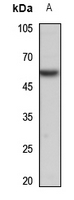
- 产品详情
- 实验流程
Application 
| WB |
|---|---|
| Primary Accession | Q99717 |
| Reactivity | Human, Mouse, Rat, Sheep |
| Host | Rabbit |
| Clonality | Polyclonal |
| Calculated MW | 52258 Da |
| Gene ID | 4090 |
|---|---|
| Other Names | MADH5; Mothers against decapentaplegic homolog 5; MAD homolog 5; Mothers against DPP homolog 5; JV5-1; SMAD family member 5; SMAD 5; Smad5; hSmad5 |
| Target/Specificity | KLH-conjugated synthetic peptide encompassing a sequence within the center region of human SMAD5. The exact sequence is proprietary. |
| Dilution | WB~~WB (1/500 - 1/1000) |
| Format | Liquid in 0.42% Potassium phosphate, 0.87% Sodium chloride, pH 7.3, 30% glycerol, and 0.01% sodium azide. |
| Storage | Store at -20 °C.Stable for 12 months from date of receipt |
For Research Use Only. Not For Use In Diagnostic Procedures.
| Name | SMAD5 (HGNC:6771) |
|---|---|
| Synonyms | MADH5 |
| Function | Transcriptional regulator that plays a role in various cellular processes including embryonic development, cell differentiation, angiogenesis and tissue homeostasis (PubMed:12064918, PubMed:16516194). Upon BMP ligand binding to their receptors at the cell surface, is phosphorylated by activated type I BMP receptors (BMPRIs) and associates with SMAD4 to form a heteromeric complex which translocates into the nucleus acting as transcription factor (PubMed:9442019). In turn, the hetero-trimeric complex recognizes cis- regulatory elements containing Smad Binding Elements (SBEs) to modulate the outcome of the signaling network (PubMed:33510867). Non- phosphorylated SMAD5 has a cytoplasmic role in energy metabolism regulation by promoting mitochondrial respiration and glycolysis in response to cytoplasmic pH changes (PubMed:28675158). Mechanistically, interacts with hexokinase 1/HK1 and thereby accelerates glycolysis (PubMed:28675158). |
| Cellular Location | Cytoplasm. Nucleus Mitochondrion. Note=Cytoplasmic in the absence of ligand. Migrates to the nucleus when complexed with SMAD4 |
| Tissue Location | Ubiquitous. |
Research Areas
Application Protocols
Provided below are standard protocols that you may find useful for product applications.
REFERENCES
Riggins G.J.,et al.Nat. Genet. 13:347-349(1996).
Hejlik D.P.,et al.Cancer Res. 57:3779-3783(1997).
Zavadil J.,et al.Leukemia 11:1187-1192(1997).
Gemma A.,et al.Oncogene 16:951-956(1998).
Nishimura R.,et al.J. Biol. Chem. 273:1872-1879(1998).

终于等到您。ABCEPTA(百远生物)抗体产品。
点击下方“我要评价 ”按钮提交您的反馈信息,您的反馈和评价是我们最宝贵的财富之一,
我们将在1-3个工作日内处理您的反馈信息。
如有疑问,联系:0512-88856768 tech-china@abcepta.com.
¥ 1,250.00
Cat# AP51527


