


 癌症的基本特征包括细胞增殖、血管生成、迁移、凋亡逃避机制和细胞永生等。找到癌症发生过程中这些通路的关键标记物和对应的抗体用于检测至关重要。
 为您推荐一个泛素化位点预测神器——泛素化分析工具,可以为您的蛋白的泛素化位点作出预测和评分。
 细胞自噬受体图形绘图工具为你的蛋白的细胞受体结合位点作出预测和评分,识别结合到自噬通路中的蛋白是非常重要的,便于让我们理解自噬在正常生理、病理过程中的作用,如发育、细胞分化、神经退化性疾病、压力条件下、感染和癌症。
Anti-CDC42 Antibody
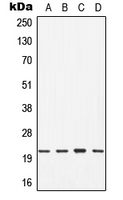
- 产品详情
- 实验流程
Application 
| WB |
|---|---|
| Primary Accession | P60953 |
| Reactivity | Human, Mouse, Rat, Zebrafish, Pig, Chicken, Bovine, Dog, Mk |
| Host | Rabbit |
| Clonality | Polyclonal |
| Calculated MW | 21259 Da |
| Gene ID | 998 |
|---|---|
| Other Names | Cell division control protein 42 homolog; G25K GTP-binding protein |
| Target/Specificity | KLH-conjugated synthetic peptide encompassing a sequence within the center region of human CDC42. The exact sequence is proprietary. |
| Dilution | WB~~WB (1/500 - 1/1000) |
| Format | Liquid in 0.42% Potassium phosphate, 0.87% Sodium chloride, pH 7.3, 30% glycerol, and 0.01% sodium azide. |
| Storage | Store at -20 °C.Stable for 12 months from date of receipt |
For Research Use Only. Not For Use In Diagnostic Procedures.
| Name | CDC42 (HGNC:1736) |
|---|---|
| Function | Plasma membrane-associated small GTPase which cycles between an active GTP-bound and an inactive GDP-bound state. In active state binds to a variety of effector proteins to regulate cellular responses. Involved in epithelial cell polarization processes. Regulates the bipolar attachment of spindle microtubules to kinetochores before chromosome congression in metaphase (PubMed:15642749). Regulates cell migration (PubMed:17038317, PubMed:22843693). In neurons, plays a role in the extension and maintenance of the formation of filopodia, thin and actin-rich surface projections (PubMed:14978216). Required for DOCK10-mediated spine formation in Purkinje cells and hippocampal neurons. In podocytes, facilitates filopodia and podosomes formation upon DOCK11-activation (PubMed:33523862). Upon activation by CaMKII, modulates dendritic spine structural plasticity by relaying CaMKII transient activation to synapse-specific, long-term signaling (By similarity). Also plays a role in phagocytosis through organization of the F-actin cytoskeleton associated with forming phagocytic cups (PubMed:26465210). Upon activation by PLEKHG4B, involved in actin cytoskeletal remodeling during epithelial cell-cell junction formation (PubMed:33310911). Negatively regulates polymerization of SEPTIN12, as a result may be involved in spermatogenesis (PubMed:30189608). |
| Cellular Location | Cell membrane; Lipid-anchor; Cytoplasmic side. Cytoplasm, cytoskeleton, microtubule organizing center, centrosome. Cytoplasm, cytoskeleton, spindle. Midbody Cell projection, dendrite {ECO:0000250|UniProtKB:P60766}. Cytoplasmic vesicle, secretory vesicle, acrosome {ECO:0000250|UniProtKB:P60766} Note=Localizes to spindle during prometaphase cells. Moves to the central spindle as cells progressed through anaphase to telophase (PubMed:15642749). Localizes at the end of cytokinesis in the intercellular bridge formed between two daughter cells (PubMed:15642749). Its localization is regulated by the activities of guanine nucleotide exchange factor ECT2 and GTPase activating protein RACGAP1 (PubMed:15642749). Colocalizes with NEK6 in the centrosome (PubMed:20873783). In its active GTP-bound form localizes to the leading edge membrane of migrating dendritic cells (By similarity) During sperm head formation in elongating spermatids, expressed at the acrosome, perinuclear mantle of the manchette structure and the sperm neck (By similarity). Expressed at the neck and mitochondrial materials in elongated spermatids (By similarity). Expressed at the midpiece in mature spermatozoa (By similarity). {ECO:0000250|UniProtKB:P60766, ECO:0000269|PubMed:15642749, ECO:0000269|PubMed:20873783} |
Research Areas
Application Protocols
Provided below are standard protocols that you may find useful for product applications.
REFERENCES
Munemitsu S.,et al.Mol. Cell. Biol. 10:5977-5982(1990).
Shinjo K.,et al.Proc. Natl. Acad. Sci. U.S.A. 87:9853-9857(1990).
Rhodes S.,et al.Submitted (OCT-1999) to the EMBL/GenBank/DDBJ databases.
Puhl H.L. III,et al.Submitted (APR-2002) to the EMBL/GenBank/DDBJ databases.
Gregory S.G.,et al.Nature 441:315-321(2006).

终于等到您。ABCEPTA(百远生物)抗体产品。
点击下方“我要评价 ”按钮提交您的反馈信息,您的反馈和评价是我们最宝贵的财富之一,
我们将在1-3个工作日内处理您的反馈信息。
如有疑问,联系:0512-88856768 tech-china@abcepta.com.
¥ 1,250.00
Cat# AP51888


