


 癌症的基本特征包括细胞增殖、血管生成、迁移、凋亡逃避机制和细胞永生等。找到癌症发生过程中这些通路的关键标记物和对应的抗体用于检测至关重要。
 为您推荐一个泛素化位点预测神器——泛素化分析工具,可以为您的蛋白的泛素化位点作出预测和评分。
 细胞自噬受体图形绘图工具为你的蛋白的细胞受体结合位点作出预测和评分,识别结合到自噬通路中的蛋白是非常重要的,便于让我们理解自噬在正常生理、病理过程中的作用,如发育、细胞分化、神经退化性疾病、压力条件下、感染和癌症。
Anti-CD156c Antibody
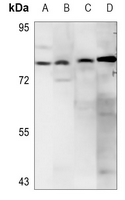
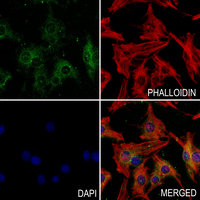
- 产品详情
- 实验流程
Application 
| WB, IF/IC |
|---|---|
| Primary Accession | O14672 |
| Reactivity | Human, Mouse, Rat, Pig, Bovine |
| Host | Rabbit |
| Clonality | Polyclonal |
| Calculated MW | 84142 Da |
| Gene ID | 102 |
|---|---|
| Other Names | KUZ; MADM; Disintegrin and metalloproteinase domain-containing protein 10; ADAM 10; CDw156; Kuzbanian protein homolog; Mammalian disintegrin-metalloprotease; CD156c |
| Target/Specificity | KLH-conjugated synthetic peptide encompassing a sequence within the center region of human CD156c. The exact sequence is proprietary. |
| Dilution | WB~~WB (1/500 - 1/1000) IF/IC~~N/A |
| Format | Liquid in 0.42% Potassium phosphate, 0.87% Sodium chloride, pH 7.3, 30% glycerol, and 0.01% sodium azide. |
| Storage | Store at -20 °C.Stable for 12 months from date of receipt |
For Research Use Only. Not For Use In Diagnostic Procedures.
| Name | ADAM10 (HGNC:188) |
|---|---|
| Synonyms | KUZ, MADM |
| Function | Transmembrane metalloprotease which mediates the ectodomain shedding of a myriad of transmembrane proteins, including adhesion proteins, growth factor precursors and cytokines being essential for development and tissue homeostasis (PubMed:11786905, PubMed:12475894, PubMed:20592283, PubMed:24990881, PubMed:26686862, PubMed:28600292, PubMed:31792032, PubMed:31792032). Associates with six members of the tetraspanin superfamily TspanC8 which regulate its exit from the endoplasmic reticulum and its substrate selectivity (PubMed:26686862, PubMed:28600292, PubMed:31792032, PubMed:34739841, PubMed:37516108). Cleaves the membrane-bound precursor of TNF at '76-Ala-|-Val-77' to its mature soluble form. Responsible for the proteolytical release of soluble JAM3 from endothelial cells surface (PubMed:20592283). Responsible for the proteolytic release of several other cell-surface proteins, including heparin-binding epidermal growth-like factor, ephrin-A2, CD44, CDH2 and for constitutive and regulated alpha- secretase cleavage of amyloid precursor protein (APP) (PubMed:11786905, PubMed:26686862, PubMed:29224781, PubMed:34739841, PubMed:33731436). Contributes to the normal cleavage of the cellular prion protein (PubMed:11477090). Involved in the cleavage of the adhesion molecule L1 at the cell surface and in released membrane vesicles, suggesting a vesicle-based protease activity (PubMed:12475894). Also controls the proteolytic processing of Notch and mediates lateral inhibition during neurogenesis (By similarity). Required for the development of type 1 transitional B cells into marginal zone B cells, probably by cleaving Notch (By similarity). Responsible for the FasL ectodomain shedding and for the generation of the remnant ADAM10-processed FasL (FasL APL) transmembrane form (PubMed:17557115). Also cleaves the ectodomain of the integral membrane proteins CORIN and ITM2B (PubMed:19114711, PubMed:21288900). Mediates the proteolytic cleavage of LAG3, leading to release the secreted form of LAG3 (By similarity). Mediates the proteolytic cleavage of IL6R and IL11RA, leading to the release of secreted forms of IL6R and IL11RA (PubMed:26876177). Enhances the cleavage of CHL1 by BACE1 (By similarity). Cleaves NRCAM (By similarity). Cleaves TREM2, resulting in shedding of the TREM2 ectodomain (PubMed:24990881). Involved in the development and maturation of glomerular and coronary vasculature (By similarity). During development of the cochlear organ of Corti, promotes pillar cell separation by forming a ternary complex with CADH1 and EPHA4 and cleaving CADH1 at adherens junctions (By similarity). May regulate the EFNA5-EPHA3 signaling (PubMed:16239146). Regulates leukocyte transmigration as a sheddase for the adherens junction protein VE- cadherin/CDH5 in endothelial cells (PubMed:28600292). |
| Cellular Location | Cell membrane; Single-pass type I membrane protein. Golgi apparatus membrane; Single-pass type I membrane protein. Cytoplasmic vesicle, clathrin-coated vesicle. Cell projection, axon {ECO:0000250|UniProtKB:O35598}. Cell projection, dendrite {ECO:0000250|UniProtKB:O35598}. Cell junction, adherens junction. Cytoplasm Note=Is localized in the plasma membrane but is also expressed in the Golgi apparatus and in clathrin-coated vesicles derived likely from the Golgi (PubMed:12475894). During long term depression, it is recruited to the cell membrane by DLG1 (PubMed:23676497). The immature form is mainly located near cytoplasmic fibrillar structures, while the mature form is predominantly located at zonula adherens and the cell membrane (PubMed:30463011). The localization and clustering of mature ADAM10 to zonula adherens is regulated by AFDN, TSPAN33, PLEKHA7 and PDZD11 (PubMed:30463011). |
| Tissue Location | Expressed in the brain (at protein level) (PubMed:23676497). Expressed in spleen, lymph node, thymus, peripheral blood leukocyte, bone marrow, cartilage, chondrocytes and fetal liver (PubMed:11511685, PubMed:9016778). |
Research Areas
Application Protocols
Provided below are standard protocols that you may find useful for product applications.
REFERENCES
Rosendahl M.S.,et al.J. Biol. Chem. 272:24588-24593(1997).
Howard L.,et al.Biochem. J. 317:45-50(1996).
McKie N.,et al.Biochem. Biophys. Res. Commun. 230:335-339(1997).
Gutwein P.,et al.FASEB J. 17:292-294(2003).
Vincent B.,et al.J. Biol. Chem. 276:37743-37746(2001).

终于等到您。ABCEPTA(百远生物)抗体产品。
点击下方“我要评价 ”按钮提交您的反馈信息,您的反馈和评价是我们最宝贵的财富之一,
我们将在1-3个工作日内处理您的反馈信息。
如有疑问,联系:0512-88856768 tech-china@abcepta.com.
¥ 1,250.00
Cat# AP51935


