


 癌症的基本特征包括细胞增殖、血管生成、迁移、凋亡逃避机制和细胞永生等。找到癌症发生过程中这些通路的关键标记物和对应的抗体用于检测至关重要。
 为您推荐一个泛素化位点预测神器——泛素化分析工具,可以为您的蛋白的泛素化位点作出预测和评分。
 细胞自噬受体图形绘图工具为你的蛋白的细胞受体结合位点作出预测和评分,识别结合到自噬通路中的蛋白是非常重要的,便于让我们理解自噬在正常生理、病理过程中的作用,如发育、细胞分化、神经退化性疾病、压力条件下、感染和癌症。
PIWIL1 Rabbit pAb
PIWIL1 Rabbit pAb
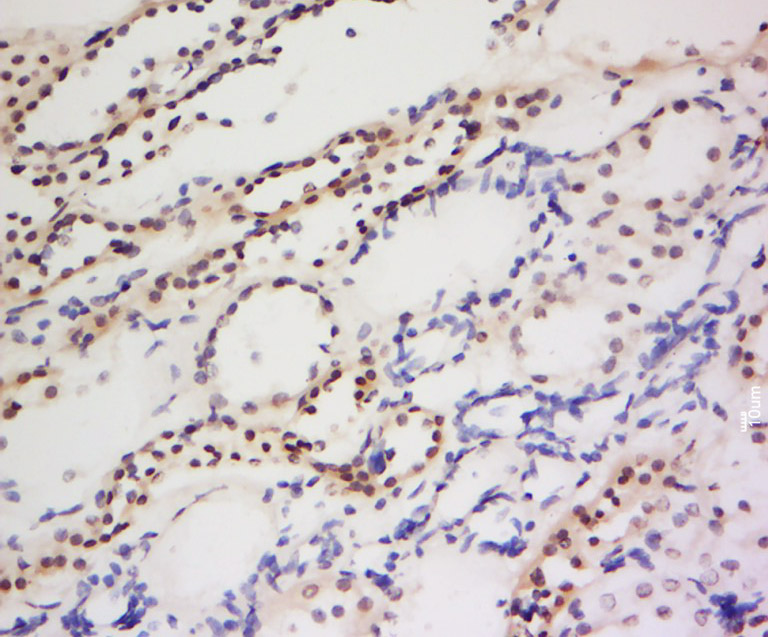
- 产品详情
- 实验流程
- 背景知识
Application 
| IHC-P, IHC-F, IF |
|---|---|
| Primary Accession | Q96J94 |
| Reactivity | Human |
| Predicted | Rat, Mouse, Chicken |
| Host | Rabbit |
| Clonality | Polyclonal |
| Calculated MW | 98603 Da |
| Physical State | Liquid |
| Immunogen | KLH conjugated synthetic peptide derived from human PIWIL1 |
| Epitope Specificity | 551-650/861 |
| Isotype | IgG |
| Purity | affinity purified by Protein A |
| Buffer | 0.01M TBS (pH7.4) with 1% BSA, 0.02% Proclin300 and 50% Glycerol. |
| SUBCELLULAR LOCATION | Cytoplasm. Note=Component of the meiotic nuage, also named P granule, a germ-cell-specific organelle required to repress transposon during meiosis. Also present in chromatoid body. |
| Important Note | This product as supplied is intended for research use only, not for use in human, therapeutic or diagnostic applications. |
| Background Descriptions | This gene encodes a member of the PIWI subfamily of Argonaute proteins, evolutionarily conserved proteins containing both PAZ and Piwi motifs that play important roles in stem cell self-renewal, RNA silencing, and translational regulation in diverse organisms. The encoded protein may play a role as an intrinsic regulator of the self-renewal capacity of germline and hematopoietic stem cells. Alternatively spliced transcript variants encoding different isoforms have been found for this gene. [provided by RefSeq, Jul 2010]. |
| Gene ID | 9271 |
|---|---|
| Other Names | Piwi-like protein 1, 3.1.26.-, PIWIL1 |
| Dilution | IHC-P=1:100-500,IHC-F=1:100-500,IF=1:100-500 |
| Storage | Store at -20 °C for one year. Avoid repeated freeze/thaw cycles. When reconstituted in sterile pH 7.4 0.01M PBS or diluent of antibody the antibody is stable for at least two weeks at 2-4 °C. |
For Research Use Only. Not For Use In Diagnostic Procedures.
| Name | PIWIL1 |
|---|---|
| Function | Endoribonuclease that plays a central role in postnatal germ cells by repressing transposable elements and preventing their mobilization, which is essential for the germline integrity. Acts via the piRNA metabolic process, which mediates the repression of transposable elements during meiosis by forming complexes composed of piRNAs and Piwi proteins and governs the methylation and subsequent repression of transposons. Directly binds methylated piRNAs, a class of 24 to 30 nucleotide RNAs that are generated by a Dicer-independent mechanism and are primarily derived from transposons and other repeated sequence elements. Strongly prefers a uridine in the first position of their guide (g1U preference, also named 1U-bias). Not involved in the piRNA amplification loop, also named ping-pong amplification cycle. Acts as an endoribonuclease that cleaves transposon messenger RNAs. Besides their function in transposable elements repression, piRNAs are probably involved in other processes during meiosis such as translation regulation. Probable component of some RISC complex, which mediates RNA cleavage and translational silencing. Also plays a role in the formation of chromatoid bodies and is required for some miRNAs stability. Required to sequester RNF8 in the cytoplasm until late spermatogenesis; RNF8 being released upon ubiquitination and degradation of PIWIL1. |
| Cellular Location | Cytoplasm {ECO:0000250|UniProtKB:Q9JMB7}. Note=Component of the meiotic nuage, also named P granule, a germ-cell- specific organelle required to repress transposon activity during meiosis. Also present in chromatoid body {ECO:0000250|UniProtKB:Q9JMB7} |
| Tissue Location | Expressed in spermatocytes and spermatids. Also detected in prostate cancer (at protein level). Detected in most fetal and adult tissues. Expressed in testes, specifically in germline cells; detected in spermatocytes and spermatids during spermatogenesis Increased expression in testicular tumors originating from embryonic germ cells with retention of germ cells phenotype. No expression in testicular tumors of somatic origin, such as Sertoli cell and Leydig cell tumors. Overexpressed in gastric cancer cells. Isoform 3: Ubiquitously expressed, and specifically in CD34(+) hematopoietic progenitor cells but not in more differentiated cells |
Research Areas
Application Protocols
Provided below are standard protocols that you may find useful for product applications.
BACKGROUND
This product as supplied is intended for research use only, not for use in human, therapeutic or diagnostic applications.
REFERENCES
Wang Y.,et al.Submitted (MAY-2007) to the EMBL/GenBank/DDBJ databases.

终于等到您。ABCEPTA(百远生物)抗体产品。
点击下方“我要评价 ”按钮提交您的反馈信息,您的反馈和评价是我们最宝贵的财富之一,
我们将在1-3个工作日内处理您的反馈信息。
如有疑问,联系:0512-88856768 tech-china@abcepta.com.
¥ 1,250.00
Cat# AP52028


