


 癌症的基本特征包括细胞增殖、血管生成、迁移、凋亡逃避机制和细胞永生等。找到癌症发生过程中这些通路的关键标记物和对应的抗体用于检测至关重要。
 为您推荐一个泛素化位点预测神器——泛素化分析工具,可以为您的蛋白的泛素化位点作出预测和评分。
 细胞自噬受体图形绘图工具为你的蛋白的细胞受体结合位点作出预测和评分,识别结合到自噬通路中的蛋白是非常重要的,便于让我们理解自噬在正常生理、病理过程中的作用,如发育、细胞分化、神经退化性疾病、压力条件下、感染和癌症。
PKA alpha + beta Rabbit pAb
PKA alpha + beta Rabbit pAb
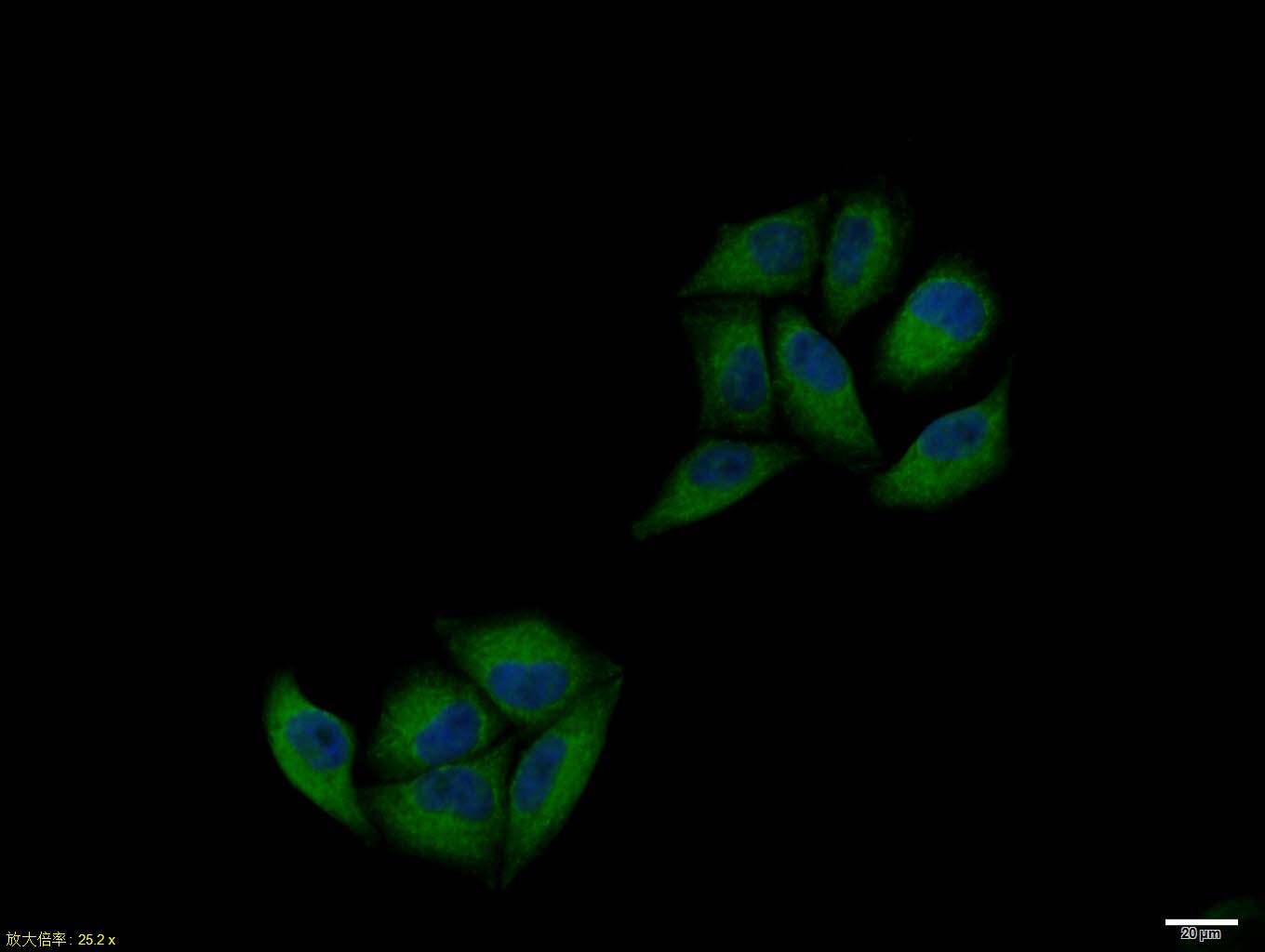
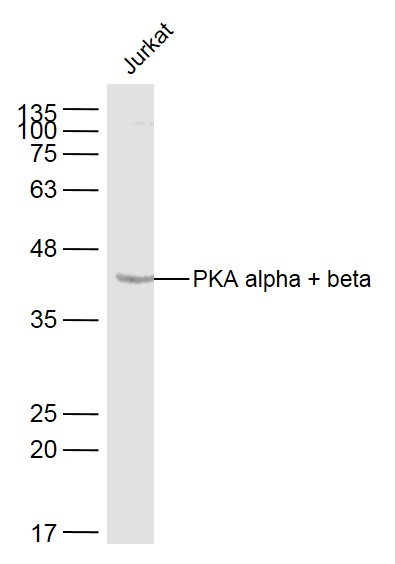
- 产品详情
- 实验流程
- 背景知识
Application 
| WB |
|---|---|
| Primary Accession | P17612 |
| Reactivity | Rat, Human, Mouse |
| Host | Rabbit |
| Clonality | Polyclonal |
| Calculated MW | 40590 Da |
| Physical State | Liquid |
| Immunogen | KLH conjugated synthetic peptide derived from human PRKACA/PRKACB |
| Epitope Specificity | 17-100/351 |
| Isotype | IgG |
| Purity | affinity purified by Protein A |
| Buffer | 0.01M TBS (pH7.4) with 1% BSA, 0.02% Proclin300 and 50% Glycerol. |
| SUBCELLULAR LOCATION | oplasm. Cell membrane. Nucleus (By similarity). Note=Translocates into the nucleus (monomeric catalytic subunit) (By similarity). The inactive holoenzyme is found in the cytoplasm (By similarity). |
| DISEASE | A chromosomal aberration involving PRKX is a cause of sex reversal disorder. Translocation t(X;Y)(p22;p11) with PRKY. Chromosomal translocations proximal to PRKY account for about 30% of the cases of sex reversal disorder in XX males and XY females. |
| Important Note | This product as supplied is intended for research use only, not for use in human, therapeutic or diagnostic applications. |
| Background Descriptions | cAMP is a signaling molecule important for a variety of cellular functions. cAMP exerts its effects by activating the cAMP dependent protein kinase (AMPK), which transduces the signal through phosphorylation of different target proteins. The inactive holoenzyme of AMPK is a tetramer composed of two regulatory and two catalytic subunits. cAMP causes the dissociation of the inactive holoenzyme into a dimer of regulatory subunits bound to four cAMP and two free monomeric catalytic subunits. Four different regulatory subunits and three catalytic subunits of AMPK have been identified in humans. PKA beta (catalytic subunit) is a member of the Ser/Thr protein kinase family and is a catalytic subunit of AMPK. |
| Gene ID | 5566 |
|---|---|
| Other Names | cAMP-dependent protein kinase catalytic subunit alpha, PKA C-alpha, 2.7.11.11, PRKACA, PKACA |
| Dilution | WB=1:500-2000,ICC/IF=1:100-500 |
| Storage | Store at -20 °C for one year. Avoid repeated freeze/thaw cycles. When reconstituted in sterile pH 7.4 0.01M PBS or diluent of antibody the antibody is stable for at least two weeks at 2-4 °C. |
For Research Use Only. Not For Use In Diagnostic Procedures.
| Name | PRKACA |
|---|---|
| Synonyms | PKACA |
| Function | Phosphorylates a large number of substrates in the cytoplasm and the nucleus (PubMed:15642694, PubMed:15905176, PubMed:16387847, PubMed:17333334, PubMed:17565987, PubMed:17693412, PubMed:18836454, PubMed:19949837, PubMed:20356841, PubMed:21085490, PubMed:21514275, PubMed:21812984, PubMed:21852232, PubMed:31112131, PubMed:41652173). Phosphorylates CDC25B, ABL1, NFKB1, CLDN3, histone H1.4 (H1-4), PSMC5/RPT6, PJA2, RYR2, RORA, SLC6A6, SOX9, UHRF1 and VASP (PubMed:15178447, PubMed:15642694, PubMed:15905176, PubMed:16387847, PubMed:17333334, PubMed:17565987, PubMed:17693412, PubMed:18836454, PubMed:19949837, PubMed:20356841, PubMed:21085490, PubMed:21514275, PubMed:21812984, PubMed:41652173). Regulates the abundance of compartmentalized pools of its regulatory subunits through phosphorylation of PJA2 which binds and ubiquitinates these subunits, leading to their subsequent proteolysis (PubMed:21423175). RORA is activated by phosphorylation (PubMed:21514275). Required for glucose- mediated adipogenic differentiation increase and osteogenic differentiation inhibition from osteoblasts (PubMed:19949837). Involved in chondrogenesis by mediating phosphorylation of SOX9 (By similarity). Involved in the regulation of platelets in response to thrombin and collagen; maintains circulating platelets in a resting state by phosphorylating proteins in numerous platelet inhibitory pathways when in complex with NF-kappa-B (NFKB1 and NFKB2) and I-kappa-B-alpha (NFKBIA), but thrombin and collagen disrupt these complexes and free active PRKACA stimulates platelets and leads to platelet aggregation by phosphorylating VASP (PubMed:15642694, PubMed:20356841). Prevents the antiproliferative and anti-invasive effects of alpha- difluoromethylornithine in breast cancer cells when activated (PubMed:17333334). RYR2 channel activity is potentiated by phosphorylation in presence of luminal Ca(2+), leading to reduced amplitude and increased frequency of store overload-induced Ca(2+) release (SOICR) characterized by an increased rate of Ca(2+) release and propagation velocity of spontaneous Ca(2+) waves, despite reduced wave amplitude and resting cytosolic Ca(2+) (PubMed:17693412). PSMC5/RPT6 activation by phosphorylation stimulates proteasome (PubMed:17565987). Negatively regulates tight junctions (TJs) in ovarian cancer cells via CLDN3 phosphorylation (PubMed:15905176). NFKB1 phosphorylation promotes NF-kappa-B p50-p50 DNA binding (PubMed:15642694). Acts as a key inhibitor of smoothened signaling pathway by mediating phosphorylation of GLI (GLI1, GLI2 and GLI3) transcription factors in absence of hedgehog (DHH, IHH or SHH) morphogens: GLI phosphorylation promotes their processing and prevents transcriptional activation of smoothened target genes (PubMed:16705181). GLI transcription factor phosphorylation is inhibited by interaction of PRKACA with SMO which sequesters PRKACA at the cell membrane (PubMed:36202993, PubMed:39138140). Also inhibits the smoothened signaling pathway in embryonic development by catalyzing phosphorylation of OFD1 in ciliogenesis (PubMed:33934390). Prevents meiosis resumption in prophase-arrested oocytes via CDC25B inactivation by phosphorylation (By similarity). May also regulate rapid eye movement (REM) sleep in the pedunculopontine tegmental (PPT) (By similarity). Phosphorylates APOBEC3G and AICDA (PubMed:16387847, PubMed:18836454). Phosphorylates HSF1; this phosphorylation promotes HSF1 nuclear localization and transcriptional activity upon heat shock (PubMed:21085490). Acts as a negative regulator of mTORC1 by mediating phosphorylation of RPTOR (PubMed:31112131). Phosphorylates AKAP19 (PubMed:27028580). |
| Cellular Location | Cytoplasm. Cell membrane. Membrane; Lipid-anchor. Nucleus. Mitochondrion {ECO:0000250|UniProtKB:P05132}. Note=Translocates into the nucleus (monomeric catalytic subunit). The inactive holoenzyme is found in the cytoplasm. Distributed throughout the cytoplasm in meiotically incompetent oocytes. Associated to mitochondrion as meiotic competence is acquired. Aggregates around the germinal vesicles (GV) at the immature GV stage oocytes (By similarity). Colocalizes with HSF1 in nuclear stress bodies (nSBs) upon heat shock (PubMed:21085490) Recruited to the cell membrane through interaction with SMO (By similarity). {ECO:0000250|UniProtKB:P05132, ECO:0000269|PubMed:21085490} |
| Tissue Location | Isoform 1 is ubiquitous. Isoform 2 is sperm- specific and is enriched in pachytene spermatocytes but is not detected in round spermatids. |
Provided below are standard protocols that you may find useful for product applications.
BACKGROUND
This product as supplied is intended for research use only, not for use in human, therapeutic or diagnostic applications.
REFERENCES
Showers M.O.,et al.J. Biol. Chem. 261:16288-16291(1986).
Wiemann S.,et al.J. Biol. Chem. 266:5140-5146(1991).
Jedrzejewski P.T.,et al.Protein Sci. 7:457-469(1998).
Pepperkok R.,et al.J. Cell Biol. 148:715-726(2000).
Kinzel V.,et al.Protein Sci. 9:2269-2277(2000).

终于等到您。ABCEPTA(百远生物)抗体产品。
点击下方“我要评价 ”按钮提交您的反馈信息,您的反馈和评价是我们最宝贵的财富之一,
我们将在1-3个工作日内处理您的反馈信息。
如有疑问,联系:0512-88856768 tech-china@abcepta.com.


