


 癌症的基本特征包括细胞增殖、血管生成、迁移、凋亡逃避机制和细胞永生等。找到癌症发生过程中这些通路的关键标记物和对应的抗体用于检测至关重要。
 为您推荐一个泛素化位点预测神器——泛素化分析工具,可以为您的蛋白的泛素化位点作出预测和评分。
 细胞自噬受体图形绘图工具为你的蛋白的细胞受体结合位点作出预测和评分,识别结合到自噬通路中的蛋白是非常重要的,便于让我们理解自噬在正常生理、病理过程中的作用,如发育、细胞分化、神经退化性疾病、压力条件下、感染和癌症。
MSX1 Rabbit pAb
MSX1 Rabbit pAb
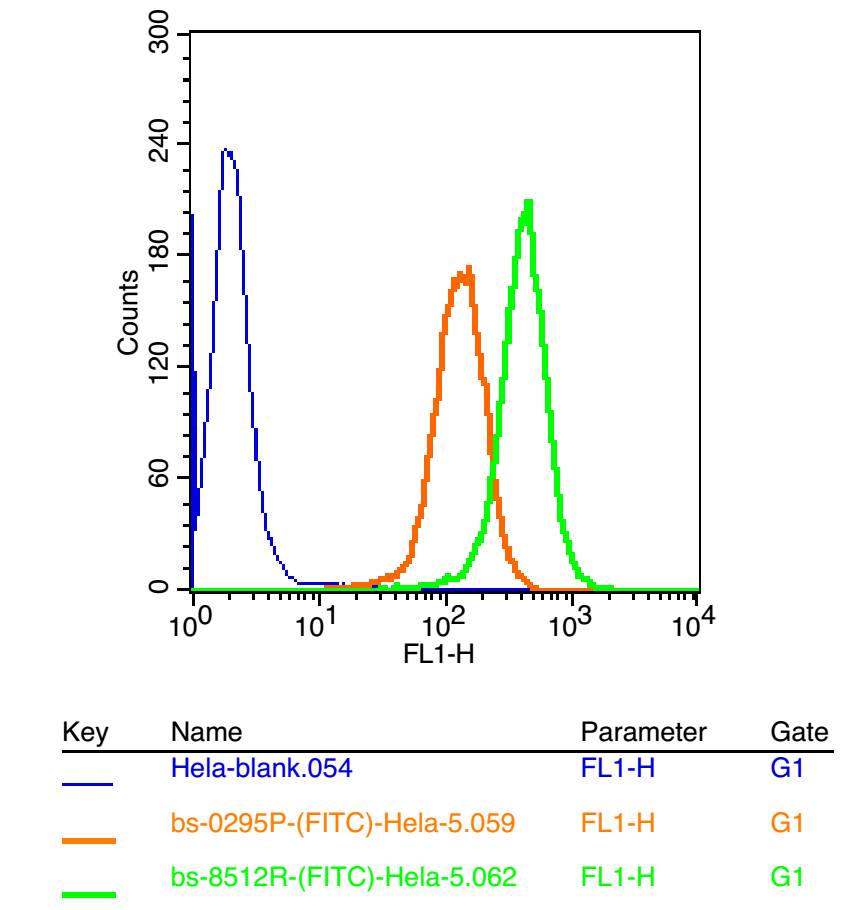
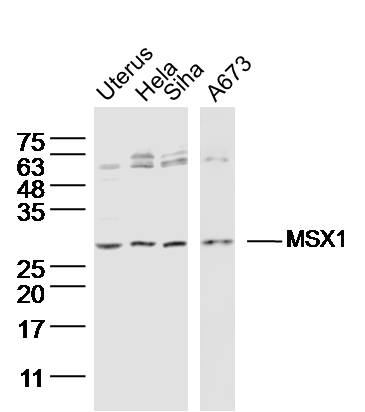
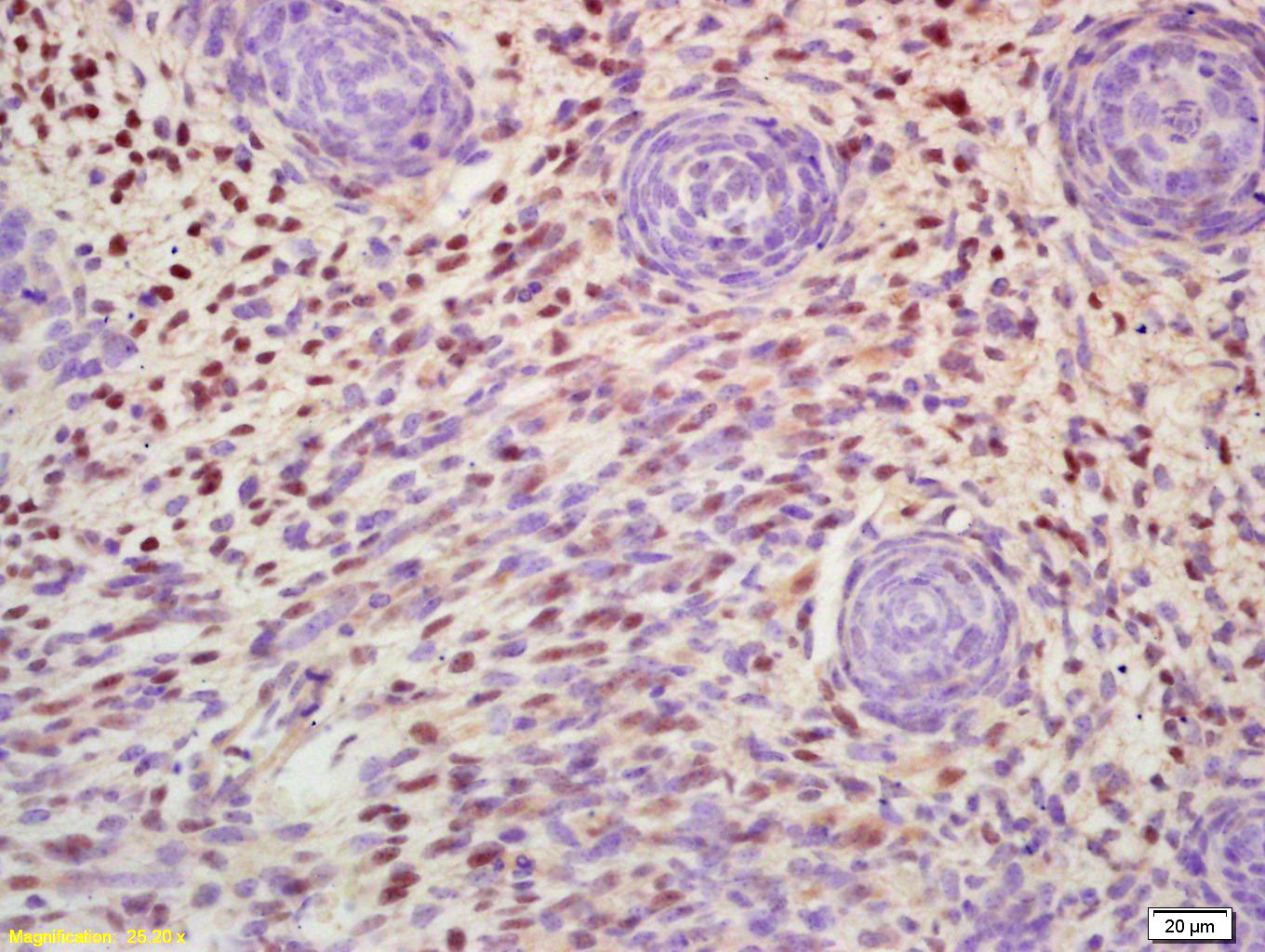
- 产品详情
- 实验流程
- 背景知识
Application 
| WB, IHC-P, IHC-F, IF |
|---|---|
| Primary Accession | P28360 |
| Reactivity | Human, Mouse |
| Predicted | Rat, Dog |
| Host | Rabbit |
| Clonality | Polyclonal |
| Calculated MW | 31496 Da |
| Physical State | Liquid |
| Immunogen | KLH conjugated synthetic peptide derived from human MSX1 |
| Epitope Specificity | 151-297/297 |
| Isotype | IgG |
| Purity | affinity purified by Protein A |
| Buffer | 0.01M TBS (pH7.4) with 1% BSA, 0.02% Proclin300 and 50% Glycerol. |
| SUBCELLULAR LOCATION | Nucleus |
| DISEASE | Defects in MSX1 are the cause of tooth agenesis selective type 1 (STHAG1) [MIM:106600]. A form of selective tooth agenesis, a common anomaly characterized by the congenital absence of one or more teeth. Selective tooth agenesis without associated systemic disorders has sometimes been divided into 2 types: oligodontia, defined as agenesis of 6 or more permanent teeth, and hypodontia, defined as agenesis of less than 6 teeth. The number in both cases does not include absence of third molars (wisdom teeth). Tooth agenesis selective type 1 can be associated with orofacial cleft in some patients. Note=MSX1 is deleted in some patients with Wolf-Hirschhorn syndrome (WHS). WHS results from sub-telomeric deletions in the short arm of chromosome 4. Defects in MSX1 are the cause of Witkop syndrome (WITS) [MIM:189500]. WITS is a form of ectodermal dyslasia also called tooth-and-nail syndrome or dysplasia of nails with hypodontia. Ectodermal dysplasias (EDs) constitute a heterogeneous group of developmental disorders affecting tissues of ectodermal origin. EDs are characterized by abnormal development of two or more ectodermal structures such as hair, teeth, nails and sweat glands, with or without any additional clinical sign. Each combination of clinical features represents a different type of ectodermal dysplasia. Witkop syndrome is characterized by abnormalities largely limited largely to teeth (some of which are missing) and nails (which are poorly formed early in life, especially toenails). This condition is distinguished from anhidrotic ectodermal dysplasia by autosomal dominant inheritance and little involvement of hair and sweat glands. The teeth are not as severely affected. Defects in MSX1 are the cause of non-syndromic orofacial cleft type 5 (OFC5) [MIM:608874]; also called non-syndromic cleft lip with or without cleft palate 5. Non-syndromic orofacial cleft is a common birth defect consisting of cleft lips with or without cleft palate. Cleft lips are associated with cleft palate in two-third of cases. A cleft lip can occur on one or both sides and range in severity from a simple notch in the upper lip to a complete opening in the lip extending into the floor of the nostril and involving the upper gum. |
| Important Note | This product as supplied is intended for research use only, not for use in human, therapeutic or diagnostic applications. |
| Background Descriptions | Acts as a transcriptional repressor. May play a role in limb-pattern formation. Acts in cranofacial development and specifically in odontogenesis. Expression in the developing nail bed mesenchyme is important for nail plate thickness and integrity. |
| Gene ID | 4487 |
|---|---|
| Other Names | Homeobox protein MSX-1, Homeobox protein Hox-7, Msh homeobox 1-like protein, MSX1 (HGNC:7391) |
| Dilution | WB=1:500-2000,IHC-P=1:100-500,IHC-F=1:100-500,IF=1:100-500,Flow-Cyt=5 µg /Test |
| Storage | Store at -20 °C for one year. Avoid repeated freeze/thaw cycles. When reconstituted in sterile pH 7.4 0.01M PBS or diluent of antibody the antibody is stable for at least two weeks at 2-4 °C. |
For Research Use Only. Not For Use In Diagnostic Procedures.
| Name | MSX1 (HGNC:7391) |
|---|---|
| Function | Acts as a transcriptional repressor (By similarity). Capable of transcription autoinactivation (By similarity). Binds to the consensus sequence 5'-C/GTAAT-3' in downstream activin regulatory elements (DARE) in the gene promoter, thereby repressing the transcription of CGA/alpha-GSU and GNRHR (By similarity). Represses transcription of myoblast differentiation factors (By similarity). Binds to core enhancer regions in target gene promoters of myoblast differentiation factors with binding specificity facilitated by interaction with PIAS1 (By similarity). Regulates, in a stage-specific manner, a developmental program of gene expression in the fetal tooth bud that controls odontoblast differentiation and proliferation of dental mesenchymal cells (By similarity). At the bud stage, required for mesenchymal molar tooth bud development via facilitating reciprocal signaling between dental epithelial and mesenchymal cells (By similarity). May also regulate expression of Wnt antagonists such as DKK2 and SFPR2 in the developing tooth mesenchyme (By similarity). Required for BMP4 expression in dental mesenchyme cells (By similarity). Also, in response to BMP4, required for BMP4 expression in neighboring dental epithelial cells (By similarity). Required for maximal FGF4-induced expression of SDC1 in dental mesenchyme cells (By similarity). Also in response to SDC1, required for SDC1 expression in neighboring dental epithelial cells (By similarity). At the early bell stage, acts to drive proliferation of dental mesenchyme cells, however during the late bell stage acts as an homeostatic regulator of the cell cycle (By similarity). Regulates proliferation and inhibits premature mesenchymal odontogenesis during the bell stage via inhibition of the Wnt signaling component CTNNB1 and subsequent repression of the odontoblast differentiation factors BMP2, BMP4, LEF1, ALPL and BGLAP/OCN (By similarity). Additionally, required for correct development and fusion of the palatal shelves and embryonic mandibular formation (By similarity). Plays a role in embryonic bone formation of the middle ear, skull and nasal bones (By similarity). Required for correct formation and thickness of the nail plate (By similarity). May play a role in limb-pattern formation (By similarity). |
| Cellular Location | Nucleus {ECO:0000250|UniProtKB:P13297}. Note=Interaction with PIAS1 is required for localization to the nuclear periphery (By similarity). {ECO:0000250|UniProtKB:P13297} |
Research Areas
Application Protocols
Provided below are standard protocols that you may find useful for product applications.
BACKGROUND
This product as supplied is intended for research use only, not for use in human, therapeutic or diagnostic applications.
REFERENCES
Hewitt J.E.,et al.Genomics 11:670-678(1991).
Padanilam B.J.,et al.Hum. Mol. Genet. 1:407-410(1992).
Jezewski P.A.,et al.J. Med. Genet. 40:399-407(2003).
Hillier L.W.,et al.Nature 434:724-731(2005).
Ivens A.,et al.Hum. Genet. 84:473-476(1990).

终于等到您。ABCEPTA(百远生物)抗体产品。
点击下方“我要评价 ”按钮提交您的反馈信息,您的反馈和评价是我们最宝贵的财富之一,
我们将在1-3个工作日内处理您的反馈信息。
如有疑问,联系:0512-88856768 tech-china@abcepta.com.


