


 癌症的基本特征包括细胞增殖、血管生成、迁移、凋亡逃避机制和细胞永生等。找到癌症发生过程中这些通路的关键标记物和对应的抗体用于检测至关重要。
 为您推荐一个泛素化位点预测神器——泛素化分析工具,可以为您的蛋白的泛素化位点作出预测和评分。
 细胞自噬受体图形绘图工具为你的蛋白的细胞受体结合位点作出预测和评分,识别结合到自噬通路中的蛋白是非常重要的,便于让我们理解自噬在正常生理、病理过程中的作用,如发育、细胞分化、神经退化性疾病、压力条件下、感染和癌症。
Serotonin transporter Rabbit pAb
Serotonin transporter Rabbit pAb
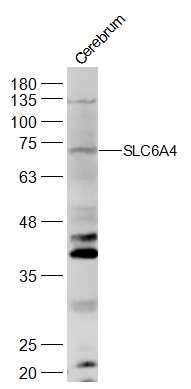
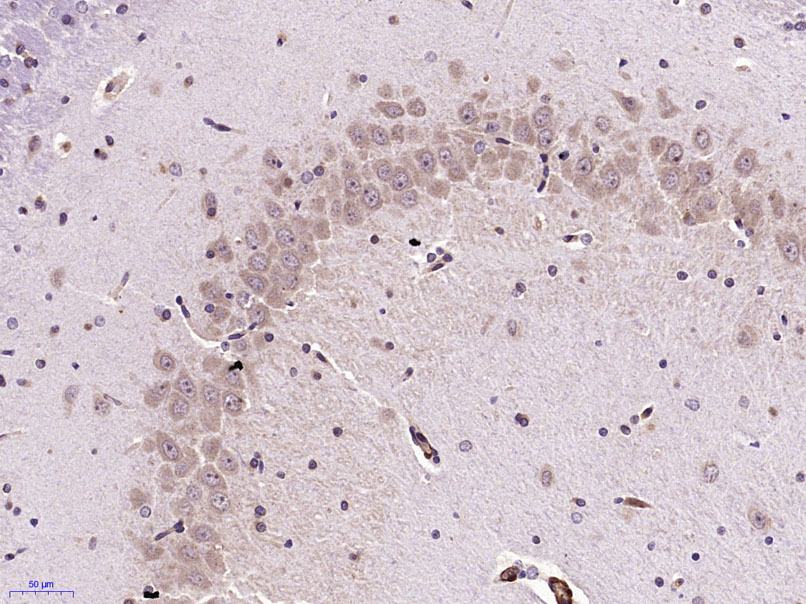
- 产品详情
- 实验流程
- 背景知识
Application 
| WB, IHC-P, IHC-F, IF |
|---|---|
| Primary Accession | P31645 |
| Reactivity | Rat, Mouse |
| Predicted | Pig, Dog, Human, Chicken, Sheep |
| Host | Rabbit |
| Clonality | Polyclonal |
| Calculated MW | 70325 Da |
| Physical State | Liquid |
| Immunogen | KLH conjugated synthetic peptide derived from human 5-HTT |
| Epitope Specificity | 401-500/630 |
| Isotype | IgG |
| Purity | affinity purified by Protein A |
| Buffer | 0.01M TBS (pH7.4) with 1% BSA, 0.02% Proclin300 and 50% Glycerol. |
| SUBCELLULAR LOCATION | Cell membrane; Multi-pass membrane protein. Endomembrane system; Multi-pass membrane protein. Endosome membrane; Multi-pass membrane protein. |
| Important Note | This product as supplied is intended for research use only, not for use in human, therapeutic or diagnostic applications. |
| Background Descriptions | This gene encodes an integral membrane protein that transports the neurotransmitter serotonin from synaptic spaces into presynaptic neurons. The encoded protein terminates the action of serotonin and recycles it in a sodium-dependent manner. This protein is a target of psychomotor stimulants, such as amphetamines and cocaine, and is a member of the sodium:neurotransmitter symporter family. A repeat length polymorphism in the promoter of this gene has been shown to affect the rate of serotonin uptake and may play a role in sudden infant death syndrome, aggressive behavior in Alzheimer disease patients, and depression-susceptibility in people experiencing emotional trauma. [provided by RefSeq, Jul 2008]. |
| Gene ID | 6532 |
|---|---|
| Other Names | Sodium-dependent serotonin transporter, SERT, 5HT transporter, 5HTT, Solute carrier family 6 member 4, SLC6A4, HTT, SERT |
| Dilution | WB=1:500-2000,IHC-P=1:100-500,IHC-F=1:100-500,IF=1:100-500 |
| Storage | Store at -20 °C for one year. Avoid repeated freeze/thaw cycles. When reconstituted in sterile pH 7.4 0.01M PBS or diluent of antibody the antibody is stable for at least two weeks at 2-4 °C. |
For Research Use Only. Not For Use In Diagnostic Procedures.
| Name | SLC6A4 |
|---|---|
| Synonyms | HTT, SERT |
| Function | Serotonin transporter that cotransports serotonin with one Na(+) ion in exchange for one K(+) ion and possibly one proton in an overall electroneutral transport cycle. Transports serotonin across the plasma membrane from the extracellular compartment to the cytosol thus limiting serotonin intercellular signaling (PubMed:10407194, PubMed:12869649, PubMed:21730057, PubMed:27049939, PubMed:27756841, PubMed:34851672). Essential for serotonin homeostasis in the central nervous system. In the developing somatosensory cortex, acts in glutamatergic neurons to control serotonin uptake and its trophic functions accounting for proper spatial organization of cortical neurons and elaboration of sensory circuits. In the mature cortex, acts primarily in brainstem raphe neurons to mediate serotonin uptake from the synaptic cleft back into the pre-synaptic terminal thus terminating serotonin signaling at the synapse (By similarity). Modulates mucosal serotonin levels in the gastrointestinal tract through uptake and clearance of serotonin in enterocytes. Required for enteric neurogenesis and gastrointestinal reflexes (By similarity). Regulates blood serotonin levels by ensuring rapid high affinity uptake of serotonin from plasma to platelets, where it is further stored in dense granules via vesicular monoamine transporters and then released upon stimulation (PubMed:17506858, PubMed:18317590). Mechanistically, the transport cycle starts with an outward-open conformation having Na1(+) and Cl(-) sites occupied. The binding of a second extracellular Na2(+) ion and serotonin substrate leads to structural changes to outward- occluded to inward-occluded to inward-open, where the Na2(+) ion and serotonin are released into the cytosol. Binding of intracellular K(+) ion induces conformational transitions to inward-occluded to outward- open and completes the cycle by releasing K(+) possibly together with a proton bound to Asp-98 into the extracellular compartment. Na1(+) and Cl(-) ions remain bound throughout the transport cycle (PubMed:10407194, PubMed:12869649, PubMed:21730057, PubMed:27049939, PubMed:27756841, PubMed:34851672). Additionally, displays serotonin- induced channel-like conductance for monovalent cations, mainly Na(+) ions. The channel activity is uncoupled from the transport cycle and may contribute to the membrane resting potential or excitability (By similarity). |
| Cellular Location | Cell membrane; Multi-pass membrane protein. Endomembrane system; Multi-pass membrane protein. Endosome membrane; Multi- pass membrane protein. Synapse {ECO:0000250|UniProtKB:Q60857}. Cell junction, focal adhesion {ECO:0000250|UniProtKB:Q60857}. Cell projection, neuron projection {ECO:0000250|UniProtKB:Q60857}. Note=Could be part of recycling endosomes (PubMed:16870614). Density of transporter molecules on the plasma membrane is itself regulated by STX1A (By similarity). Density of transporter molecules on the plasma membrane is also regulated by serotonin (PubMed:17506858). Density of transporter molecules seems to be modulated by ITGAV:ITGB3 (By similarity) {ECO:0000250|UniProtKB:P31652, ECO:0000250|UniProtKB:Q60857, ECO:0000269|PubMed:16870614, ECO:0000269|PubMed:17506858} |
| Tissue Location | Expressed in platelets (at protein level). |
Provided below are standard protocols that you may find useful for product applications.
BACKGROUND
This product as supplied is intended for research use only, not for use in human, therapeutic or diagnostic applications.
REFERENCES
Lesch K.P.,et al.J. Neural Transm. 91:67-73(1993).
Ramamoorthy S.,et al.Proc. Natl. Acad. Sci. U.S.A. 90:2542-2546(1993).
Lesch K.P.,et al.J. Neurochem. 60:2319-2322(1993).
Iceta R.,et al.J. Physiol. Pharmacol. 57:119-130(2006).
Bradley C.C.,et al.Submitted (JUN-1997) to the EMBL/GenBank/DDBJ databases.

终于等到您。ABCEPTA(百远生物)抗体产品。
点击下方“我要评价 ”按钮提交您的反馈信息,您的反馈和评价是我们最宝贵的财富之一,
我们将在1-3个工作日内处理您的反馈信息。
如有疑问,联系:0512-88856768 tech-china@abcepta.com.


