


 癌症的基本特征包括细胞增殖、血管生成、迁移、凋亡逃避机制和细胞永生等。找到癌症发生过程中这些通路的关键标记物和对应的抗体用于检测至关重要。
 为您推荐一个泛素化位点预测神器——泛素化分析工具,可以为您的蛋白的泛素化位点作出预测和评分。
 细胞自噬受体图形绘图工具为你的蛋白的细胞受体结合位点作出预测和评分,识别结合到自噬通路中的蛋白是非常重要的,便于让我们理解自噬在正常生理、病理过程中的作用,如发育、细胞分化、神经退化性疾病、压力条件下、感染和癌症。
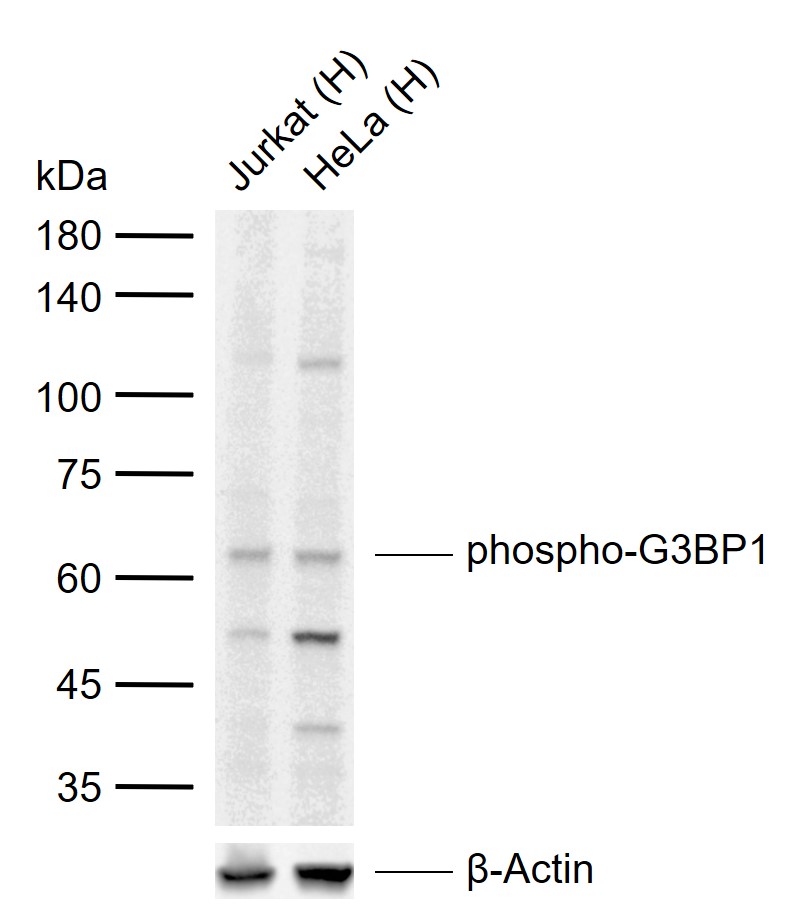
phospho-G3BP1 (Ser232) Rabbit pAb
phospho-G3BP1 (Ser232) Rabbit pAb
- 产品详情
- 实验流程
- 背景知识
Application 
| WB |
|---|---|
| Primary Accession | Q13283 |
| Reactivity | Human |
| Predicted | Pig, Rabbit |
| Host | Rabbit |
| Clonality | Polyclonal |
| Calculated MW | 52164 Da |
| Physical State | Liquid |
| Immunogen | KLH conjugated Synthesised phosphopeptide derived from human G3BP1 around the phosphorylation site of Ser232 |
| Epitope Specificity | SS(p-S)PA |
| Isotype | IgG |
| Purity | affinity purified by Protein A |
| Buffer | 0.01M TBS (pH7.4) with 1% BSA, 0.02% Proclin300 and 50% Glycerol. |
| SUBCELLULAR LOCATION | Cytoplasm. Cytoplasm, cytosol. Cell membrane. Nucleus. Note=Cytoplasmic in proliferating cells, can be recruited to the plasma membrane in exponentially growing cells. Cytosolic and partially nuclear in resting cells. Recruited to stress granules (SGs) upon either arsenite or high temperature treatment. Recruitment to SGs is influenced by HRAS. |
| Important Note | This product as supplied is intended for research use only, not for use in human, therapeutic or diagnostic applications. |
| Background Descriptions | This gene encodes one of the DNA-unwinding enzymes which prefers partially unwound 3'-tailed substrates and can also unwind partial RNA/DNA and RNA/RNA duplexes in an ATP-dependent fashion. This enzyme is a member of the heterogeneous nuclear RNA-binding proteins and is also an element of the Ras signal transduction pathway. It binds specifically to the Ras-GTPase-activating protein by associating with its SH3 domain. Several alternatively spliced transcript variants of this gene have been described, but the full-length nature of some of these variants has not been determined. [provided by RefSeq]. |
| Gene ID | 10146 |
|---|---|
| Other Names | Ras GTPase-activating protein-binding protein 1, G3BP-1, 3.6.4.12, 3.6.4.13, ATP-dependent DNA helicase VIII, hDH VIII, GAP SH3 domain-binding protein 1, G3BP1 {ECO:0000303|PubMed:23279204, ECO:0000312|HGNC:HGNC:30292} |
| Dilution | WB=1:500-2000 |
| Storage | Store at -20 °C for one year. Avoid repeated freeze/thaw cycles. When reconstituted in sterile pH 7.4 0.01M PBS or diluent of antibody the antibody is stable for at least two weeks at 2-4 °C. |
For Research Use Only. Not For Use In Diagnostic Procedures.
| Name | G3BP1 {ECO:0000303|PubMed:23279204, ECO:0000312|HGNC:HGNC:30292} |
|---|---|
| Function | Protein involved in various processes, such as stress granule formation and innate immunity (PubMed:37672657, PubMed:20180778, PubMed:23279204, PubMed:30510222, PubMed:30804210). Plays an essential role in stress granule formation (PubMed:37672657, PubMed:20180778, PubMed:23279204, PubMed:32302570, PubMed:32302571, PubMed:32302572, PubMed:34739333, PubMed:35977029, PubMed:36183834, PubMed:36279435, PubMed:36692217, PubMed:37379838). Stress granules are membraneless compartments that store mRNAs and proteins, such as stalled translation pre-initiation complexes, in response to stress (PubMed:37672657, PubMed:20180778, PubMed:23279204, PubMed:27022092, PubMed:32302570, PubMed:32302571, PubMed:32302572, PubMed:36279435, PubMed:37379838). Promotes formation of stress granules phase-separated membraneless compartment by undergoing liquid-liquid phase separation (LLPS) upon unfolded RNA-binding: functions as a molecular switch that triggers RNA-dependent LLPS in response to a rise in intracellular free RNA concentrations (PubMed:32302570, PubMed:32302571, PubMed:32302572, PubMed:34739333, PubMed:36279435, PubMed:36692217). Also acts as an ATP- and magnesium-dependent helicase: unwinds DNA/DNA, RNA/DNA, and RNA/RNA substrates with comparable efficiency (PubMed:9889278). Acts unidirectionally by moving in the 5' to 3' direction along the bound single-stranded DNA (PubMed:9889278). Unwinds preferentially partial DNA and RNA duplexes having a 17 bp annealed portion and either a hanging 3' tail or hanging tails at both 5'- and 3'-ends (PubMed:9889278). Plays an essential role in innate immunity by promoting CGAS and RIGI activity (PubMed:30510222, PubMed:30804210). Participates in the DNA-triggered cGAS/STING pathway by promoting the DNA binding and activation of CGAS (PubMed:30510222). Triggers the condensation of cGAS, a process probably linked to the formation of membrane-less organelles (PubMed:34779554). Also enhances RIGI-induced type I interferon production probably by helping RIGI at sensing pathogenic RNA (PubMed:30804210). May also act as a phosphorylation- dependent sequence-specific endoribonuclease in vitro: Cleaves exclusively between cytosine and adenine and cleaves MYC mRNA preferentially at the 3'-UTR (PubMed:11604510). |
| Cellular Location | Cytoplasm, cytosol. Perikaryon {ECO:0000250|UniProtKB:P97855}. Cytoplasm, Stress granule. Nucleus Note=Cytoplasmic in proliferating cells (PubMed:11604510). Cytosolic and partially nuclear in resting cells (PubMed:11604510). Recruited to stress granules in response to arsenite treatment (PubMed:37672657, PubMed:20180778). The unphosphorylated form is recruited to stress granules (PubMed:37672657). HRAS signaling contributes to this process by regulating G3BP dephosphorylation (PubMed:37672657) |
| Tissue Location | Ubiquitous.. |
Provided below are standard protocols that you may find useful for product applications.
BACKGROUND
This product as supplied is intended for research use only, not for use in human, therapeutic or diagnostic applications.
REFERENCES
Parker F.,et al.Mol. Cell. Biol. 16:2561-2569(1996).
Bienvenut W.V.,et al.Submitted (DEC-2008) to UniProtKB.
Costa M.,et al.Nucleic Acids Res. 27:817-821(1999).
Tourriere H.,et al.Mol. Cell. Biol. 21:7747-7760(2001).
Soncini C.,et al.Oncogene 20:3869-3879(2001).

终于等到您。ABCEPTA(百远生物)抗体产品。
点击下方“我要评价 ”按钮提交您的反馈信息,您的反馈和评价是我们最宝贵的财富之一,
我们将在1-3个工作日内处理您的反馈信息。
如有疑问,联系:0512-88856768 tech-china@abcepta.com.


