


 癌症的基本特征包括细胞增殖、血管生成、迁移、凋亡逃避机制和细胞永生等。找到癌症发生过程中这些通路的关键标记物和对应的抗体用于检测至关重要。
 为您推荐一个泛素化位点预测神器——泛素化分析工具,可以为您的蛋白的泛素化位点作出预测和评分。
 细胞自噬受体图形绘图工具为你的蛋白的细胞受体结合位点作出预测和评分,识别结合到自噬通路中的蛋白是非常重要的,便于让我们理解自噬在正常生理、病理过程中的作用,如发育、细胞分化、神经退化性疾病、压力条件下、感染和癌症。
Shh Rabbit pAb
Shh Rabbit pAb
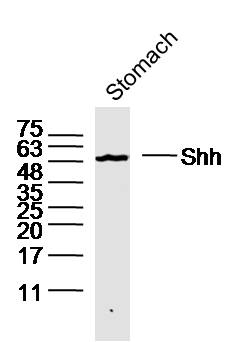
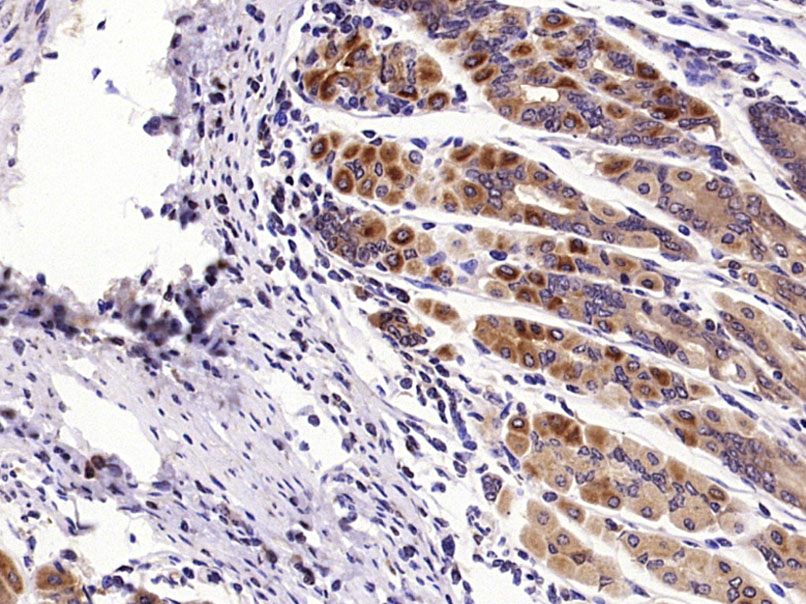
- 产品详情
- 实验流程
- 背景知识
Application 
| WB, IHC-P, IHC-F, IF |
|---|---|
| Primary Accession | Q15465 |
| Reactivity | Rat, Mouse |
| Predicted | Human, Rabbit, Chicken, Horse |
| Host | Rabbit |
| Clonality | Polyclonal |
| Calculated MW | 49607 Da |
| Physical State | Liquid |
| Immunogen | KLH conjugated synthetic peptide derived from human Shh |
| Epitope Specificity | 21-120/462 |
| Isotype | IgG |
| Purity | affinity purified by Protein A |
| Buffer | 0.01M TBS (pH7.4) with 1% BSA, 0.02% Proclin300 and 50% Glycerol. |
| SUBCELLULAR LOCATION | Sonic hedgehog protein C-product: Secreted, extracellular space. Note=The C-terminal peptide diffuses from the cell. Sonic hedgehog protein N-product: Cell membrane; Lipid-anchor. Note=The N-product either remains associated with lipid rafts at the cell surface, or forms freely diffusible active multimers with its hydrophobic lipid-modified N- and C-termini buried inside. |
| DISEASE | Defects in SHH are the cause of microphthalmia isolated with coloboma type 5 (MCOPCB5) [MIM:611638]. Microphthalmia is a clinically heterogeneous disorder of eye formation, ranging from small size of a single eye to complete bilateral absence of ocular tissues. Ocular abnormalities like opacities of the cornea and lens, scaring of the retina and choroid, cataract and other abnormalities like cataract may also be present. Ocular colobomas are a set of malformations resulting from abnormal morphogenesis of the optic cup and stalk, and the fusion of the fetal fissure (optic fissure).Defects in SHH are the cause of holoprosencephaly type 3 (HPE3) [MIM:142945]. Holoprosencephaly (HPE) [MIM:236100] is the most common structural anomaly of the brain, in which the developing forebrain fails to correctly separate into right and left hemispheres. Holoprosencephaly is genetically heterogeneous and associated with several distinct facies and phenotypic variability. The majority of HPE3 cases are apparently sporadic, although clear examples of autosomal dominant inheritance have been described. Interestingly, up to 30% of obligate carriers of HPE3 gene in autosomal dominant pedigrees are clinically unaffected. Defects in SHH are a cause of solitary median maxillary central incisor (SMMCI) [MIM:147250]. SMMCI is a rare dental anomaly characterized by the congenital absence of one maxillary central incisor. Defects in SHH are the cause of triphalangeal thumb-polysyndactyly syndrome (TPTPS) [MIM:174500]. TPTPS is an autosomal dominant syndrome characterized by a wide spectrum of pre- and post-axial abnormalities due to altered SHH expression pattern during limb development. TPTPS mutations have been mapped to the 7q36 locus in the LMBR1 gene which contains in its intron 5 a long-range cis-regulatory element of SHH expression. |
| Important Note | This product as supplied is intended for research use only, not for use in human, therapeutic or diagnostic applications. |
| Background Descriptions | SHH binds to the patched (PTC) receptor, which functions in association with smoothened (SMO), to activate the transcription of target genes. In the absence of SHH, PTC represses the constitutive signaling activity of SMO. Also regulates another target, the gli oncogene. Intercellular signal essential for a variety of patterning events during development: signal produced by the notochord that induces ventral cell fate in the neural tube and somites, and the polarizing signal for patterning of the anterior-posterior axis of the developing limb bud. Displays both floor plate- and motor neuron-inducing activity. The threshold concentration of N-product required for motor neuron induction is 5-fold lower than that required for floor plate induction (By similarity). |
| Gene ID | 6469 |
|---|---|
| Other Names | Sonic hedgehog protein, SHH, 3.1.-.-, HHG-1, Shh unprocessed N-terminal signaling and C-terminal autoprocessing domains, ShhNC, Sonic hedgehog protein N-product, ShhN, Shh N-terminal processed signaling domains, ShhNp, SHH (HGNC:10848) |
| Dilution | WB=1:500-2000,IHC-P=1:100-500,IHC-F=1:100-500,IF=1:100-500 |
| Storage | Store at -20 °C for one year. Avoid repeated freeze/thaw cycles. When reconstituted in sterile pH 7.4 0.01M PBS or diluent of antibody the antibody is stable for at least two weeks at 2-4 °C. |
For Research Use Only. Not For Use In Diagnostic Procedures.
| Name | SHH {ECO:0000303|PubMed:7590746, ECO:0000312|HGNC:HGNC:10848} |
|---|---|
| Function | [Sonic hedgehog protein]: Precursor of sonic hedgehog, a morphogen that activates the smoothened signaling pathway, and which is essential for a variety of patterning events during development (PubMed:29954986, PubMed:29995851, PubMed:30139912, PubMed:31127104, PubMed:31548691). The C-terminal part of the precursor displays an autoproteolysis and a cholesterol transferase activity, resulting (1) in the cleavage of the full-length protein into two parts, Sonic hedgehog protein N-product and C-product (ShhN and ShhC, respectively) and (2) covalent attachment of a cholesterol moiety to the C-terminus of the newly generated ShhN (By similarity). Both autoproteolysis and a cholesterol transferase activities occur in the endoplasmic reticulum (By similarity). Following additional lipidation, ShhN acts as a morphogen, while ShhC is degraded in the endoplasmic reticulum (By similarity). |
| Cellular Location | [Sonic hedgehog protein]: Endoplasmic reticulum membrane. Golgi apparatus membrane. Note=Co-localizes with HHAT in the ER and Golgi membrane. |
Provided below are standard protocols that you may find useful for product applications.
BACKGROUND
This product as supplied is intended for research use only, not for use in human, therapeutic or diagnostic applications.
REFERENCES
Marigo V.,et al.Genomics 28:44-51(1995).
Tate G.,et al.J. Biochem. Mol. Biol. Biophys. 4:27-34(2000).
Hillier L.W.,et al.Nature 424:157-164(2003).
Scherer S.W.,et al.Science 300:767-772(2003).
Pepinsky R.B.,et al.J. Biol. Chem. 273:14037-14045(1998).

终于等到您。ABCEPTA(百远生物)抗体产品。
点击下方“我要评价 ”按钮提交您的反馈信息,您的反馈和评价是我们最宝贵的财富之一,
我们将在1-3个工作日内处理您的反馈信息。
如有疑问,联系:0512-88856768 tech-china@abcepta.com.


