


 癌症的基本特征包括细胞增殖、血管生成、迁移、凋亡逃避机制和细胞永生等。找到癌症发生过程中这些通路的关键标记物和对应的抗体用于检测至关重要。
 为您推荐一个泛素化位点预测神器——泛素化分析工具,可以为您的蛋白的泛素化位点作出预测和评分。
 细胞自噬受体图形绘图工具为你的蛋白的细胞受体结合位点作出预测和评分,识别结合到自噬通路中的蛋白是非常重要的,便于让我们理解自噬在正常生理、病理过程中的作用,如发育、细胞分化、神经退化性疾病、压力条件下、感染和癌症。
TLR3 Rabbit pAb
TLR3 Rabbit pAb
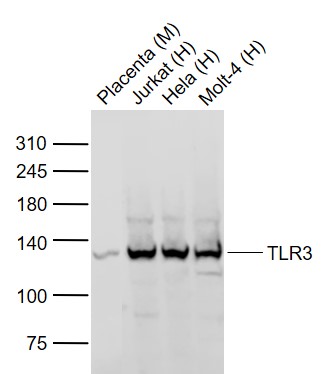
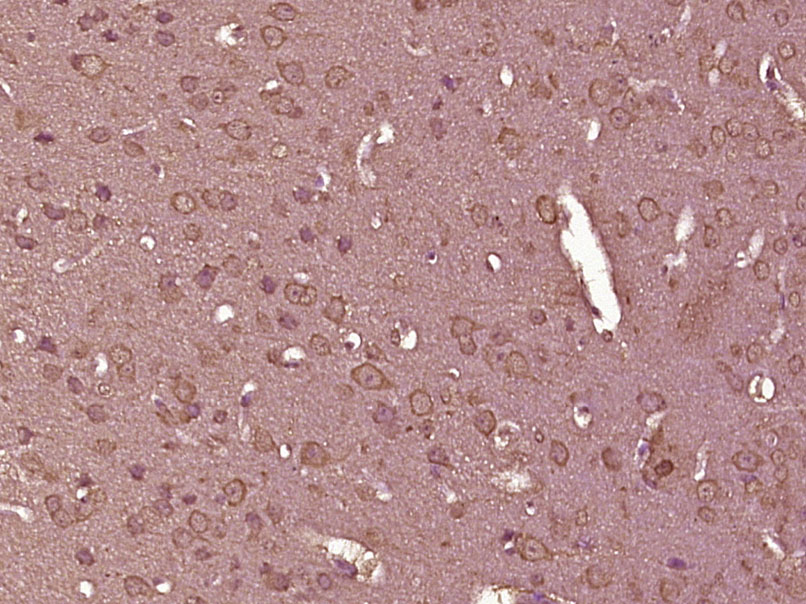
- 产品详情
- 实验流程
- 背景知识
Application 
| WB, IHC-P, IHC-F, IF |
|---|---|
| Primary Accession | O15455 |
| Reactivity | Human, Mouse |
| Predicted | Rat, Pig, Dog |
| Host | Rabbit |
| Clonality | Polyclonal |
| Calculated MW | 103829 Da |
| Physical State | Liquid |
| Immunogen | KLH conjugated synthetic peptide derived from human TLR3 |
| Epitope Specificity | 801-905/905 |
| Isotype | IgG |
| Purity | affinity purified by Protein A |
| Buffer | 0.01M TBS (pH7.4) with 1% BSA, 0.02% Proclin300 and 50% Glycerol. |
| SUBCELLULAR LOCATION | Endoplasmic reticulum membrane; Single-pass type I membrane protein. Endosome membrane. |
| DISEASE | Defects in TLR3 are associated with herpes simplex encephalitis type 2 (HSE2) [MIM:613002]. HSE is a rare complication of human herpesvirus 1 (HHV-1) infection, occurring in only a small minority of HHV-1 infected individuals. HSE is characterized by hemorrhagic necrosis of parts of the temporal and frontal lobes. Onset is over several days and involves fever, headache, seizures, stupor, and often coma, frequently with a fatal outcome. Note=TLR3 mutations predispose otherwise healthy individuals to isolated herpes simplex encephalitis through a mechanism that involves impaired IFNs production and reduced immune defense against viral infection in the central nervous system. |
| Important Note | This product as supplied is intended for research use only, not for use in human, therapeutic or diagnostic applications. |
| Background Descriptions | The protein encoded by this gene is a member of the Toll-like receptor (TLR) family which plays a fundamental role in pathogen recognition and activation of innate immunity. TLRs are highly conserved from Drosophila to humans and share structural and functional similarities. They recognize pathogen-associated molecular patterns (PAMPs) that are expressed on infectious agents, and mediate the production of cytokines necessary for the development of effective immunity. The various TLRs exhibit different patterns of expression. This receptor is most abundantly expressed in placenta and pancreas, and is restricted to the dendritic subpopulation of the leukocytes. It recognizes dsRNA associated with viral infection, and induces the activation of NF-kappaB and the production of type I interferons. It may thus play a role in host defense against viruses. Use of alternative polyadenylation sites to generate different length transcripts has been noted for this gene. |
| Gene ID | 7098 |
|---|---|
| Other Names | Toll-like receptor 3, CD283, TLR3 (HGNC:11849) |
| Dilution | WB=1:500-2000,IHC-P=1:100-500,IHC-F=1:100-500,IF=1:100-500 |
| Storage | Store at -20 °C for one year. Avoid repeated freeze/thaw cycles. When reconstituted in sterile pH 7.4 0.01M PBS or diluent of antibody the antibody is stable for at least two weeks at 2-4 °C. |
For Research Use Only. Not For Use In Diagnostic Procedures.
| Name | TLR3 (HGNC:11849) |
|---|---|
| Function | Key component of innate and adaptive immunity. TLRs (Toll- like receptors) control host immune response against pathogens through recognition of molecular patterns specific to microorganisms. TLR3 is a nucleotide-sensing TLR which is activated by double-stranded RNA, a sign of viral infection. Acts via the adapter TRIF/TICAM1, leading to NF-kappa-B activation, IRF3 nuclear translocation, cytokine secretion and the inflammatory response. |
| Cellular Location | Endoplasmic reticulum membrane; Single-pass type I membrane protein. Endosome membrane. Early endosome |
| Tissue Location | Expressed at high level in placenta and pancreas. Also detected in CD11c+ immature dendritic cells. Only expressed in dendritic cells and not in other leukocytes, including monocyte precursors. TLR3 is the TLR that is expressed most strongly in the brain, especially in astrocytes, glia, and neurons |
Provided below are standard protocols that you may find useful for product applications.
BACKGROUND
This product as supplied is intended for research use only, not for use in human, therapeutic or diagnostic applications.
REFERENCES
Alexopoulou L.,et al.Nature 413:732-738(2001).
Applequist S.E.,et al.Submitted (FEB-2001) to the EMBL/GenBank/DDBJ databases.
Carninci P.,et al.Science 309:1559-1563(2005).
Tabeta K.,et al.Proc. Natl. Acad. Sci. U.S.A. 101:3516-3521(2004).
Brinkmann M.M.,et al.J. Cell Biol. 177:265-275(2007).

终于等到您。ABCEPTA(百远生物)抗体产品。
点击下方“我要评价 ”按钮提交您的反馈信息,您的反馈和评价是我们最宝贵的财富之一,
我们将在1-3个工作日内处理您的反馈信息。
如有疑问,联系:0512-88856768 tech-china@abcepta.com.


