


 癌症的基本特征包括细胞增殖、血管生成、迁移、凋亡逃避机制和细胞永生等。找到癌症发生过程中这些通路的关键标记物和对应的抗体用于检测至关重要。
 为您推荐一个泛素化位点预测神器——泛素化分析工具,可以为您的蛋白的泛素化位点作出预测和评分。
 细胞自噬受体图形绘图工具为你的蛋白的细胞受体结合位点作出预测和评分,识别结合到自噬通路中的蛋白是非常重要的,便于让我们理解自噬在正常生理、病理过程中的作用,如发育、细胞分化、神经退化性疾病、压力条件下、感染和癌症。
TMEM106B Rabbit pAb
TMEM106B Rabbit pAb
- 产品详情
- 实验流程
- 背景知识
Application 
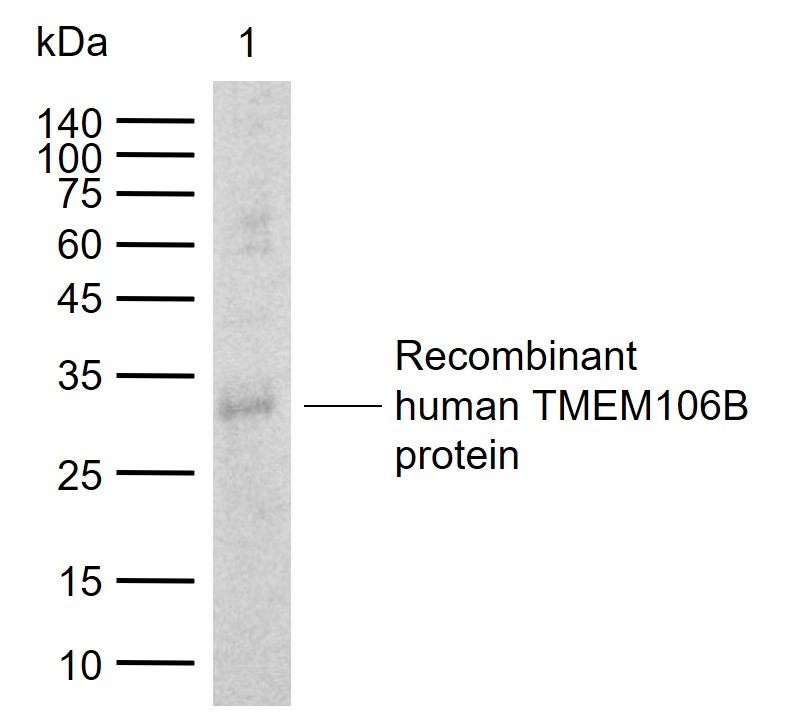
| WB |
|---|---|
| Primary Accession | Q9NUM4 |
| Reactivity | Human |
| Predicted | Rat, Pig, Dog, Mouse, Rabbit, Horse, Sheep |
| Host | Rabbit |
| Clonality | Polyclonal |
| Calculated MW | 31127 Da |
| Physical State | Liquid |
| Immunogen | KLH conjugated synthetic peptide derived from human TMEM106B |
| Epitope Specificity | 101-200/274 |
| Isotype | IgG |
| Purity | affinity purified by Protein A |
| Buffer | 0.01M TBS (pH7.4) with 1% BSA, 0.02% Proclin300 and 50% Glycerol. |
| SUBCELLULAR LOCATION | Late endosome membrane; Single-pass type II membrane protein. Lysosome membrane; Single-pass type II membrane protein. |
| DISEASE | Note=TMEM106B genotype, when containing 3 particular single-nucleotide polymorphisms, is strongly correlated with frontotemporal lobar degeneration with TAR DNA-binding protein (TDP-43) inclusions (FTLD-TDP). Frontotemporal lobar degeneration (FTLD) is the second most common cause of presenile dementia and 20% of patients with this neurodegenerative disease have autosomal dominant GRN mutations. Expression of TMEM106B associated with these polymorphisms is increased in frontal cortex of patients with FTLD-TDP compared to unaffected controls. Thus, increased TMEM106B expression in the brain may be linked to mechanisms of disease in FTLD-TDP and risk alleles confer genetic susceptibility by increasing gene expression. |
| Important Note | This product as supplied is intended for research use only, not for use in human, therapeutic or diagnostic applications. |
| Background Descriptions | TMEM106B is a 274 amino acid single-pass membrane protein that is encoded by a gene which maps to human chromosome 7. Chromosome 7 houses over 1,000 genes and comprises nearly 5% of the human genome. Defects in some of the genes localized to chromosome 7 have been linked to Osteogenesis imperfecta, Pendred syndrome, Lissencephaly, Citrullinemia and Shwachman-Diamond syndrome. The deletion of a portion of the q arm of chromosome 7 is associated with Williams-Beuren syndrome, a condition characterized by mild mental retardation, an unusual comfort and friendliness with strangers and an elfin appearance. Deletions of portions of the q arm of chromosome 7 are also seen in a number of myeloid disorders, including cases of acute myelogenous leukemia and myelodysplasia. |
| Gene ID | 54664 |
|---|---|
| Other Names | Transmembrane protein 106B, TMEM106B (HGNC:22407) |
| Dilution | WB=1:500-2000 |
| Storage | Store at -20 °C for one year. Avoid repeated freeze/thaw cycles. When reconstituted in sterile pH 7.4 0.01M PBS or diluent of antibody the antibody is stable for at least two weeks at 2-4 °C. |
For Research Use Only. Not For Use In Diagnostic Procedures.
| Name | TMEM106B (HGNC:22407) |
|---|---|
| Function | In neurons, involved in the transport of late endosomes/lysosomes (PubMed:25066864). May be involved in dendrite morphogenesis and maintenance by regulating lysosomal trafficking (PubMed:25066864). May act as a molecular brake for retrograde transport of late endosomes/lysosomes, possibly via its interaction with MAP6 (By similarity). In motoneurons, may mediate the axonal transport of lysosomes and axonal sorting at the initial segment (By similarity). It remains unclear whether TMEM106B affects the transport of moving lysosomes in the anterograde or retrograde direction in neurites and whether it is important in the sorting of lysosomes in axons or in dendrites (By similarity). In neurons, may also play a role in the regulation of lysosomal size and responsiveness to stress (PubMed:25066864). Required for proper lysosomal acidification (By similarity). |
| Cellular Location | Late endosome membrane; Single-pass type II membrane protein. Lysosome membrane; Single-pass type II membrane protein. Cell membrane; Single-pass type II membrane protein. Note=Colocalizes with LAMP1. A small fraction resides on the cell surface (PubMed:37421949). |
| Tissue Location | Expressed in the brain, including in the frontal cortex (at protein level) (PubMed:35247328, PubMed:35344985). Expressed in lung epithelial cells (PubMed:33686287) |
Provided below are standard protocols that you may find useful for product applications.
BACKGROUND
This product as supplied is intended for research use only, not for use in human, therapeutic or diagnostic applications.
REFERENCES
Ota T.,et al.Nat. Genet. 36:40-45(2004).
Suzuki Y.,et al.Submitted (APR-2005) to the EMBL/GenBank/DDBJ databases.
Scherer S.W.,et al.Science 300:767-772(2003).
Mural R.J.,et al.Submitted (JUL-2005) to the EMBL/GenBank/DDBJ databases.
Hillier L.W.,et al.Nature 424:157-164(2003).

终于等到您。ABCEPTA(百远生物)抗体产品。
点击下方“我要评价 ”按钮提交您的反馈信息,您的反馈和评价是我们最宝贵的财富之一,
我们将在1-3个工作日内处理您的反馈信息。
如有疑问,联系:0512-88856768 tech-china@abcepta.com.


