


 癌症的基本特征包括细胞增殖、血管生成、迁移、凋亡逃避机制和细胞永生等。找到癌症发生过程中这些通路的关键标记物和对应的抗体用于检测至关重要。
 为您推荐一个泛素化位点预测神器——泛素化分析工具,可以为您的蛋白的泛素化位点作出预测和评分。
 细胞自噬受体图形绘图工具为你的蛋白的细胞受体结合位点作出预测和评分,识别结合到自噬通路中的蛋白是非常重要的,便于让我们理解自噬在正常生理、病理过程中的作用,如发育、细胞分化、神经退化性疾病、压力条件下、感染和癌症。
JMJD6(N-terminus) Antibody
Purified Mouse Monoclonal Antibody (Mab)
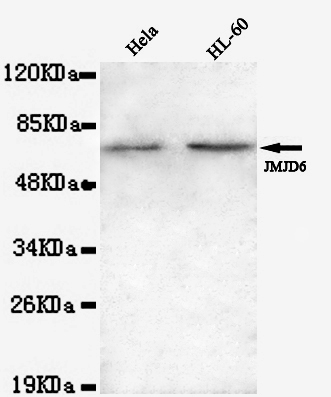
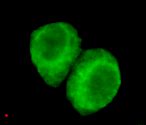
- 产品详情
- 实验流程
- 背景知识
Application 
| WB, ICC |
|---|---|
| Primary Accession | Q6NYC1 |
| Reactivity | Human |
| Host | Mouse |
| Clonality | Monoclonal |
| Isotype | IgG1 |
| Calculated MW | 46462 Da |
| Gene ID | 23210 |
|---|---|
| Other Names | Apoptotic cell clearance receptor;Bifunctional arginine demethylase and lysyl-hydroxylase JMJD6;Histone arginine demethylase JMJD6;JmjC domain-containing protein 6;JMJD 6;JMJD6;JMJD6_HUMAN;Jumonji domain containing 6;Jumonji domain-containing protein 6;KIAA0585;Lysyl-hydroxylase JMJD6;Peptide-lysine 5-dioxygenase JMJD6;Phosphatidylserine receptor;Protein PTDSR;PSR;PTDSR 1;PTDSR;PTDSR1. |
| Dilution | WB~~1:1000 ICC~~1:200 |
| Format | Liquid in PBS containing 50% glycerol, 0.5% BSA and 0.02% sodium azide, pH 7.3. |
| Storage | Store at 4°C short term. Aliquot and store at -20°C long term. Avoid freeze/thaw cycles. |
For Research Use Only. Not For Use In Diagnostic Procedures.
| Name | JMJD6 (HGNC:19355) |
|---|---|
| Function | Dioxygenase that can both act as a arginine demethylase and a lysyl-hydroxylase (PubMed:17947579, PubMed:20684070, PubMed:21060799, PubMed:22189873, PubMed:24498420). Acts as a lysyl-hydroxylase that catalyzes 5-hydroxylation on specific lysine residues of target proteins such as U2AF2/U2AF65 and LUC7L2. Regulates RNA splicing by mediating 5-hydroxylation of U2AF2/U2AF65, affecting the pre-mRNA splicing activity of U2AF2/U2AF65 (PubMed:19574390). Hydroxylates its own N-terminus, which is required for homooligomerization (PubMed:22189873). Plays a role in the regulation of nucleolar liquid- liquid phase separation (LLPS) by post-translationally modifying LIAT1 at its lysine-rich domain which inhibits LIAT1 nucleolar targeting (By similarity). In addition to peptidyl-lysine 5-dioxygenase activity, may act as an RNA hydroxylase, as suggested by its ability to bind single strand RNA (PubMed:20679243, PubMed:29176719). Also acts as an arginine demethylase which preferentially demethylates asymmetric dimethylation (PubMed:17947579, PubMed:24360279, PubMed:24498420). Demethylates histone H3 at 'Arg-2' (H3R2me) and histone H4 at 'Arg-3' (H4R3me), including mono-, symmetric di- and asymmetric dimethylated forms, thereby playing a role in histone code (PubMed:17947579, PubMed:24360279). However, histone arginine demethylation may not constitute the primary activity in vivo (PubMed:17947579, PubMed:21060799, PubMed:22189873). In collaboration with BRD4, interacts with the positive transcription elongation factor b (P-TEFb) complex in its active form to regulate polymerase II promoter-proximal pause release for transcriptional activation of a large cohort of genes. On distal enhancers, so called anti-pause enhancers, demethylates both histone H4R3me2 and the methyl cap of 7SKsnRNA leading to the dismissal of the 7SKsnRNA:HEXIM1 inhibitor complex. After removal of repressive marks, the complex BRD4:JMJD6 attract and retain the P-TEFb complex on chromatin, leading to its activation, promoter-proximal polymerase II pause release, and transcriptional activation (PubMed:24360279). Demethylates other arginine methylated- proteins such as ESR1 (PubMed:24498420). Has no histone lysine demethylase activity (PubMed:21060799). Required for differentiation of multiple organs during embryogenesis. Acts as a key regulator of hematopoietic differentiation: required for angiogenic sprouting by regulating the pre-mRNA splicing activity of U2AF2/U2AF65 (By similarity). Seems to be necessary for the regulation of macrophage cytokine responses (PubMed:15622002). |
| Cellular Location | Nucleus, nucleoplasm. Nucleus, nucleolus. Cytoplasm. Note=Mainly found throughout the nucleoplasm outside of regions containing heterochromatic DNA, with some localization in nucleolus. During mitosis, excluded from the nucleus and reappears in the telophase of the cell cycle. |
| Tissue Location | Highly expressed in the heart, skeletal muscle and kidney. Expressed at moderate or low level in brain, placenta, lung, liver, pancreas, spleen, thymus, prostate, testis and ovary. Up- regulated in many patients with chronic pancreatitis. Expressed in nursing thymic epithelial cells. |
Provided below are standard protocols that you may find useful for product applications.
BACKGROUND
Dioxygenase that can both act as a histone arginine demethylase and a lysyl-hydroxylase. Acts as a lysyl-hydroxylase that catalyzes 5-hydroxylation on specific lysine residues of target proteins such as U2AF2/U2AF65 and LUC7L2. Acts as a regulator of RNA splicing by mediating 5-hydroxylation of U2AF2/U2AF65, affecting the pre-mRNA splicing activity of U2AF2/U2AF65. In addition to peptidyl-lysine 5-dioxygenase activity, may act as an RNA hydroxylase, as suggested by its ability to bind single strand RNA. Also acts as an arginine demethylase which demethylates histone H3 at 'Arg-2' (H3R2me) and histone H4 at 'Arg-3' (H4R3me), thereby playing a role in histone code. However, histone arginine demethylation may not constitute the primary activity in vivo. Has no histone lysine demethylase activity. Required for differentiation of multiple organs during embryogenesis. Acts as a key regulator of hematopoietic differentiation: required for angiogenic sprouting by regulating the pre-mRNA splicing activity of U2AF2/U2AF65. Seems to be necessary for the regulation of macrophage cytokine responses.
REFERENCES
Izawa M.,et al.Submitted (OCT-2001) to the EMBL/GenBank/DDBJ databases.
Nagase T.,et al.DNA Res. 5:31-39(1998).
Ota T.,et al.Nat. Genet. 36:40-45(2004).
Zody M.C.,et al.Nature 440:1045-1049(2006).
Mural R.J.,et al.Submitted (JUL-2005) to the EMBL/GenBank/DDBJ databases.

终于等到您。ABCEPTA(百远生物)抗体产品。
点击下方“我要评价 ”按钮提交您的反馈信息,您的反馈和评价是我们最宝贵的财富之一,
我们将在1-3个工作日内处理您的反馈信息。
如有疑问,联系:0512-88856768 tech-china@abcepta.com.


