


 癌症的基本特征包括细胞增殖、血管生成、迁移、凋亡逃避机制和细胞永生等。找到癌症发生过程中这些通路的关键标记物和对应的抗体用于检测至关重要。
 为您推荐一个泛素化位点预测神器——泛素化分析工具,可以为您的蛋白的泛素化位点作出预测和评分。
 细胞自噬受体图形绘图工具为你的蛋白的细胞受体结合位点作出预测和评分,识别结合到自噬通路中的蛋白是非常重要的,便于让我们理解自噬在正常生理、病理过程中的作用,如发育、细胞分化、神经退化性疾病、压力条件下、感染和癌症。
Anti-ZFP36L2 Antibody
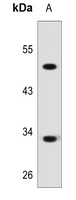
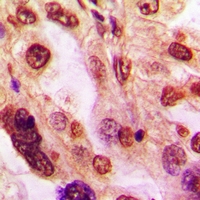
- 产品详情
- 实验流程
Application 
| WB, IHC |
|---|---|
| Primary Accession | P47974 |
| Reactivity | Human, Mouse, Bovine |
| Host | Rabbit |
| Clonality | Polyclonal |
| Calculated MW | 51063 Da |
| Gene ID | 678 |
|---|---|
| Other Names | BRF2; ERF2; RNF162C; TIS11D; Zinc finger protein 36, C3H1 type-like 2; ZFP36-like 2; Butyrate response factor 2; EGF-response factor 2; ERF-2; Protein TIS11D |
| Target/Specificity | KLH-conjugated synthetic peptide encompassing a sequence within the center region of human ZFP36L2. The exact sequence is proprietary. |
| Dilution | WB~~WB (1/500 - 1/1000) IHC~~1:100~500 |
| Format | Liquid in 0.42% Potassium phosphate, 0.87% Sodium chloride, pH 7.3, 30% glycerol, and 0.01% sodium azide. |
| Storage | Store at -20 °C.Stable for 12 months from date of receipt |
For Research Use Only. Not For Use In Diagnostic Procedures.
| Name | ZFP36L2 (HGNC:1108) |
|---|---|
| Function | Zinc-finger RNA-binding protein that destabilizes several cytoplasmic AU-rich element (ARE)-containing mRNA transcripts by promoting their poly(A) tail removal or deadenylation, and hence provide a mechanism for attenuating protein synthesis (PubMed:14981510, PubMed:25106868, PubMed:34611029). Acts as a 3'-untranslated region (UTR) ARE mRNA-binding adapter protein to communicate signaling events to the mRNA decay machinery (PubMed:25106868). Functions by recruiting the CCR4-NOT deadenylase complex and probably other components of the cytoplasmic RNA decay machinery to the bound ARE-containing mRNAs, and hence promotes ARE-mediated mRNA deadenylation and decay processes (PubMed:25106868). Binds to 3'-UTR ARE of numerous mRNAs (PubMed:14981510, PubMed:20506496, PubMed:25106868). Promotes ARE- containing mRNA decay of the low-density lipoprotein (LDL) receptor (LDLR) mRNA in response to phorbol 12-myristate 13-acetate (PMA) treatment in a p38 MAPK-dependent manner (PubMed:25106868). Positively regulates early adipogenesis by promoting ARE-mediated mRNA decay of immediate early genes (IEGs). Plays a role in mature peripheral neuron integrity by promoting ARE-containing mRNA decay of the transcriptional repressor REST mRNA. Plays a role in ovulation and oocyte meiotic maturation by promoting ARE-mediated mRNA decay of the luteinizing hormone receptor LHCGR mRNA. Acts as a negative regulator of erythroid cell differentiation: promotes glucocorticoid-induced self-renewal of erythroid cells by binding mRNAs that are induced or highly expressed during terminal erythroid differentiation and promotes their degradation, preventing erythroid cell differentiation. In association with ZFP36L1 maintains quiescence on developing B lymphocytes by promoting ARE-mediated decay of several mRNAs encoding cell cycle regulators that help B cells progress through the cell cycle, and hence ensuring accurate variable-diversity-joining (VDJ) recombination process and functional immune cell formation. Together with ZFP36L1 is also necessary for thymocyte development and prevention of T-cell acute lymphoblastic leukemia (T-ALL) transformation by promoting ARE-mediated mRNA decay of the oncogenic transcription factor NOTCH1 mRNA. |
| Cellular Location | Nucleus. Cytoplasm. Note=Shuttles between the nucleus and the cytoplasm in a XPO1/CRM1-dependent manner {ECO:0000250|UniProtKB:P23949} |
| Tissue Location | Expressed mainly in the basal epidermal layer, weakly in the suprabasal epidermal layers (PubMed:27182009). Expressed in epidermal keratinocytes (at protein level) (PubMed:27182009) Expressed in oocytes (PubMed:34611029). |
Research Areas
Application Protocols
Provided below are standard protocols that you may find useful for product applications.
REFERENCES
Ino T.,et al.Oncogene 11:2705-2710(1995).
Nie X.F.,et al.Gene 152:285-286(1995).
Hillier L.W.,et al.Nature 434:724-731(2005).
Mural R.J.,et al.Submitted (JUL-2005) to the EMBL/GenBank/DDBJ databases.
Dephoure N.,et al.Proc. Natl. Acad. Sci. U.S.A. 105:10762-10767(2008).

终于等到您。ABCEPTA(百远生物)抗体产品。
点击下方“我要评价 ”按钮提交您的反馈信息,您的反馈和评价是我们最宝贵的财富之一,
我们将在1-3个工作日内处理您的反馈信息。
如有疑问,联系:0512-88856768 tech-china@abcepta.com.
¥ 1,250.00
Cat# AP53380


