


 癌症的基本特征包括细胞增殖、血管生成、迁移、凋亡逃避机制和细胞永生等。找到癌症发生过程中这些通路的关键标记物和对应的抗体用于检测至关重要。
 为您推荐一个泛素化位点预测神器——泛素化分析工具,可以为您的蛋白的泛素化位点作出预测和评分。
 细胞自噬受体图形绘图工具为你的蛋白的细胞受体结合位点作出预测和评分,识别结合到自噬通路中的蛋白是非常重要的,便于让我们理解自噬在正常生理、病理过程中的作用,如发育、细胞分化、神经退化性疾病、压力条件下、感染和癌症。
Anti-PKM2 Antibody
Mouse Anti Human Monoclonal Antibody
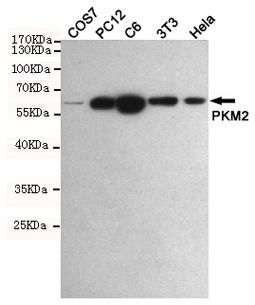
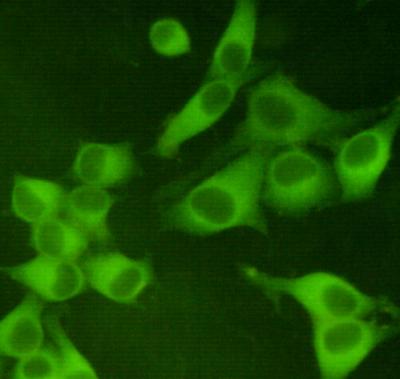
- 产品详情
- 实验流程
- 背景知识
Application 
| WB, IF |
|---|---|
| Primary Accession | P14618 |
| Other Accession | NM_002654 |
| Reactivity | Human, Mouse, Rat, Monkey |
| Host | Mouse |
| Clonality | Monoclonal |
| Isotype | IgG1 |
| Immunogen | Purified recombinant human PKM2 protein fragments expressed in E.coli. |
| Purification | Affinity purified |
| Calculated MW | 57937 Da |
| Gene ID | 5315 |
|---|---|
| Other Names | CTHBP;Cytosolic thyroid hormone binding protein;Cytosolic thyroid hormone-binding protein;KPYM_HUMAN;MGC3932;OIP 3;OIP-3;OIP3;OPA interacting protein 3;Opa-interacting protein 3;p58;PK muscle type;PK, muscle type;PK2;PK3;PKM;PKM2;pykm;Pyruvate kinase 2/3;Pyruvate kinase 3;Pyruvate kinase isozymes M1/M2;Pyruvate kinase muscle;Pyruvate kinase muscle isozyme;pyruvate kinase PKM;Pyruvate kinase, muscle 2;TCB;THBP1;Thyroid hormone binding protein 1;Thyroid hormone binding protein cytosolic;Thyroid hormone-binding protein 1;Tumor M2 PK;Tumor M2-PK. |
| Dilution | WB~~1:1000 IF~~1:50~200 |
| Format | Liquid in PBS containing 50% glycerol, 0.02% sodium azide, pH 7.4. |
| Storage | Store at 4°C short term. Aliquot and store at -20°C long term. Avoid freeze/thaw cycles. |
For Research Use Only. Not For Use In Diagnostic Procedures.
| Name | PKM |
|---|---|
| Synonyms | OIP3 {ECO:0000303|PubMed:9466265}, PK2, |
| Function | Catalyzes the final rate-limiting step of glycolysis by mediating the transfer of a phosphoryl group from phosphoenolpyruvate (PEP) to ADP, generating ATP (PubMed:15996096, PubMed:1854723, PubMed:20847263). The ratio between the highly active tetrameric form and nearly inactive dimeric form determines whether glucose carbons are channeled to biosynthetic processes or used for glycolytic ATP production (PubMed:15996096, PubMed:1854723, PubMed:20847263). The transition between the 2 forms contributes to the control of glycolysis and is important for tumor cell proliferation and survival (PubMed:15996096, PubMed:1854723, PubMed:20847263). |
| Cellular Location | [Isoform M2]: Cytoplasm. Nucleus Note=Translocates to the nucleus in response to various signals, such as EGF receptor activation or apoptotic stimuli (PubMed:17308100, PubMed:22056988, PubMed:24120661). Nuclear translocation is promoted by acetylation by EP300 (PubMed:24120661). Deacetylation by SIRT6 promotes its nuclear export in a process dependent of XPO4, thereby suppressing its ability to activate transcription and promote tumorigenesis (PubMed:26787900). |
| Tissue Location | [Isoform M2]: Specifically expressed in proliferating cells, such as embryonic stem cells, embryonic carcinoma cells, as well as cancer cells. |
Research Areas
Application Protocols
Provided below are standard protocols that you may find useful for product applications.
BACKGROUND
Glycolytic enzyme that catalyzes the transfer of a phosphoryl group from phosphoenolpyruvate (PEP) to ADP, generating ATP. Stimulates POU5F1-mediated transcriptional activation. Plays a general role in caspase independent cell death of tumor cells. The ra

终于等到您。ABCEPTA(百远生物)抗体产品。
点击下方“我要评价 ”按钮提交您的反馈信息,您的反馈和评价是我们最宝贵的财富之一,
我们将在1-3个工作日内处理您的反馈信息。
如有疑问,联系:0512-88856768 tech-china@abcepta.com.
¥ 1,250.00
Cat# AP53402


