


 癌症的基本特征包括细胞增殖、血管生成、迁移、凋亡逃避机制和细胞永生等。找到癌症发生过程中这些通路的关键标记物和对应的抗体用于检测至关重要。
 为您推荐一个泛素化位点预测神器——泛素化分析工具,可以为您的蛋白的泛素化位点作出预测和评分。
 细胞自噬受体图形绘图工具为你的蛋白的细胞受体结合位点作出预测和评分,识别结合到自噬通路中的蛋白是非常重要的,便于让我们理解自噬在正常生理、病理过程中的作用,如发育、细胞分化、神经退化性疾病、压力条件下、感染和癌症。
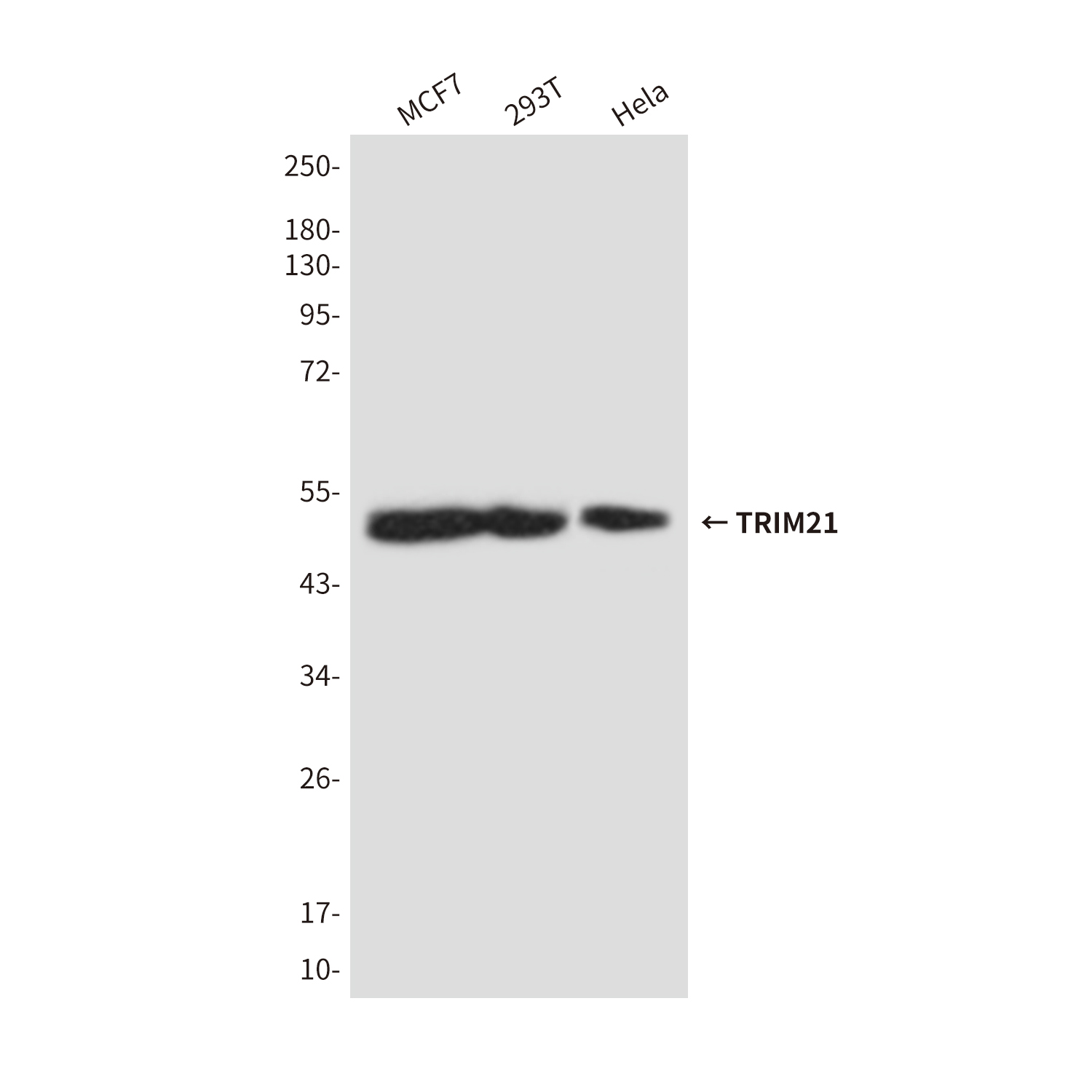
TRIM21 (5B9) Mouse mAb
- 产品详情
- 实验流程
- 背景知识
Application 
| WB |
|---|---|
| Primary Accession | P19474 |
| Reactivity | Human |
| Host | Mouse |
| Clonality | Monoclonal Antibody |
| Isotype | IgG1 |
| Conjugate | Unconjugated |
| Purification | Affinity Purified |
| Calculated MW | 54170 Da |
| Gene ID | 6737 |
|---|---|
| Other Names | TRIM21 |
| Dilution | WB~~1:500-1:1000 |
| Format | Liquid in PBS containing 50% glycerol, 0.5% BSA and 0.02% sodium azide, pH 7.3. |
| Storage | Store at 4°C short term. Aliquot and store at -20°C long term. Avoid freeze/thaw cycles. |
For Research Use Only. Not For Use In Diagnostic Procedures.
| Name | TRIM21 (HGNC:11312) |
|---|---|
| Synonyms | RNF81, RO52, SSA1 |
| Function | E3 ubiquitin-protein ligase whose activity is dependent on E2 enzymes, UBE2D1, UBE2D2, UBE2E1 and UBE2E2 (PubMed:16297862, PubMed:16316627, PubMed:16472766, PubMed:16880511, PubMed:18022694, PubMed:18361920, PubMed:18641315, PubMed:18845142, PubMed:19675099, PubMed:26347139). Forms a ubiquitin ligase complex in cooperation with the E2 UBE2D2 that is used not only for the ubiquitination of USP4 and IKBKB but also for its self-ubiquitination (PubMed:16880511, PubMed:19675099). Component of cullin-RING-based SCF (SKP1-CUL1-F-box protein) E3 ubiquitin-protein ligase complexes such as SCF(SKP2)-like complexes (PubMed:16880511). A TRIM21-containing SCF(SKP2)-like complex is shown to mediate ubiquitination of CDKN1B ('Thr-187' phosphorylated- form), thereby promoting its degradation by the proteasome (PubMed:16880511). Monoubiquitinates IKBKB that will negatively regulates Tax-induced NF-kappa-B signaling (PubMed:19675099). Negatively regulates IFN-beta production post-pathogen recognition by catalyzing polyubiquitin-mediated degradation of IRF3 (PubMed:18641315). Mediates the ubiquitin-mediated proteasomal degradation of IgG1 heavy chain, which is linked to the VCP-mediated ER-associated degradation (ERAD) pathway (PubMed:18022694). Promotes IRF8 ubiquitination, which enhanced the ability of IRF8 to stimulate cytokine genes transcription in macrophages (By similarity). Plays a role in the regulation of the cell cycle progression (PubMed:16880511). Enhances the decapping activity of DCP2 (PubMed:18361920). Exists as a ribonucleoprotein particle present in all mammalian cells studied and composed of a single polypeptide and one of four small RNA molecules (PubMed:1985094, PubMed:8666824). At least two isoforms are present in nucleated and red blood cells, and tissue specific differences in RO/SSA proteins have been identified (PubMed:8666824). The common feature of these proteins is their ability to bind HY RNAs.2 (PubMed:8666824). Involved in the regulation of innate immunity and the inflammatory response in response to IFNG/IFN-gamma (PubMed:26347139). Organizes autophagic machinery by serving as a platform for the assembly of ULK1, Beclin 1/BECN1 and ATG8 family members and recognizes specific autophagy targets, thus coordinating target recognition with assembly of the autophagic apparatus and initiation of autophagy (PubMed:26347139). Also regulates autophagy through FIP200/RB1CC1 ubiquitination and subsequent decreased protein stability (PubMed:36359729). Represses the innate antiviral response by facilitating the formation of the NMI-IFI35 complex through 'Lys-63'- linked ubiquitination of NMI (PubMed:26342464). During viral infection, promotes cell pyroptosis by mediating 'Lys-6'-linked ubiquitination of ISG12a/IFI27, facilitating its translocation into the mitochondria and subsequent CASP3 activation (PubMed:36426955). When up-regulated through the IFN/JAK/STAT signaling pathway, promotes 'Lys-27'-linked ubiquitination of MAVS, leading to the recruitment of TBK1 and up- regulation of innate immunity (PubMed:29743353). Mediates 'Lys-63'- linked polyubiquitination of G3BP1 in response to heat shock, leading to stress granule disassembly (PubMed:36692217). |
| Cellular Location | Cytoplasm. Cytoplasmic vesicle, autophagosome. Nucleus. Cytoplasm, P-body. Cytoplasm, Stress granule. Note=Enters the nucleus upon exposure to nitric oxide (PubMed:18361920). Localizes to small dot- or rod-like structures in the cytoplasm, called processing bodies (P-bodies) that are located underneath the plasma membrane and also diffusely in the cytoplasm (PubMed:18361920). They are located along the microtubules and are highly motile in cells (PubMed:18361920). Colocalizes with DCP2 in P-bodies (PubMed:18361920). Localizes to stress granules in response to oxidative stress (PubMed:36692217). |
| Tissue Location | Isoform 1 and isoform 2 are expressed in fetal and adult heart and fetal lung |
Provided below are standard protocols that you may find useful for product applications.
BACKGROUND
This gene encodes a member of the tripartite motif (TRIM) family. The TRIM motif includes three zinc-binding domains, a RING, a B-box type 1 and a B-box type 2, and a coiled-coil region. The encoded protein is part of the RoSSA ribonucleoprotein, which includes a single polypeptide and one of four small RNA molecules. The RoSSA particle localizes to both the cytoplasm and the nucleus. RoSSA interacts with autoantigens in patients with Sjogren syndrome and systemic lupus erythematosus. Alternatively spliced transcript variants for this gene have been described but the full-length nature of only one has been determined.

终于等到您。ABCEPTA(百远生物)抗体产品。
点击下方“我要评价 ”按钮提交您的反馈信息,您的反馈和评价是我们最宝贵的财富之一,
我们将在1-3个工作日内处理您的反馈信息。
如有疑问,联系:0512-88856768 tech-china@abcepta.com.


