


 癌症的基本特征包括细胞增殖、血管生成、迁移、凋亡逃避机制和细胞永生等。找到癌症发生过程中这些通路的关键标记物和对应的抗体用于检测至关重要。
 为您推荐一个泛素化位点预测神器——泛素化分析工具,可以为您的蛋白的泛素化位点作出预测和评分。
 细胞自噬受体图形绘图工具为你的蛋白的细胞受体结合位点作出预测和评分,识别结合到自噬通路中的蛋白是非常重要的,便于让我们理解自噬在正常生理、病理过程中的作用,如发育、细胞分化、神经退化性疾病、压力条件下、感染和癌症。
GDAP1 Rabbit pAb
GDAP1 Rabbit pAb
- 产品详情
- 实验流程
- 背景知识
Application 
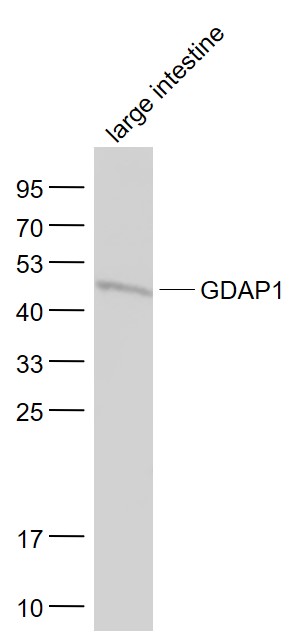
| WB |
|---|---|
| Primary Accession | Q8TB36 |
| Reactivity | Mouse |
| Predicted | Rat, Pig, Dog, Orangutan, Human, Rabbit, Chicken, Horse, Sheep |
| Host | Rabbit |
| Clonality | Polyclonal |
| Calculated MW | 41346 Da |
| Physical State | Liquid |
| Immunogen | KLH conjugated synthetic peptide derived from human GDAP1 |
| Epitope Specificity | 151-230/358 |
| Isotype | IgG |
| Purity | affinity purified by Protein A |
| Buffer | 0.01M TBS (pH7.4) with 1% BSA, 0.02% Proclin300 and 50% Glycerol. |
| SUBCELLULAR LOCATION | Mitochondrion outer membrane; Multi-pass membrane protein. Cytoplasm (By similarity). |
| DISEASE | Defects in GDAP1 are the cause of Charcot-Marie-Tooth disease type 4A (CMT4A) [MIM:214400]. CMT4A is a form of Charcot-Marie-Tooth disease, the most common inherited disorder of the peripheral nervous system. Charcot-Marie-Tooth disease is classified in two main groups on the basis of electrophysiologic properties and histopathology: primary peripheral demyelinating neuropathy or CMT1, and primary peripheral axonal neuropathy or CMT2. Demyelinating CMT neuropathies are characterized by severely reduced nerve conduction velocities (less than 38 m/sec), segmental demyelination and remyelination with onion bulb formations on nerve biopsy, slowly progressive distal muscle atrophy and weakness, absent deep tendon reflexes, and hollow feet. Autosomal recessive forms of demyelinating Charcot-Marie-Tooth disease are by convention designated CMT4. CMT4A is a severe form characterized by early age of onset and rapid progression leading to inability to walk in late childhood or adolescence. Defects in GDAP1 are the cause of Charcot-Marie-Tooth disease axonal recessive with vocal cord paresis (CMT2RV) [MIM:607706]. CMT2RV is a form of Charcot-Marie-Tooth disease characterized by the association of axonal neuropathy with vocal cord paresis. Defects in GDAP1 are the cause of Charcot-Marie-Tooth disease type 2K (CMT2K) [MIM:607831]. CMT2K is an axonal form of Charcot-Marie-Tooth disease. Axonal CMT neuropathies are characterized by signs of axonal regeneration in the absence of obvious myelin alterations, normal or slightly reduced nerve conduction velocities, and progressive distal muscle weakness and atrophy. CMT2K onset is in early childhood (younger than 3 years). This phenotype is characterized by foot deformities, kyphoscoliosis, distal limb muscle weakness and atrophy, areflexia, and diminished sensation in the lower limbs. Weakness in the upper limbs is observed in the first decade, with clawing of the fingers. Inheritance can be autosomal dominant or recessive. Defects in GDAP1 are the cause of Charcot-Marie-Tooth disease recessive intermediate type A (CMTRIA) [MIM:608340]. CMTRIA is a form of Charcot-Marie-Tooth disease characterized by clinical and pathologic features intermediate between demyelinating and axonal peripheral neuropathies, and motor median nerve conduction velocities ranging from 25 to 45 m/sec. |
| Important Note | This product as supplied is intended for research use only, not for use in human, therapeutic or diagnostic applications. |
| Background Descriptions | Glutathione S-transferases (GSTs) function to conjugate reduced glutathione to many exogenous and endogenous hydrophobic electrophiles. Although it shares the carboxy and amino-terminal glutathione S-transferase domains, GDAP1 is characterized as a GST-like protein because it contains an extended GST domain II and a predicted transmembrane domain, two characteristics which are unusual for GST family members. GDAP1 may function in a signal transduction pathway that is responsible for ganglioside-induced neurite differentiation and also may play a role in protecting myelin membranes from free-radical damage. Mutations in the gene encoding GDAP1 is the cause of many forms of Charcot-Marie-Tooth disease, a common inherited disorder of the peripheral nervous system that is characterized by reduced nerve conduction velocities, slow progressive distal muscle atrophy and absent deep tendon reflexes. |
| Gene ID | 54332 |
|---|---|
| Other Names | Ganglioside-induced differentiation-associated protein 1, GDAP1, GDAP1 |
| Dilution | WB=1:500-2000 |
| Storage | Store at -20 °C for one year. Avoid repeated freeze/thaw cycles. When reconstituted in sterile pH 7.4 0.01M PBS or diluent of antibody the antibody is stable for at least two weeks at 2-4 °C. |
For Research Use Only. Not For Use In Diagnostic Procedures.
| Name | GDAP1 |
|---|---|
| Function | Regulates the mitochondrial network by promoting mitochondrial fission. |
| Cellular Location | Mitochondrion outer membrane; Multi-pass membrane protein. Cytoplasm {ECO:0000250|UniProtKB:O88741} |
| Tissue Location | Highly expressed in whole brain and spinal cord. Predominant expression in central tissues of the nervous system not only in neurons but also in Schwann cells |
Research Areas
Application Protocols
Provided below are standard protocols that you may find useful for product applications.
BACKGROUND
This product as supplied is intended for research use only, not for use in human, therapeutic or diagnostic applications.

终于等到您。ABCEPTA(百远生物)抗体产品。
点击下方“我要评价 ”按钮提交您的反馈信息,您的反馈和评价是我们最宝贵的财富之一,
我们将在1-3个工作日内处理您的反馈信息。
如有疑问,联系:0512-88856768 tech-china@abcepta.com.
¥ 1,250.00
Cat# AP54610


