


 癌症的基本特征包括细胞增殖、血管生成、迁移、凋亡逃避机制和细胞永生等。找到癌症发生过程中这些通路的关键标记物和对应的抗体用于检测至关重要。
 为您推荐一个泛素化位点预测神器——泛素化分析工具,可以为您的蛋白的泛素化位点作出预测和评分。
 细胞自噬受体图形绘图工具为你的蛋白的细胞受体结合位点作出预测和评分,识别结合到自噬通路中的蛋白是非常重要的,便于让我们理解自噬在正常生理、病理过程中的作用,如发育、细胞分化、神经退化性疾病、压力条件下、感染和癌症。
EXOSC10 Rabbit pAb
EXOSC10 Rabbit pAb
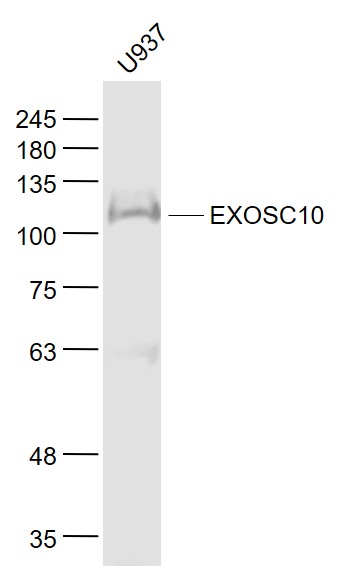
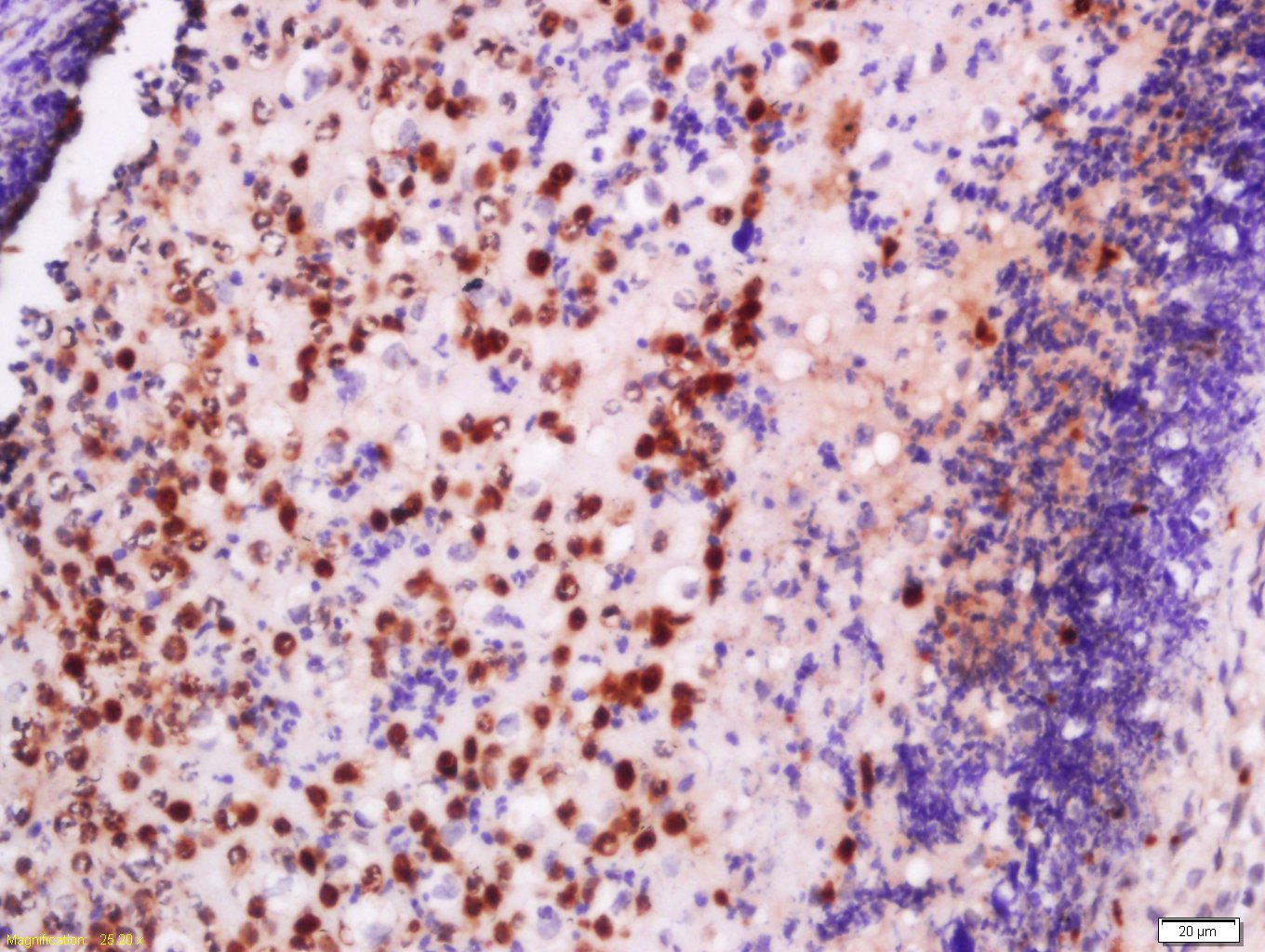
- 产品详情
- 实验流程
- 背景知识
Application 
| WB, IHC-P, IHC-F, IF |
|---|---|
| Primary Accession | Q01780 |
| Reactivity | Human, Mouse |
| Predicted | Rat, Pig, Dog, Horse, Sheep |
| Host | Rabbit |
| Clonality | Polyclonal |
| Calculated MW | 100831 Da |
| Physical State | Liquid |
| Immunogen | KLH conjugated synthetic peptide derived from human EXOSC10/PMSCL2 |
| Epitope Specificity | 41-140/885 |
| Isotype | IgG |
| Purity | affinity purified by Protein A |
| Buffer | 0.01M TBS (pH7.4) with 1% BSA, 0.02% Proclin300 and 50% Glycerol. |
| SUBCELLULAR LOCATION | Cytoplasm. Nucleus > nucleolus. Nucleus. Strongly enriched in the nucleolus and a small amount has been found in cytoplasm supporting the existence of a nucleolar RNA exosome complex form. |
| Important Note | This product as supplied is intended for research use only, not for use in human, therapeutic or diagnostic applications. |
| Background Descriptions | The exosome is a multi-subunit complex composed of several highly conserved proteins, some of which are 3’ to 5’ exoribonucleases. The complex is involved in a variety of cellular processes and is responsible for degrading unstable mRNAs that contain AU-rich (ARE) elements in their untranslated 3’ region. EXOSC10, also known as PMSCL, PMSCL2, p2, p3, p4, RRP6, Rrp6p, PM-Scl, or PM/Scl-100, is an 885 amino acid protein that contains one HRDC domain and one 3’-5’ enonuclease domain. Localized to both the cytoplasm and the nucleus, EXOSC10 is part of the post-splicing exosome complex and is involved in mRNA surveillance, mRNA nuclear export and nonsense-mediated decay of mRNAs containing premature stop codons. Antibodies against EXOSC10 have been found in patients with scleroderma and/or polymyositis (chronic diseases of the skin and muscle, respectively), suggesting that EXOSC10 may be involved in the pathogenesis of these diseases. Two isoforms of EXOSC10 exist due to alternative splicing events. |
| Gene ID | 5394 |
|---|---|
| Other Names | Exosome complex component 10, 3.1.13.-, Autoantigen PM/Scl 2, P100 polymyositis-scleroderma overlap syndrome-associated autoantigen, Polymyositis/scleroderma autoantigen 100 kDa, PM/Scl-100, Polymyositis/scleroderma autoantigen 2, EXOSC10 (HGNC:9138) |
| Dilution | WB=1:500-2000,IHC-P=1:100-500,IHC-F=1:100-500,IF=1:100-500 |
| Storage | Store at -20 °C for one year. Avoid repeated freeze/thaw cycles. When reconstituted in sterile pH 7.4 0.01M PBS or diluent of antibody the antibody is stable for at least two weeks at 2-4 °C. |
For Research Use Only. Not For Use In Diagnostic Procedures.
| Name | EXOSC10 (HGNC:9138) |
|---|---|
| Function | Catalytic component of the RNA exosome complex which has 3'->5' exoribonuclease activity and participates in a multitude of cellular RNA processing and degradation events. In the nucleus, the RNA exosome complex is involved in proper maturation of stable RNA species such as rRNA, snRNA and snoRNA, in the elimination of RNA processing by-products and non-coding 'pervasive' transcripts, such as antisense RNA species and promoter-upstream transcripts (PROMPTs), and of mRNAs with processing defects, thereby limiting or excluding their export to the cytoplasm. Part of the small subunit (SSU) processome, first precursor of the small eukaryotic ribosomal subunit. During the assembly of the SSU processome in the nucleolus, many ribosome biogenesis factors, an RNA chaperone and ribosomal proteins associate with the nascent pre-rRNA and work in concert to generate RNA folding, modifications, rearrangements and cleavage as well as targeted degradation of pre-ribosomal RNA by the RNA exosome (PubMed:34516797). The RNA exosome may be involved in Ig class switch recombination (CSR) and/or Ig variable region somatic hypermutation (SHM) by targeting AICDA deamination activity to transcribed dsDNA substrates. In the cytoplasm, the RNA exosome complex is involved in general mRNA turnover and specifically degrades inherently unstable mRNAs containing AU-rich elements (AREs) within their 3' untranslated regions, and in RNA surveillance pathways, preventing translation of aberrant mRNAs. It seems to be involved in degradation of histone mRNA. EXOSC10 is required for nucleolar localization of C1D and probably mediates the association of MTREX, C1D and MPHOSPH6 with the RNA exosome involved in the maturation of 5.8S rRNA. Plays a role in the recruitment of replication protein A complex (RPA) and RAD51 to DNA double-strand breaks caused by irradiation, contributing to DNA repair by homologous recombination (PubMed:25632158, PubMed:31086179). Regulates levels of damage-induced RNAs in order to prevent DNA-RNA hybrid formation at DNA double-strand breaks and limit DNA end resection after damage (PubMed:31086179). Plays a role in oocyte development, maturation and survival (By similarity). Required for normal testis development and mitotic division of spermatogonia (By similarity). Plays a role in proper embryo development (By similarity). Required for global protein translation (PubMed:26857222, PubMed:36912080). Required for cell proliferation (PubMed:36912080). Regulates metabolism of C9orf72- derived repeat RNA that can be translated into toxic dipeptide repeat proteins (PubMed:32830871). |
| Cellular Location | Cytoplasm. Nucleus. Nucleus, nucleolus. Nucleus, nucleoplasm Note=Strongly enriched in the nucleolus and a small amount has been found in cytoplasm supporting the existence of a nucleolar RNA exosome complex form (PubMed:20531386, PubMed:34516797). Arginine-rich dipeptide repeat proteins expressed from C9orf72-derived repeat RNA cause diffuse nuclear misdistribution of EXOSC10 (PubMed:32830871) Relocates to the DNA double-strand breaks in response to irradiation (PubMed:31086179). |
Research Areas
Application Protocols
Provided below are standard protocols that you may find useful for product applications.
BACKGROUND
This product as supplied is intended for research use only, not for use in human, therapeutic or diagnostic applications.

终于等到您。ABCEPTA(百远生物)抗体产品。
点击下方“我要评价 ”按钮提交您的反馈信息,您的反馈和评价是我们最宝贵的财富之一,
我们将在1-3个工作日内处理您的反馈信息。
如有疑问,联系:0512-88856768 tech-china@abcepta.com.


