


 癌症的基本特征包括细胞增殖、血管生成、迁移、凋亡逃避机制和细胞永生等。找到癌症发生过程中这些通路的关键标记物和对应的抗体用于检测至关重要。
 为您推荐一个泛素化位点预测神器——泛素化分析工具,可以为您的蛋白的泛素化位点作出预测和评分。
 细胞自噬受体图形绘图工具为你的蛋白的细胞受体结合位点作出预测和评分,识别结合到自噬通路中的蛋白是非常重要的,便于让我们理解自噬在正常生理、病理过程中的作用,如发育、细胞分化、神经退化性疾病、压力条件下、感染和癌症。
GEM Rabbit pAb
GEM Rabbit pAb
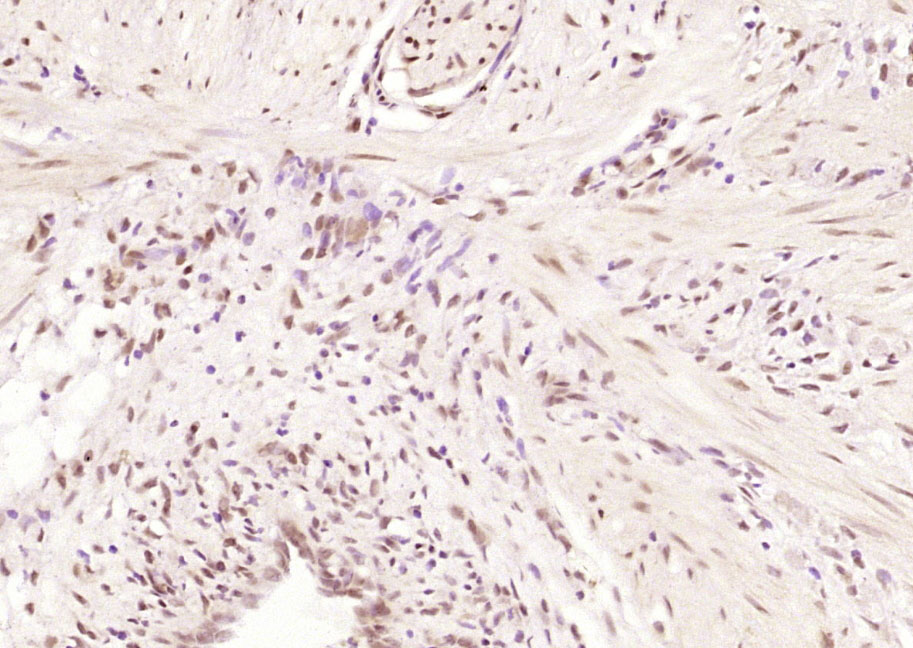
- 产品详情
- 实验流程
- 背景知识
Application 
| IHC-P, IHC-F, IF |
|---|---|
| Primary Accession | P55040 |
| Reactivity | Human |
| Predicted | Rat, Pig, Dog, Mouse, Horse |
| Host | Rabbit |
| Clonality | Polyclonal |
| Calculated MW | 33949 Da |
| Physical State | Liquid |
| Immunogen | KLH conjugated synthetic peptide derived from human GEM |
| Epitope Specificity | 201-296/296 |
| Isotype | IgG |
| Purity | affinity purified by Protein A |
| Buffer | 0.01M TBS (pH7.4) with 1% BSA, 0.02% Proclin300 and 50% Glycerol. |
| SUBCELLULAR LOCATION | Cell membrane; Peripheral membrane protein; Cytoplasmic side. |
| Important Note | This product as supplied is intended for research use only, not for use in human, therapeutic or diagnostic applications. |
| Background Descriptions | Gem belongs to the Rad/Gem/Kir (RGK) subfamily of Ras-related GTPases, which lack typical C-terminal amino acid motifs for isoprenylation. Rad and Gem bind calmodulin in a Ca2+-dependent manner via this C-terminal extension, involving residues 278–297 in human Rad. High intracellular Gem levels, which interact with intact microtubules and microfilaments, promote profound changes in cell morphology. Ectopic Gem expression is sufficient to stimulate cell flattening and neurite extension in N1E-115 and SH-SY5Y neuroblastoma cells, suggesting a role for Gem in cytoskeletal rearrangement and/or morphological differentiation of neurons. Gem was also observed in developing trigeminal nerve ganglia in 12.5 day mouse embryos, demonstrating that Gem expression is a property of normal ganglionic development. The interaction of Gem with beta-subunits regulates Ca2+ channel expression at the cell surface. The human Gem gene maps to chromosome 8q22.1. |
| Gene ID | 2669 |
|---|---|
| Other Names | GTP-binding protein GEM, GTP-binding mitogen-induced T-cell protein, RAS-like protein KIR, GEM, KIR |
| Dilution | IHC-P=1:100-500,IHC-F=1:100-500,IF=1:100-500 |
| Storage | Store at -20 °C for one year. Avoid repeated freeze/thaw cycles. When reconstituted in sterile pH 7.4 0.01M PBS or diluent of antibody the antibody is stable for at least two weeks at 2-4 °C. |
For Research Use Only. Not For Use In Diagnostic Procedures.
| Name | GEM |
|---|---|
| Synonyms | KIR |
| Function | Could be a regulatory protein, possibly participating in receptor-mediated signal transduction at the plasma membrane. Has guanine nucleotide-binding activity but undetectable intrinsic GTPase activity. |
| Cellular Location | Cell membrane; Peripheral membrane protein; Cytoplasmic side |
| Tissue Location | Most abundant in thymus, spleen, kidney, lung, and testis. Less abundant in heart, brain, liver and skeletal muscle |
Research Areas
Application Protocols
Provided below are standard protocols that you may find useful for product applications.
BACKGROUND
This product as supplied is intended for research use only, not for use in human, therapeutic or diagnostic applications.

终于等到您。ABCEPTA(百远生物)抗体产品。
点击下方“我要评价 ”按钮提交您的反馈信息,您的反馈和评价是我们最宝贵的财富之一,
我们将在1-3个工作日内处理您的反馈信息。
如有疑问,联系:0512-88856768 tech-china@abcepta.com.


