


 癌症的基本特征包括细胞增殖、血管生成、迁移、凋亡逃避机制和细胞永生等。找到癌症发生过程中这些通路的关键标记物和对应的抗体用于检测至关重要。
 为您推荐一个泛素化位点预测神器——泛素化分析工具,可以为您的蛋白的泛素化位点作出预测和评分。
 细胞自噬受体图形绘图工具为你的蛋白的细胞受体结合位点作出预测和评分,识别结合到自噬通路中的蛋白是非常重要的,便于让我们理解自噬在正常生理、病理过程中的作用,如发育、细胞分化、神经退化性疾病、压力条件下、感染和癌症。
DIP13B Rabbit pAb
DIP13B Rabbit pAb
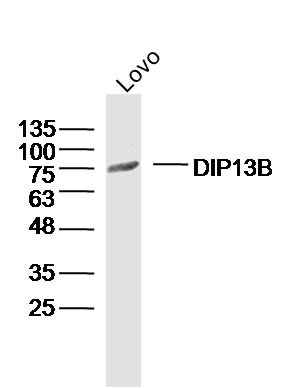

- 产品详情
- 实验流程
- 背景知识
Application 
| WB, IHC-P, IHC-F, IF |
|---|---|
| Primary Accession | Q8NEU8 |
| Reactivity | Rat, Human |
| Predicted | Dog, Mouse, Chicken, Sheep |
| Host | Rabbit |
| Clonality | Polyclonal |
| Calculated MW | 74493 Da |
| Physical State | Liquid |
| Immunogen | KLH conjugated synthetic peptide derived from human DIP13B/APPL2 |
| Epitope Specificity | 101-200/664 |
| Isotype | IgG |
| Purity | affinity purified by Protein A |
| Buffer | 0.01M TBS (pH7.4) with 1% BSA, 0.02% Proclin300 and 50% Glycerol. |
| SUBCELLULAR LOCATION | Early endosome membrane. Nucleus. Early endosomal membrane-bound and nuclear. Translocated into the nucleus upon release from endosomal membranes following internalization of EGF. |
| DISEASE | Note=A chromosomal aberration involving APPL2/DIP13B is found in patients with chromosome 22q13.3 deletion syndrome. Translocation t(12;22)(q24.1;q13.3) with SHANK3/PSAP2. |
| Important Note | This product as supplied is intended for research use only, not for use in human, therapeutic or diagnostic applications. |
| Background Descriptions | The APPL family of proteins are involved in linking, trafficking and signaling downstream of tyrosine kinase receptors. APPL1, also designated adaptor protein containing pH domain, PTB domain and leucine zipper motif 1; APPL; or DCC interacting protein 13å (DIP13å), and APPL2, also designated adaptor protein containing pH domain, PTB domain and leucine zipper motif 2 or DCC interacting protein 13∫ (DIP13∫), are involved in the coupling of epidermal growth factor (EGF) signaling and chromatin remodeling in the nucleus. They associate with GTPase Rab 5 and are released from the plasma membrane and translocated to the nucleus. In the nucleus, APPL1 and APPL2 associate with NuRD/MeCP1 and are essential for cell growth and proliferation. APPL2 also associates with follicle stimulating hormone receptor (FSHR). APPL2 is highly expressed in heart, brain, skeletal muscle, and kidney. APPL2 shares 54% homology with APPL1 |
| Gene ID | 55198 |
|---|---|
| Other Names | DCC-interacting protein 13-beta, Dip13-beta {ECO:0000303|Ref.1}, Adapter protein containing PH domain, PTB domain and leucine zipper motif 2, APPL2 (HGNC:18242), DIP13B |
| Dilution | WB=1:500-2000,IHC-P=1:100-500,IHC-F=1:100-500,IF=1:100-500 |
| Storage | Store at -20 °C for one year. Avoid repeated freeze/thaw cycles. When reconstituted in sterile pH 7.4 0.01M PBS or diluent of antibody the antibody is stable for at least two weeks at 2-4 °C. |
For Research Use Only. Not For Use In Diagnostic Procedures.
| Name | APPL2 (HGNC:18242) |
|---|---|
| Synonyms | DIP13B |
| Function | Multifunctional adapter protein that binds to various membrane receptors, nuclear factors and signaling proteins to regulate many processes, such as cell proliferation, immune response, endosomal trafficking and cell metabolism (PubMed:15016378, PubMed:24879834, PubMed:26583432). Regulates signaling pathway leading to cell proliferation through interaction with RAB5A and subunits of the NuRD/MeCP1 complex (PubMed:15016378). Plays a role in immune response by modulating phagocytosis, inflammatory and innate immune responses. In macrophages, enhances Fc-gamma receptor-mediated phagocytosis through interaction with RAB31 leading to activation of PI3K/Akt signaling. In response to LPS, modulates inflammatory responses by playing a key role on the regulation of TLR4 signaling and in the nuclear translocation of RELA/NF-kappa-B p65 and the secretion of pro- and anti-inflammatory cytokines. Also functions as a negative regulator of innate immune response via inhibition of AKT1 signaling pathway by forming a complex with APPL1 and PIK3R1 (By similarity). Plays a role in endosomal trafficking of TGFBR1 from the endosomes to the nucleus (PubMed:26583432). Plays a role in cell metabolism by regulating adiponecting and insulin signaling pathways and adaptative thermogenesis (By similarity) (PubMed:24879834). In muscle, negatively regulates adiponectin-simulated glucose uptake and fatty acid oxidation by inhibiting adiponectin signaling pathway through APPL1 sequestration thereby antagonizing APPL1 action (By similarity). In muscles, negatively regulates insulin-induced plasma membrane recruitment of GLUT4 and glucose uptake through interaction with TBC1D1 (PubMed:24879834). Plays a role in cold and diet-induced adaptive thermogenesis by activating ventromedial hypothalamus (VMH) neurons throught AMPK inhibition which enhances sympathetic outflow to subcutaneous white adipose tissue (sWAT), sWAT beiging and cold tolerance (By similarity). Also plays a role in other signaling pathways namely Wnt/beta-catenin, HGF and glucocorticoid receptor signaling (By similarity) (PubMed:19433865). Positive regulator of beta-catenin/TCF-dependent transcription through direct interaction with RUVBL2/reptin resulting in the relief of RUVBL2-mediated repression of beta-catenin/TCF target genes by modulating the interactions within the beta-catenin-reptin-HDAC complex (PubMed:19433865). May affect adult neurogenesis in hippocampus and olfactory system via regulating the sensitivity of glucocorticoid receptor. Required for fibroblast migration through HGF cell signaling (By similarity). |
| Cellular Location | Early endosome membrane; Peripheral membrane protein. Nucleus. Cell membrane. Endosome membrane. Cytoplasm {ECO:0000250|UniProtKB:Q8K3G9}. Cytoplasmic vesicle, phagosome {ECO:0000250|UniProtKB:Q8K3G9}. Cell projection, ruffle {ECO:0000250|UniProtKB:Q8K3G9}. Cell projection, ruffle membrane {ECO:0000250|UniProtKB:Q8K3G9}. Cell membrane {ECO:0000250|UniProtKB:Q8K3G9}. Cytoplasmic vesicle, phagosome membrane {ECO:0000250|UniProtKB:Q8K3G9}. Note=Early endosomal membrane-bound and nuclear (PubMed:15016378). Translocated into the nucleus upon release from endosomal membranes following internalization of EGF (PubMed:15016378). Associates dynamically with cytoplasmic membrane structures that undergo changes in shape, movement, fusion and fission events (PubMed:18034774). PI(4,5)P2 levels are important for membrane association of APPL2 (PubMed:18034774). Absent of endosome in macrophage. Colocalized with RAB31 at early-stage phagosome (By similarity). Localized on macropinosomes in LPS-activated macrophages Associated with membrane domains in contact with pathogens and pathogen-derived ligands like LPS. First recruited to the ruffles, and accumulates on macropinosomes (By similarity) {ECO:0000250|UniProtKB:Q8K3G9, ECO:0000269|PubMed:15016378, ECO:0000269|PubMed:18034774} |
| Tissue Location | High levels in brain, heart, kidney and skeletal muscle. |
Research Areas
Application Protocols
Provided below are standard protocols that you may find useful for product applications.
BACKGROUND
This product as supplied is intended for research use only, not for use in human, therapeutic or diagnostic applications.

终于等到您。ABCEPTA(百远生物)抗体产品。
点击下方“我要评价 ”按钮提交您的反馈信息,您的反馈和评价是我们最宝贵的财富之一,
我们将在1-3个工作日内处理您的反馈信息。
如有疑问,联系:0512-88856768 tech-china@abcepta.com.


