


 癌症的基本特征包括细胞增殖、血管生成、迁移、凋亡逃避机制和细胞永生等。找到癌症发生过程中这些通路的关键标记物和对应的抗体用于检测至关重要。
 为您推荐一个泛素化位点预测神器——泛素化分析工具,可以为您的蛋白的泛素化位点作出预测和评分。
 细胞自噬受体图形绘图工具为你的蛋白的细胞受体结合位点作出预测和评分,识别结合到自噬通路中的蛋白是非常重要的,便于让我们理解自噬在正常生理、病理过程中的作用,如发育、细胞分化、神经退化性疾病、压力条件下、感染和癌症。
CSB Rabbit pAb
CSB Rabbit pAb
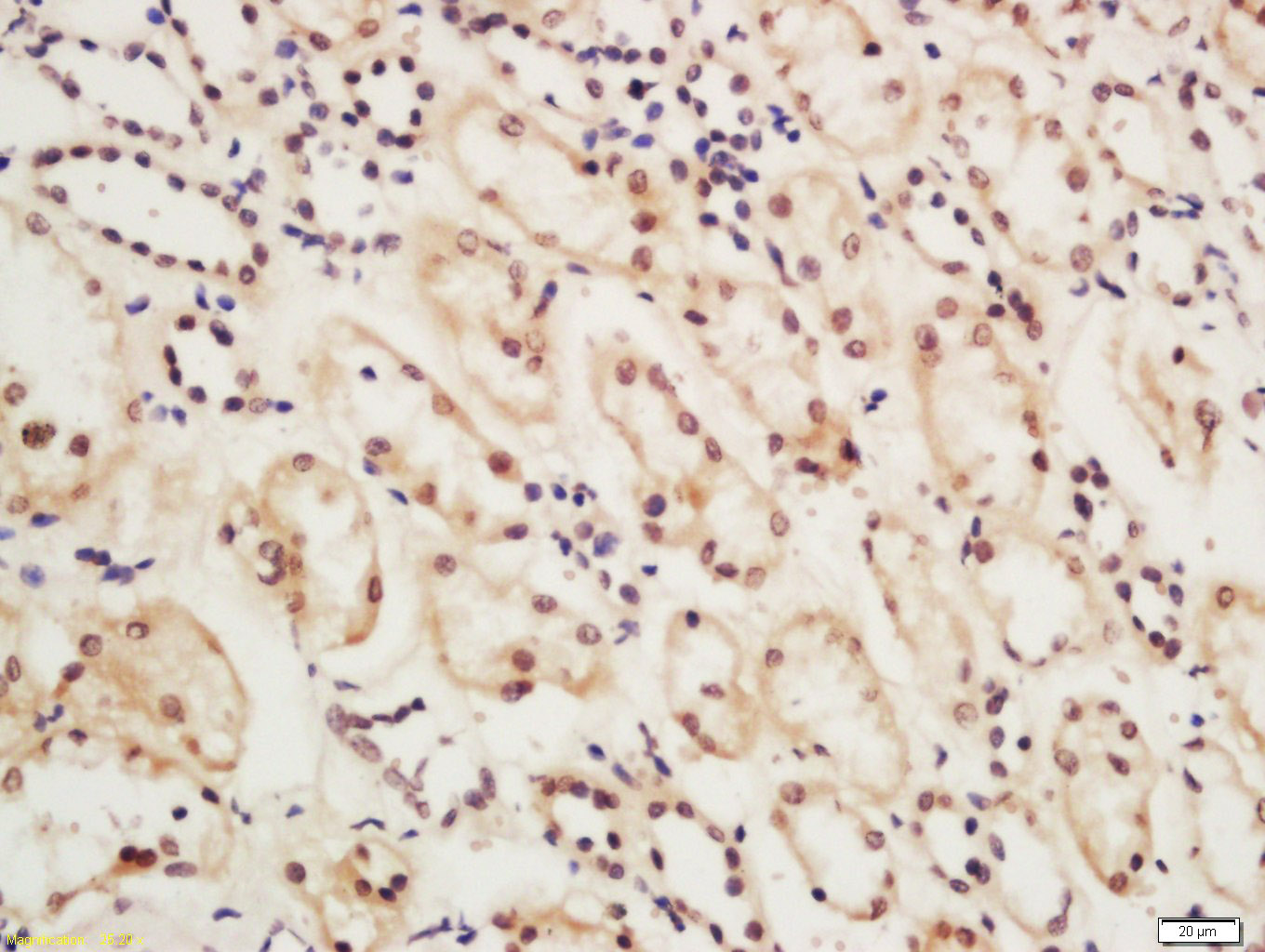
- 产品详情
- 实验流程
- 背景知识
Application 
| IHC-P, IHC-F, IF |
|---|---|
| Primary Accession | Q03468 |
| Reactivity | Rat |
| Predicted | Human, Mouse |
| Host | Rabbit |
| Clonality | Polyclonal |
| Calculated MW | 168416 Da |
| Physical State | Liquid |
| Immunogen | KLH conjugated synthetic peptide derived from human CSB |
| Epitope Specificity | 201-300/1493 |
| Isotype | IgG |
| Purity | affinity purified by Protein A |
| Buffer | 0.01M TBS (pH7.4) with 1% BSA, 0.02% Proclin300 and 50% Glycerol. |
| SUBCELLULAR LOCATION | Nucleus. |
| DISEASE | Defects in ERCC6 are the cause of Cockayne syndrome type B (CSB) [MIM:133540]. Cockayne syndrome is a rare disorder characterized by cutaneous sensitivity to sunlight, abnormal and slow growth, cachectic dwarfism, progeroid appearance, progressive pigmentary retinopathy and sensorineural deafness. There is delayed neural development and severe progressive neurologic degeneration resulting in mental retardation. Two clinical forms are recognized: in the classical form or Cockayne syndrome type 1, the symptoms are progressive and typically become apparent within the first few years or life; the less common Cockayne syndrome type 2 is characterized by more severe symptoms that manifest prenatally. Cockayne syndrome shows some overlap with certain forms of xeroderma pigmentosum. Unlike xeroderma pigmentosum, patients with Cockayne syndrome do not manifest increased freckling and other pigmentation abnormalities in the skin and have no significant increase in skin cancer. Defects in ERCC6 are the cause of cerebro-oculo-facio-skeletal syndrome type 1 (COFS1) [MIM:214150]; also known as COFS syndrome or Pena-Shokeir syndrome type 2. COFS is a degenerative autosomal recessive disorder of prenatal onset affecting the brain, eye and spinal cord. After birth, it leads to brain atrophy, hypoplasia of the corpus callosum, hypotonia, cataracts, microcornea, optic atrophy, progressive joint contractures and growth failure. Facial dysmorphism is a constant feature. Abnormalities of the skull, eyes, limbs, heart and kidney also occur. Defects in ERCC6 are a cause of De Sanctis-Cacchione syndrome (DSC) [MIM:278800]; also known as xerodermic idiocy. DSC is an autosomal recessive syndrome consisting of xeroderma pigmentosum associated with mental retardation, retarded growth, gonadal hypoplasia and sometimes neurologic complications. Note=A genetic variation in the 5-prime flanking region of ERCC6 has been shown to be associated with susceptibility to age-related macular degeneration. Defects in ERCC6 are a cause of UV-sensitive syndrome (UVS) [MIM:600630]. UVS is a rare autosomal recessive disorder characterized by photosensitivity and mild freckling but without neurological abnormalities or skin tumors. |
| Important Note | This product as supplied is intended for research use only, not for use in human, therapeutic or diagnostic applications. |
| Background Descriptions | This gene encodes a DNA-binding protein that is important in transcription-coupled excision repair. The encoded protein has ATP-stimulated ATPase activity, interacts with several transcription and excision repair proteins, and may promote complex formation at DNA repair sites. Mutations in this gene are associated with Cockayne syndrome type B and cerebrooculofacioskeletal syndrome 1. Naturally-occurring readthrough transcription occurs between this gene and the adjacent PGBD3 gene (GeneID:267004), and results in a fusion protein that shares sequence with the product of each individual gene. The readthrough locus is represented by GeneID:101243544. [provided by RefSeq, Mar 2013] |
| Gene ID | 2074 |
|---|---|
| Other Names | DNA excision repair protein ERCC-6, 3.6.4.-, ATP-dependent helicase ERCC6, Cockayne syndrome protein CSB, ERCC6 {ECO:0000303|PubMed:1339317, ECO:0000312|HGNC:HGNC:3438} |
| Dilution | IHC-P=1:100-500,IHC-F=1:100-500,IF=1:100-500 |
| Storage | Store at -20 °C for one year. Avoid repeated freeze/thaw cycles. When reconstituted in sterile pH 7.4 0.01M PBS or diluent of antibody the antibody is stable for at least two weeks at 2-4 °C. |
For Research Use Only. Not For Use In Diagnostic Procedures.
| Name | ERCC6 {ECO:0000303|PubMed:1339317, ECO:0000312|HGNC:HGNC:3438} |
|---|---|
| Function | Essential factor involved in transcription-coupled nucleotide excision repair (TC-NER), a process during which RNA polymerase II- blocking lesions are rapidly removed from the transcribed strand of active genes (PubMed:16246722, PubMed:20541997, PubMed:22483866, PubMed:26620705, PubMed:32355176, PubMed:34526721, PubMed:38316879, PubMed:38600235, PubMed:38600236). Plays a central role in the initiation of the TC-NER process: specifically recognizes and binds RNA polymerase II stalled at a lesion, and mediates recruitment of ERCC8/CSA, initiating DNA damage excision by TFIIH recruitment (PubMed:32355176, PubMed:34526721, PubMed:38600235, PubMed:38600236). Upon DNA-binding, it locally modifies DNA conformation by wrapping the DNA around itself, thereby modifying the interface between stalled RNA polymerase II and DNA (PubMed:15548521). Acts as a chromatin remodeler at DSBs; DNA-dependent ATPase-dependent activity is essential for this function (PubMed:16246722, PubMed:9565609). Plays an important role in regulating the choice of the DNA double-strand breaks (DSBs) repair pathway and G2/M checkpoint activation; DNA-dependent ATPase activity is essential for this function (PubMed:25820262). Regulates the DNA repair pathway choice by inhibiting non-homologous end joining (NHEJ), thereby promoting the homologous recombination (HR)-mediated repair of DSBs during the S/G2 phases of the cell cycle (PubMed:25820262). Mediates the activation of the ATM- and CHEK2-dependent DNA damage responses thus preventing premature entry of cells into mitosis following the induction of DNA DSBs (PubMed:25820262). Remodels chromatin by evicting histones from chromatin flanking DSBs, limiting RIF1 accumulation at DSBs thereby promoting BRCA1-mediated HR (PubMed:29203878). Required for stable recruitment of ELOA and CUL5 to DNA damage sites (PubMed:28292928). Also involved in UV-induced translocation of ERCC8 to the nuclear matrix (PubMed:26620705). Essential for neuronal differentiation and neuritogenesis; regulates transcription and chromatin remodeling activities required during neurogenesis (PubMed:24874740). |
| Cellular Location | Nucleus. Chromosome Note=Recognizes and binds RNA polymerase II stalled at DNA damage sites. |
Research Areas
Application Protocols
Provided below are standard protocols that you may find useful for product applications.
BACKGROUND
This product as supplied is intended for research use only, not for use in human, therapeutic or diagnostic applications.

终于等到您。ABCEPTA(百远生物)抗体产品。
点击下方“我要评价 ”按钮提交您的反馈信息,您的反馈和评价是我们最宝贵的财富之一,
我们将在1-3个工作日内处理您的反馈信息。
如有疑问,联系:0512-88856768 tech-china@abcepta.com.


