


 癌症的基本特征包括细胞增殖、血管生成、迁移、凋亡逃避机制和细胞永生等。找到癌症发生过程中这些通路的关键标记物和对应的抗体用于检测至关重要。
 为您推荐一个泛素化位点预测神器——泛素化分析工具,可以为您的蛋白的泛素化位点作出预测和评分。
 细胞自噬受体图形绘图工具为你的蛋白的细胞受体结合位点作出预测和评分,识别结合到自噬通路中的蛋白是非常重要的,便于让我们理解自噬在正常生理、病理过程中的作用,如发育、细胞分化、神经退化性疾病、压力条件下、感染和癌症。
Glutamate receptor 3 Rabbit pAb
Glutamate receptor 3 Rabbit pAb
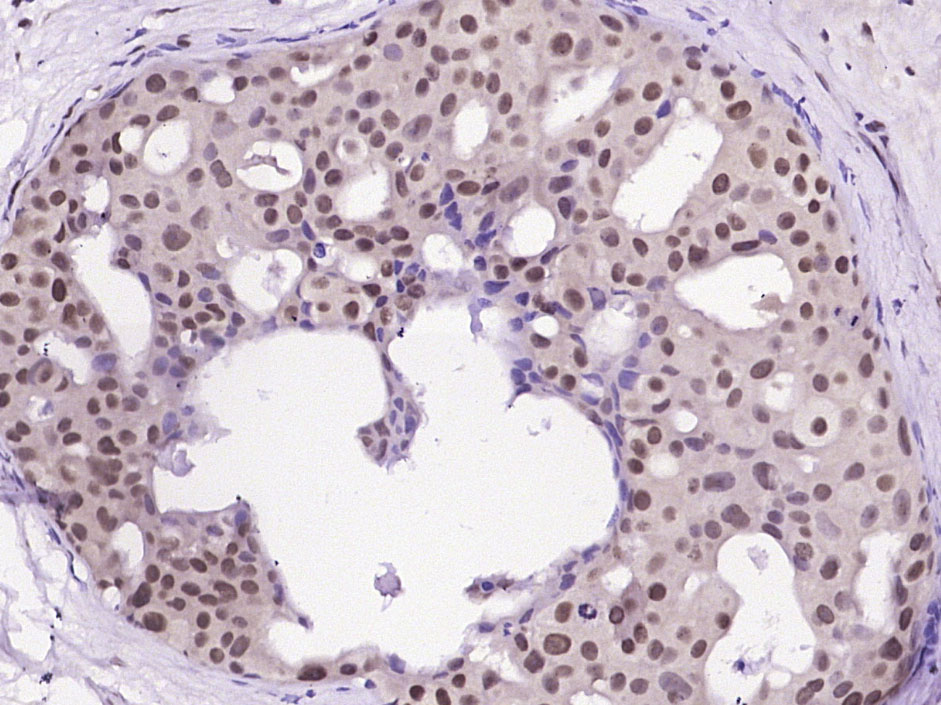
- 产品详情
- 实验流程
- 背景知识
Application 
| IHC-P, IHC-F, IF |
|---|---|
| Primary Accession | P42263 |
| Reactivity | Human |
| Predicted | Rat, Pig, Dog, Mouse, Rabbit, Horse |
| Host | Rabbit |
| Clonality | Polyclonal |
| Calculated MW | 101157 Da |
| Physical State | Liquid |
| Immunogen | KLH conjugated synthetic peptide derived from human GLUR3 |
| Epitope Specificity | 451-550/894 |
| Isotype | IgG |
| Purity | affinity purified by Protein A |
| Buffer | 0.01M TBS (pH7.4) with 1% BSA, 0.02% Proclin300 and 50% Glycerol. |
| SUBCELLULAR LOCATION | Cell membrane; Multi-pass membrane protein. Cell junction, synapse, postsynaptic cell membrane; Multi-pass membrane protein. Note=Interaction with CNIH2 and CNIH3 promotes cell surface expression (By similarity). |
| DISEASE | Defects in GRIA3 are the cause of mental retardation X-linked type 94 (MRX94) [MIM:300699]. Mental retardation is characterized by significantly sub-average general intellectual functioning associated with impairments in adaptative behavior and manifested during the developmental period. MRX94 patients have moderate mental retardation. Other variable features are macrocephaly, seizures, myoclonic jerks, autistic behavior, asthenic body habitus, distal muscle weakness and hyporeflexia. |
| Important Note | This product as supplied is intended for research use only, not for use in human, therapeutic or diagnostic applications. |
| Background Descriptions | L-Glutamate is the major excitatory neurotransmitter in the mammalian CNS, acting through both ligand gated ion channels (ionotropic receptors) and G-protein coupled (metabotropic) receptors. As such the glutamate receptors play a vital role in the mediation of excitatory synaptic transmission. The ionotropic glutamate receptors are multimeric assemblies of four or five subunits, and are subdivided into three groups (AMPA, NMDA and Kainate receptors) based on their pharmacology structural similarities Glutamate Receptor 3 is a ionotropic, AMPA-selective, membrane bound protein widely distributed in the CNS. Predominant expression is seen in the neuronal cells of the cerebral cortex, dentate gyrus, and glial cells throughout brain regions. AMPA receptors mediate fast synaptic transmission in the CNS and are composed of subunits GluR1-4, products from separate genes. Glutamate Receptor 3 exists in 2 named isoforms - Flip and Flop, produced by alternative splicing. |
| Gene ID | 2892 |
|---|---|
| Other Names | Glutamate receptor 3, GluR-3, AMPA-selective glutamate receptor 3, GluR-C, GluR-K3, Glutamate receptor ionotropic, AMPA 3, GRIA3 (HGNC:4573), GluA3, GLUR3, GLURC |
| Dilution | IHC-P=1:100-500,IHC-F=1:100-500,IF=1:100-500 |
| Storage | Store at -20 °C for one year. Avoid repeated freeze/thaw cycles. When reconstituted in sterile pH 7.4 0.01M PBS or diluent of antibody the antibody is stable for at least two weeks at 2-4 °C. |
For Research Use Only. Not For Use In Diagnostic Procedures.
| Name | GRIA3 (HGNC:4573) |
|---|---|
| Synonyms | GluA3, GLUR3, GLURC |
| Function | Ionotropic glutamate receptor that functions as a ligand- gated cation channel, gated by L-glutamate and glutamatergic agonists such as alpha-amino-3-hydroxy-5-methyl-4-isoxazolepropionic acid (AMPA), quisqualic acid, and kainic acid (By similarity). L-glutamate acts as an excitatory neurotransmitter at many synapses in the central nervous system and plays an important role in fast excitatory synaptic transmission by inducing long-term potentiation (By similarity). Binding of the excitatory neurotransmitter L-glutamate induces a conformation change, leading to the opening of the cation channel, and thereby converts the chemical signal to an electrical impulse upon entry of calcium (PubMed:17989220). The receptor then desensitizes rapidly and enters a transient inactive state, characterized by the presence of bound agonist (PubMed:17989220). In the presence of CACNG8, shows resensitization which is characterized by a delayed accumulation of current flux upon continued application of glutamate (PubMed:21172611). |
| Cellular Location | Cell membrane; Multi-pass membrane protein {ECO:0000250|UniProtKB:P19492} Postsynaptic cell membrane {ECO:0000250|UniProtKB:P19492}; Multi-pass membrane protein {ECO:0000250|UniProtKB:P19492}. Postsynaptic density membrane {ECO:0000250|UniProtKB:P19492} |
Research Areas
Application Protocols
Provided below are standard protocols that you may find useful for product applications.
BACKGROUND
This product as supplied is intended for research use only, not for use in human, therapeutic or diagnostic applications.

终于等到您。ABCEPTA(百远生物)抗体产品。
点击下方“我要评价 ”按钮提交您的反馈信息,您的反馈和评价是我们最宝贵的财富之一,
我们将在1-3个工作日内处理您的反馈信息。
如有疑问,联系:0512-88856768 tech-china@abcepta.com.
¥ 1,250.00
Cat# AP56920


