


 癌症的基本特征包括细胞增殖、血管生成、迁移、凋亡逃避机制和细胞永生等。找到癌症发生过程中这些通路的关键标记物和对应的抗体用于检测至关重要。
 为您推荐一个泛素化位点预测神器——泛素化分析工具,可以为您的蛋白的泛素化位点作出预测和评分。
 细胞自噬受体图形绘图工具为你的蛋白的细胞受体结合位点作出预测和评分,识别结合到自噬通路中的蛋白是非常重要的,便于让我们理解自噬在正常生理、病理过程中的作用,如发育、细胞分化、神经退化性疾病、压力条件下、感染和癌症。
PTPRN2 Rabbit pAb
PTPRN2 Rabbit pAb
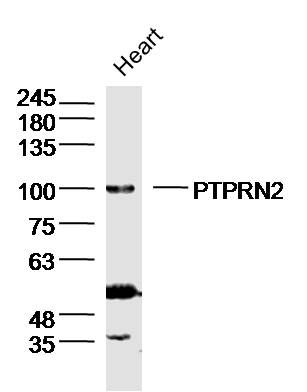
- 产品详情
- 实验流程
- 背景知识
Application 
| WB |
|---|---|
| Primary Accession | P80560 |
| Reactivity | Mouse |
| Predicted | Rat |
| Host | Rabbit |
| Clonality | Polyclonal |
| Calculated MW | 111497 Da |
| Physical State | Liquid |
| Immunogen | KLH conjugated synthetic peptide derived from mouse PTPRN2 |
| Epitope Specificity | 521-620/1015 |
| Isotype | IgG |
| Purity | affinity purified by Protein A |
| Buffer | Preservative: 0.02% Proclin300, Constituents: 1% BSA, 0.01M PBS, pH7.4. |
| SUBCELLULAR LOCATION | Membrane. |
| Important Note | This product as supplied is intended for research use only, not for use in human, therapeutic or diagnostic applications. |
| Background Descriptions | The protein encoded by this gene is a member of the protein tyrosine phosphatase (PTP) family. PTPs are known to be signaling molecules that regulate a variety of cellular processes including cell growth, differentiation, mitotic cycle, and oncogenic transformation. This PTP possesses an extracellular region, a single transmembrane region, and a single intracellular catalytic domain, and thus represents a receptor-type PTP. The catalytic domain of this PTP is most closely related to PTPRN/IA-2beta. This PTP and PTPRN are both found to be major autoantigens associated with insulin-dependent diabetes mellitus. Three alternatively spliced transcript variants of this gene, which encode distinct proteins, have been reported. [provided by RefSeq, Jul 2008] |
| Gene ID | 19276 |
|---|---|
| Other Names | Receptor-type tyrosine-protein phosphatase N2, R-PTP-N2, 3.1.3.-, 3.1.3.48, PTP IA-2beta, Phogrin, Protein tyrosine phosphatase-NP, PTP-NP, IA-2beta71, IA-2beta64, IA-2beta60, Ptprn2 |
| Dilution | WB=1:500-2000 |
| Storage | Store at -20 °C for one year. Avoid repeated freeze/thaw cycles. When reconstituted in sterile pH 7.4 0.01M PBS or diluent of antibody the antibody is stable for at least two weeks at 2-4 °C. |
For Research Use Only. Not For Use In Diagnostic Procedures.
| Name | Ptprn2 |
|---|---|
| Function | Plays a role in vesicle-mediated secretory processes (PubMed:21732083). Required for normal accumulation of secretory vesicles in hippocampus, pituitary and pancreatic islets. Required for the accumulation of normal levels of insulin-containing vesicles and preventing their degradation (PubMed:21732083). Plays a role in insulin secretion in response to glucose stimuli (PubMed:15220191, PubMed:16418280, PubMed:21732083). Required for normal accumulation of the neurotransmitters norepinephrine, dopamine and serotonin in the brain. In females, but not in males, required for normal accumulation and secretion of pituitary hormones, such as luteinizing hormone (LH) and follicle-stimulating hormone (FSH) (PubMed:16269463). Required to maintain normal levels of renin expression and renin release (PubMed:19019914). May regulate catalytic active protein-tyrosine phosphatases such as PTPRA through dimerization (PubMed:12364328). Has phosphatidylinositol phosphatase activity; the PIPase activity is involved in its ability to regulate insulin secretion. Can dephosphorylate phosphatidylinositol 4,5-biphosphate (PI(4,5)P2), phosphatidylinositol 5-phosphate and phosphatidylinositol 3-phosphate (By similarity). Regulates PI(4,5)P2 level in the plasma membrane and localization of cofilin at the plasma membrane and thus is indirectly involved in regulation of actin dynamics related to cell migration and metastasis; upon hydrolysis of PI(4,5)P2 cofilin is released from the plasma membrane and acts in the cytoplasm in severing F-actin filaments (By similarity). |
| Cellular Location | Cytoplasmic vesicle, secretory vesicle membrane; Single-pass type I membrane protein. Cytoplasmic vesicle, secretory vesicle, synaptic vesicle membrane; Single-pass type I membrane protein. Note=Predominantly found on dense-core secretory granules. Sorting to secretory granules in part is dependent of the N- terminal pro domain of the precursor and its interaction with CPE Transiently found at the cell membrane, when secretory vesicles fuse with the cell membrane to release their cargo. Is then endocytosed and recycled to secretory vesicles involving clathrin-dependent AP2- mediated endocytosis. Recycled via STX6- but not TTTGN1/TGN38- containing compartments. {ECO:0000250|UniProtKB:Q63475, ECO:0000269|PubMed:15485654, ECO:0000269|PubMed:21210912, ECO:0000305} |
| Tissue Location | Detected in brain (PubMed:15220191, PubMed:19361477). Detected in pancreas islets (at protein level) (PubMed:8681804). Detected in pancreas and brain (PubMed:8637868, PubMed:8681804). |
Research Areas
Application Protocols
Provided below are standard protocols that you may find useful for product applications.
BACKGROUND
This product as supplied is intended for research use only, not for use in human, therapeutic or diagnostic applications.

终于等到您。ABCEPTA(百远生物)抗体产品。
点击下方“我要评价 ”按钮提交您的反馈信息,您的反馈和评价是我们最宝贵的财富之一,
我们将在1-3个工作日内处理您的反馈信息。
如有疑问,联系:0512-88856768 tech-china@abcepta.com.


