


 癌症的基本特征包括细胞增殖、血管生成、迁移、凋亡逃避机制和细胞永生等。找到癌症发生过程中这些通路的关键标记物和对应的抗体用于检测至关重要。
 为您推荐一个泛素化位点预测神器——泛素化分析工具,可以为您的蛋白的泛素化位点作出预测和评分。
 细胞自噬受体图形绘图工具为你的蛋白的细胞受体结合位点作出预测和评分,识别结合到自噬通路中的蛋白是非常重要的,便于让我们理解自噬在正常生理、病理过程中的作用,如发育、细胞分化、神经退化性疾病、压力条件下、感染和癌症。
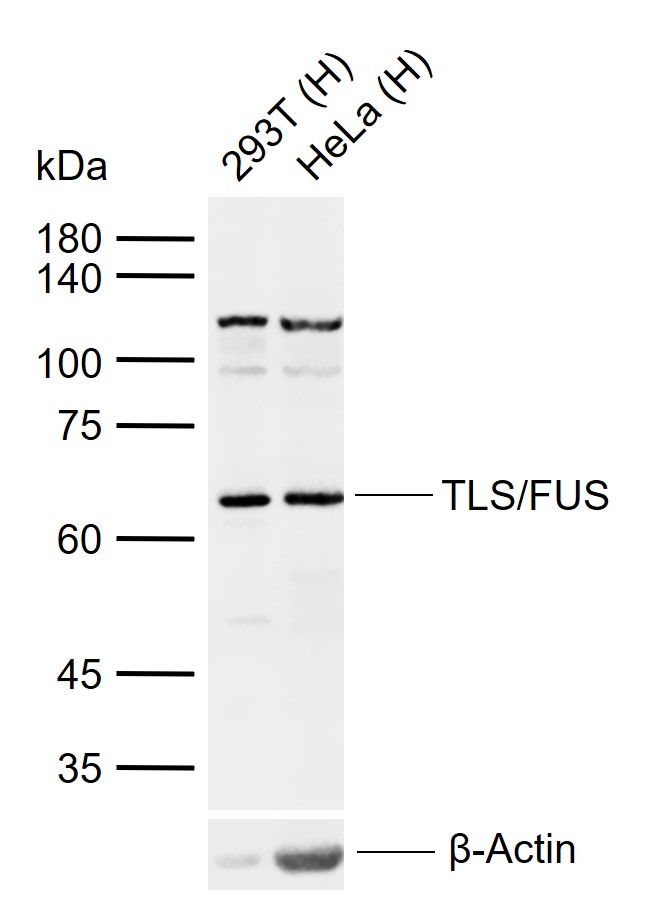
TLS/FUS Rabbit pAb
TLS/FUS Rabbit pAb
- 产品详情
- 实验流程
- 背景知识
Application 
| WB |
|---|---|
| Primary Accession | P35637 |
| Reactivity | Human |
| Predicted | Rat, Pig, Dog, Mouse, Rabbit, Horse |
| Host | Rabbit |
| Clonality | Polyclonal |
| Calculated MW | 53426 Da |
| Physical State | Liquid |
| Immunogen | KLH conjugated synthetic peptide derived from human TLS |
| Epitope Specificity | 421-526/526 |
| Isotype | IgG |
| Purity | affinity purified by Protein A |
| Buffer | 0.01M TBS (pH7.4) with 1% BSA, 0.02% Proclin300 and 50% Glycerol. |
| SUBCELLULAR LOCATION | Nucleus. |
| DISEASE | Note=A chromosomal aberration involving FUS is found in a patient with malignant myxoid liposarcoma. Translocation t(12;16)(q13;p11) with DDIT3.Note=A chromosomal aberration involving FUS is a cause of acute myeloid leukemia (AML). Translocation t(16;21)(p11;q22) with ERG.Angiomatoid fibrous histiocytoma (AFH) [MIM:612160]: A distinct variant of malignant fibrous histiocytoma that typically occurs in children and adolescents and is manifest by nodular subcutaneous growth. Characteristic microscopic features include lobulated sheets of histiocyte-like cells intimately associated with areas of hemorrhage and cystic pseudovascular spaces, as well as a striking cuffing of inflammatory cells, mimicking a lymph node metastasis. Note=The disease may be caused by mutations affecting the gene represented in this entry. A chromosomal aberration involving FUS is found in a patient with angiomatoid fibrous histiocytoma. Translocation t(12;16)(q13;p11.2) with ATF1 generates a chimeric FUS/ATF1 protein.Amyotrophic lateral sclerosis 6 (ALS6) [MIM:608030]: A neurodegenerative disorder affecting upper motor neurons in the brain and lower motor neurons in the brain stem and spinal cord, resulting in fatal paralysis. Sensory abnormalities are absent. The pathologic hallmarks of the disease include pallor of the corticospinal tract due to loss of motor neurons, presence of ubiquitin-positive inclusions within surviving motor neurons, and deposition of pathologic aggregates. The etiology of amyotrophic lateral sclerosis is likely to be multifactorial, involving both genetic and environmental factors. The disease is inherited in 5-10% of the cases. Note=The disease is caused by mutations affecting the gene represented in this entry.Tremor, hereditary essential 4 (ETM4) [MIM:614782]: A common movement disorder mainly characterized by postural tremor of the arms. Head, legs, trunk, voice, jaw, and facial muscles also may be involved. The condition can be aggravated by emotions, hunger, fatigue and temperature extremes, and may cause a functional disability or even incapacitation. Inheritance is autosomal dominant. Note=The disease is caused by mutations affecting the gene represented in this entry. |
| Important Note | This product as supplied is intended for research use only, not for use in human, therapeutic or diagnostic applications. |
| Background Descriptions | This gene encodes a multifunctional protein component of the heterogeneous nuclear ribonucleoprotein (hnRNP) complex. The hnRNP complex is involved in pre-mRNA splicing and the export of fully processed mRNA to the cytoplasm. This protein belongs to the FET family of RNA-binding proteins which have been implicated in cellular processes that include regulation of gene expression, maintenance of genomic integrity and mRNA/microRNA processing. Alternative splicing results in multiple transcript variants. Defects in this gene result in amyotrophic lateral sclerosis type 6. [provided by RefSeq]. |
| Gene ID | 2521 |
|---|---|
| Other Names | RNA-binding protein FUS, 75 kDa DNA-pairing protein, Oncogene FUS, Oncogene TLS, POMp75, Translocated in liposarcoma protein, FUS, TLS |
| Dilution | WB=1:500-2000 |
| Storage | Store at -20 °C for one year. Avoid repeated freeze/thaw cycles. When reconstituted in sterile pH 7.4 0.01M PBS or diluent of antibody the antibody is stable for at least two weeks at 2-4 °C. |
For Research Use Only. Not For Use In Diagnostic Procedures.
| Name | FUS |
|---|---|
| Synonyms | TLS |
| Function | DNA/RNA-binding protein that plays a role in various cellular processes such as transcription regulation, RNA splicing, RNA transport, DNA repair and damage response (PubMed:27731383). Binds to ssRNA containing the consensus sequence 5'-AGGUAA-3' (PubMed:21256132). Binds to nascent pre-mRNAs and acts as a molecular mediator between RNA polymerase II and U1 small nuclear ribonucleoprotein thereby coupling transcription and splicing (PubMed:26124092). Also binds its own pre- mRNA and autoregulates its expression; this autoregulation mechanism is mediated by non-sense-mediated decay (PubMed:24204307). Plays a role in DNA repair mechanisms by promoting D-loop formation and homologous recombination during DNA double-strand break repair (PubMed:10567410). In neuronal cells, plays crucial roles in dendritic spine formation and stability, RNA transport, mRNA stability and synaptic homeostasis (By similarity). |
| Cellular Location | Nucleus Note=Displays a punctate pattern inside the nucleus and is excluded from nucleoli. |
| Tissue Location | Ubiquitous. |
Research Areas
Application Protocols
Provided below are standard protocols that you may find useful for product applications.
BACKGROUND
This product as supplied is intended for research use only, not for use in human, therapeutic or diagnostic applications.

终于等到您。ABCEPTA(百远生物)抗体产品。
点击下方“我要评价 ”按钮提交您的反馈信息,您的反馈和评价是我们最宝贵的财富之一,
我们将在1-3个工作日内处理您的反馈信息。
如有疑问,联系:0512-88856768 tech-china@abcepta.com.
¥ 1,250.00
Cat# AP58069


