


 癌症的基本特征包括细胞增殖、血管生成、迁移、凋亡逃避机制和细胞永生等。找到癌症发生过程中这些通路的关键标记物和对应的抗体用于检测至关重要。
 为您推荐一个泛素化位点预测神器——泛素化分析工具,可以为您的蛋白的泛素化位点作出预测和评分。
 细胞自噬受体图形绘图工具为你的蛋白的细胞受体结合位点作出预测和评分,识别结合到自噬通路中的蛋白是非常重要的,便于让我们理解自噬在正常生理、病理过程中的作用,如发育、细胞分化、神经退化性疾病、压力条件下、感染和癌症。
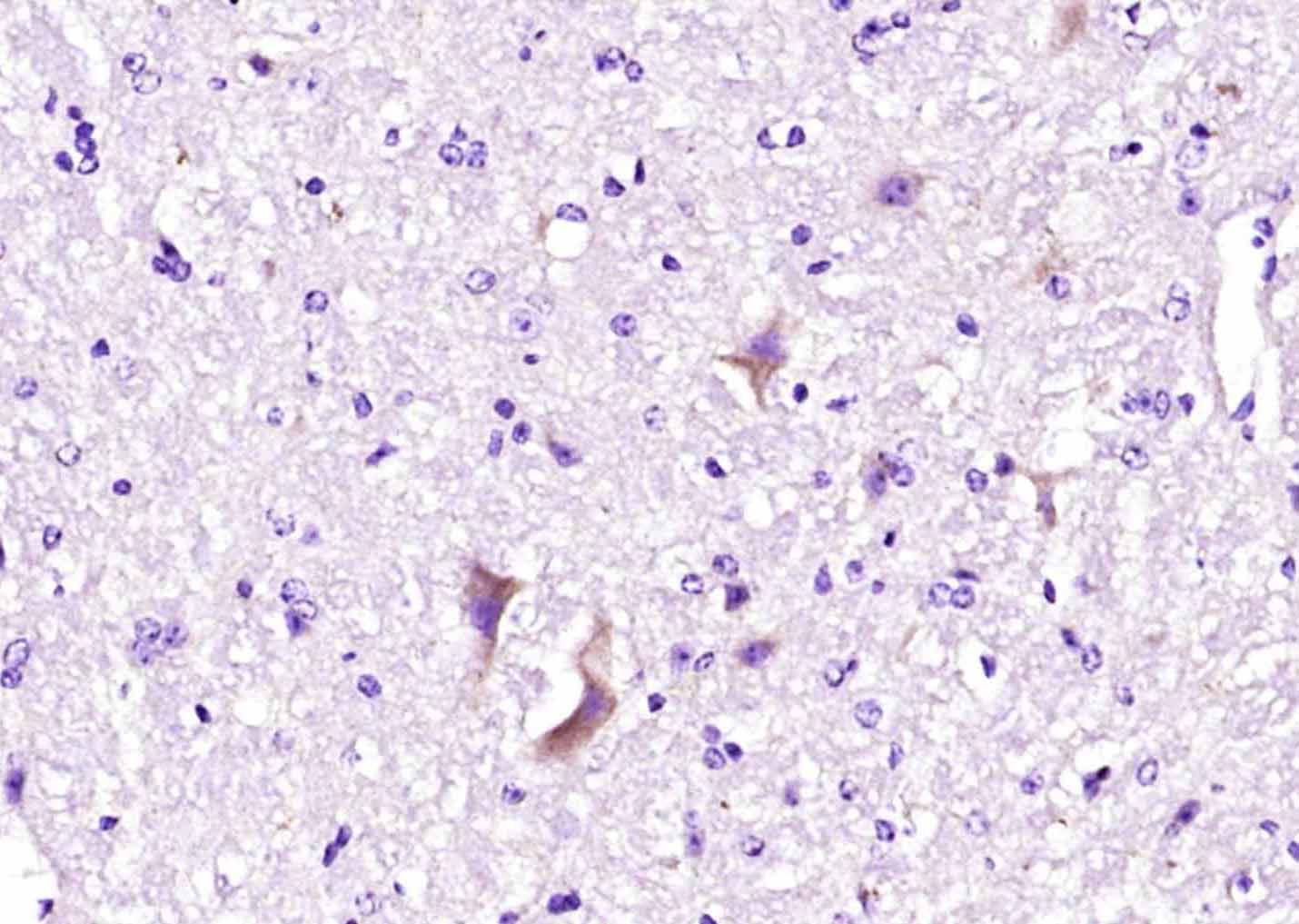
Ryanodine Receptor Rabbit pAb
Ryanodine Receptor Rabbit pAb
- 产品详情
- 实验流程
- 背景知识
Application 
| IHC-P, IHC-F, IF |
|---|---|
| Primary Accession | P21817 |
| Reactivity | Mouse |
| Predicted | Rat, Pig, Dog, Human, Rabbit |
| Host | Rabbit |
| Clonality | Polyclonal |
| Calculated MW | 565176 Da |
| Physical State | Liquid |
| Immunogen | KLH conjugated synthetic peptide derived from human Ryanodine Receptor |
| Epitope Specificity | 4701-4800/5038 |
| Isotype | IgG |
| Purity | affinity purified by Protein A |
| Buffer | 0.01M TBS (pH7.4) with 1% BSA, 0.02% Proclin300 and 50% Glycerol. |
| SUBCELLULAR LOCATION | Sarcoplasmic reticulum membrane; Multi-pass membrane protein (Probable). Membrane; Multi-pass membrane protein. Microsome membrane; Multi-pass membrane protein. |
| DISEASE | Malignant hyperthermia 1 (MHS1) [MIM:145600]: Autosomaldominant pharmacogenetic disorder of skeletal muscle and is one ofthe main causes of death due to anesthesia. In susceptible people,an MH episode can be triggered by all commonly used inhalationalanesthetics such as halothane and by depolarizing muscle relaxantssuch as succinylcholine. The clinical features of the myopathy arehyperthermia, accelerated muscle metabolism, contractures,metabolic acidosis, tachycardia and death, if not treated with thepostsynaptic muscle relaxant, dantrolene. Susceptibility to MH canbe determined with the 'in vitro' contracture test (IVCT):observing the magnitude of contractures induced in strips of muscletissue by caffeine alone and halothane alone. Patients with normalresponse are MH normal (MHN), those with abnormal response tocaffeine alone or halothane alone are MH equivocal (MHE(C) andMHE(H) respectively). Note=The disease is caused by mutationsaffecting the gene represented in this entry.Central core disease of muscle (CCD) [MIM:117000]:Autosomal dominant congenital myopathy, but a severe autosomalrecessive form also exists. Both clinical and histologicalvariability is observed. Affected individuals typically displayhypotonia and proximal muscle weakness in infancy, leading to thedelay of motor milestones. The clinical course of the disorder isusually slow or nonprogressive in adulthood, and the severity ofthe symptoms may vary from normal to significant muscle weakness.Microscopic examination of CCD-affected skeletal muscle reveals apredominance of type I fibers containing amorphous-looking areas(cores) that do not stain with oxidative and phosphorylasehistochemical techniques. Note=The disease is caused by mutationsaffecting the gene represented in this entry. Multiminicore disease with external ophthalmoplegia(MMDO) [MIM:255320]: Clinically heterogeneous neuromusculardisorder. General features include neonatal hypotonia, delayedmotor development, and generalized muscle weakness and amyotrophy,which may progress slowly or remain stable. Muscle biopsy showsmultiple, poorly circumscribed, short areas of sarcomeredisorganization and mitochondria depletion (areas termed minicores)in most muscle fibers. Typically, no dystrophic signs, such asmuscle fiber necrosis or regeneration or significant endomysialfibrosis, are present in multiminicore disease. Note=The disease iscaused by mutations affecting the gene represented in this entry. Congenital myopathy with fiber-type disproportion (CFTD)[MIM:255310]: Genetically heterogeneous disorder in which there isrelative hypotrophy of type 1 muscle fibers compared to type 2fibers on skeletal muscle biopsy. However, these findings are notspecific and can be found in many different myopathic andneuropathic conditions. Note=The disease is caused by mutationsaffecting the gene represented in this entry. Note=Defects in RYR1 may be a cause of Samaritanmyopathy, a congenital myopathy with benign course. Patientsdisplay severe hypotonia and respiratory distress at birth. Unlikeother congenital myopathies, the health status constantly improvesand patients are minimally affected at adulthood. |
| Important Note | This product as supplied is intended for research use only, not for use in human, therapeutic or diagnostic applications. |
| Background Descriptions | The Ryanodine Receptor (RyR) is the channel responsible for calcium release from muscle cell Sarcoplasmic Reticulum (SR) and also plays a role in calcium regulation in non-muscle cells. The RyR exists as a homotetramer and is predicted to have a short cytoplasmic C-terminus and 4-10 transmembrane domains. The remainder of the protein, termed the "foot" region, is located in the cytoplasm between the transverse tubule and the SR. Mammalian RyR isoforms are the product of three different genes: RyR-1 is expressed predominantly in skeletal muscle and areas of the brain; RyR-2 is expressed predominantly in heart muscle but also found in the stomach, endothelial cells and diffuse areas of the brain; and RyR-3 is found in smooth muscle and the brain (striatum, thalamus and hippocampus). In non-mammalian vertebrates, the RyR isoforms are termed alpha, beta and cardiac which correlate loosely to the mammalian RyR-1, RyR-3 and RyR-2 isoforms respectively. |
| Gene ID | 6261 |
|---|---|
| Other Names | Ryanodine receptor 1, RYR-1, RyR1, Skeletal muscle calcium release channel, Skeletal muscle ryanodine receptor, Skeletal muscle-type ryanodine receptor, Type 1 ryanodine receptor, RYR1 (HGNC:10483), RYDR |
| Dilution | IHC-P=1:100-500,IHC-F=1:100-500,IF=1:100-500 |
| Storage | Store at -20 °C for one year. Avoid repeated freeze/thaw cycles. When reconstituted in sterile pH 7.4 0.01M PBS or diluent of antibody the antibody is stable for at least two weeks at 2-4 °C. |
For Research Use Only. Not For Use In Diagnostic Procedures.
| Name | RYR1 (HGNC:10483) |
|---|---|
| Synonyms | RYDR |
| Function | Cytosolic calcium-activated calcium channel that mediates the release of Ca(2+) from the sarcoplasmic reticulum into the cytosol and thereby plays a key role in triggering muscle contraction following depolarization of T-tubules (PubMed:11741831, PubMed:16163667, PubMed:18268335, PubMed:18650434, PubMed:26115329). Repeated very high- level exercise increases the open probability of the channel and leads to Ca(2+) leaking into the cytoplasm (PubMed:18268335). Can also mediate the release of Ca(2+) from intracellular stores in neurons, and may thereby promote prolonged Ca(2+) signaling in the brain. Required for normal embryonic development of muscle fibers and skeletal muscle. Required for normal heart morphogenesis, skin development and ossification during embryogenesis (By similarity). |
| Cellular Location | Sarcoplasmic reticulum membrane; Multi-pass membrane protein. Note=The number of predicted transmembrane domains varies between orthologs. Both N-terminus and C-terminus are cytoplasmic. {ECO:0000250|UniProtKB:P11716} |
| Tissue Location | Skeletal muscle and brain (cerebellum and hippocampus). |
Research Areas
Application Protocols
Provided below are standard protocols that you may find useful for product applications.
BACKGROUND
This product as supplied is intended for research use only, not for use in human, therapeutic or diagnostic applications.

终于等到您。ABCEPTA(百远生物)抗体产品。
点击下方“我要评价 ”按钮提交您的反馈信息,您的反馈和评价是我们最宝贵的财富之一,
我们将在1-3个工作日内处理您的反馈信息。
如有疑问,联系:0512-88856768 tech-china@abcepta.com.


