


 癌症的基本特征包括细胞增殖、血管生成、迁移、凋亡逃避机制和细胞永生等。找到癌症发生过程中这些通路的关键标记物和对应的抗体用于检测至关重要。
 为您推荐一个泛素化位点预测神器——泛素化分析工具,可以为您的蛋白的泛素化位点作出预测和评分。
 细胞自噬受体图形绘图工具为你的蛋白的细胞受体结合位点作出预测和评分,识别结合到自噬通路中的蛋白是非常重要的,便于让我们理解自噬在正常生理、病理过程中的作用,如发育、细胞分化、神经退化性疾病、压力条件下、感染和癌症。
CARD7/NALP1 Rabbit pAb
CARD7/NALP1 Rabbit pAb
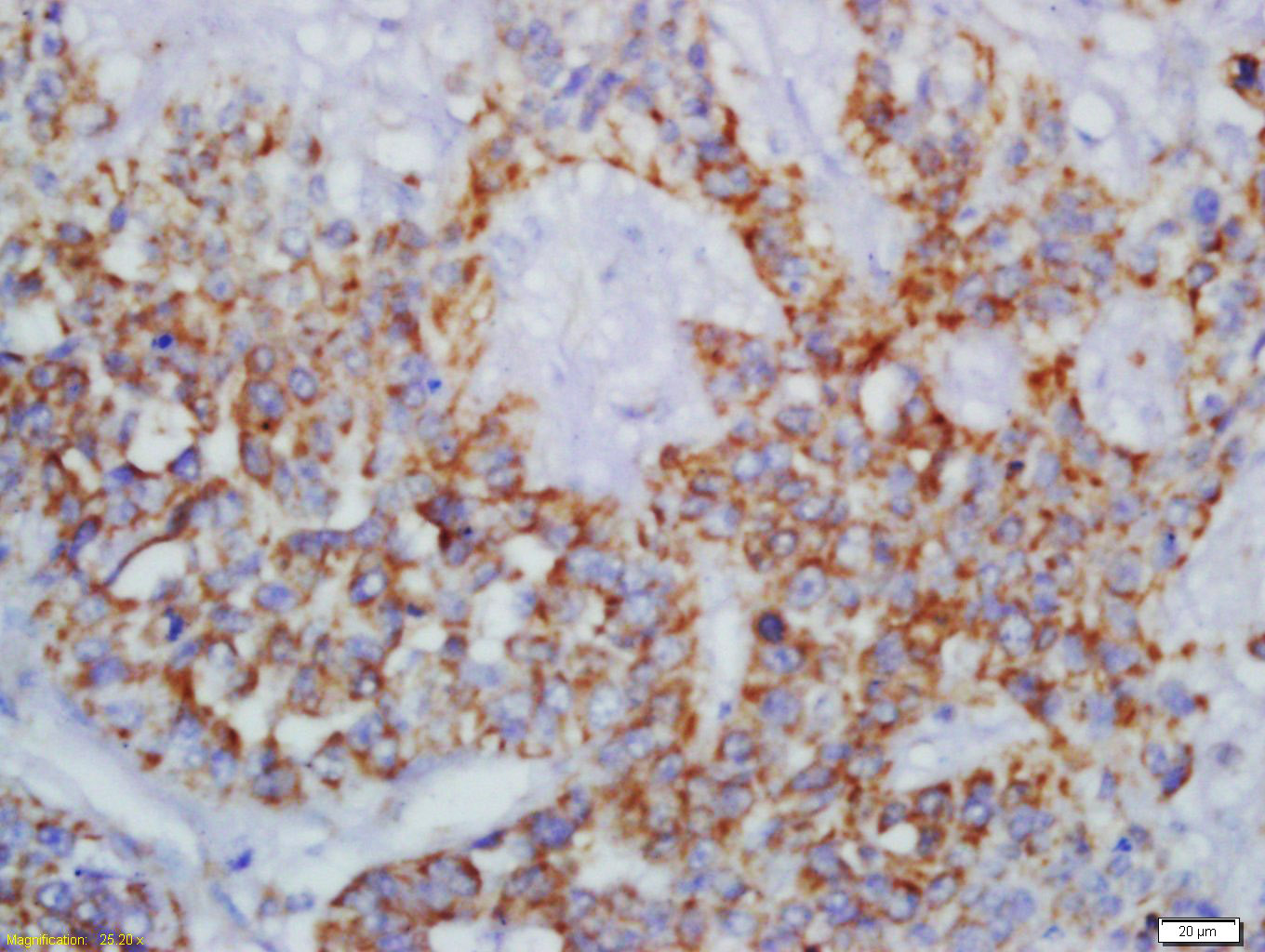
- 产品详情
- 实验流程
- 背景知识
Application 
| IHC-P, IHC-F, IF |
|---|---|
| Primary Accession | Q9C000 |
| Reactivity | Human, Mouse |
| Predicted | Rat |
| Host | Rabbit |
| Clonality | Polyclonal |
| Calculated MW | 165866 Da |
| Physical State | Liquid |
| Immunogen | KLH conjugated synthetic peptide derived from human CARD7/NALP1 |
| Epitope Specificity | 301-400/1473 |
| Isotype | IgG |
| Purity | affinity purified by Protein A |
| Buffer | 0.01M TBS (pH7.4) with 1% BSA, 0.02% Proclin300 and 50% Glycerol. |
| SUBCELLULAR LOCATION | Cytoplasm. Nucleus. |
| DISEASE | Genetic variations in NLRP1 are associated with susceptibility to vitiligo (VTLG) [MIM:193200]. VTLG is a pigmentary disorder of the skin characterized by circumscribed depigmented macules and patches, commonly on extensor aspects of extremities, on the face or neck and in skin folds. It is a progressive disorder in which some or all of the melanocytes in the affected skin are selectively destroyed. It is a multifactorial disorder with a complex etiology probably including autoimmune mechanisms, and is associated with an elevated risk of other autoimmune diseases.Genetic variations in NLRP1 gene are associated with susceptibility to vitiligo-associated multiple autoimmune disease type 1 (VAMAS1) [MIM:606579]. VAMAS1 is an autoimmune disorder characterized by the association of vitiligo with several autoimmune and autoinflammatory diseases including autoimmune thyroid disease, rheumatoid arthritis and systemic lupus erythematosus. |
| Important Note | This product as supplied is intended for research use only, not for use in human, therapeutic or diagnostic applications. |
| Background Descriptions | This gene encodes a member of the Ced-4 family of apoptosis proteins. Ced-family members contain a caspase recruitment domain (CARD) and are known to be key mediators of programmed cell death. The encoded protein contains a distinct N-terminal pyrin-like motif, which is possibly involved in protein-protein interactions. This protein interacts strongly with caspase 2 and weakly with caspase 9. Overexpression of this gene was demonstrated to induce apoptosis in cells. Multiple alternatively spliced transcript variants encoding distinct isoforms have been found for this gene, but the biological validity of some variants has not been determined. [provided by RefSeq, Jul 2008]. |
| Gene ID | 22861 |
|---|---|
| Other Names | NACHT, LRR and PYD domains-containing protein 1, 3.4.-.-, 3.6.4.-, Caspase recruitment domain-containing protein 7, Death effector filament-forming ced-4-like apoptosis protein, Nucleotide-binding domain and caspase recruitment domain, NACHT, LRR and PYD domains-containing protein 1, C-terminus, NLRP1-CT, NACHT, LRR and PYD domains-containing protein 1, N-terminus, NLRP1-NT, NLRP1 {ECO:0000303|PubMed:22665479, ECO:0000312|HGNC:HGNC:14374} |
| Dilution | IHC-P=1:100-500,IHC-F=1:100-500,IF=1:100-500 |
| Storage | Store at -20 °C for one year. Avoid repeated freeze/thaw cycles. When reconstituted in sterile pH 7.4 0.01M PBS or diluent of antibody the antibody is stable for at least two weeks at 2-4 °C. |
For Research Use Only. Not For Use In Diagnostic Procedures.
| Name | NLRP1 {ECO:0000303|PubMed:22665479, ECO:0000312|HGNC:HGNC:14374} |
|---|---|
| Function | Acts as the sensor component of the NLRP1 inflammasome, which mediates inflammasome activation in response to various pathogen- associated signals, leading to subsequent pyroptosis (PubMed:12191486, PubMed:17349957, PubMed:22665479, PubMed:27662089, PubMed:31484767, PubMed:33093214, PubMed:33410748, PubMed:33731929, PubMed:33731932, PubMed:35857590). Inflammasomes are supramolecular complexes that assemble in the cytosol in response to pathogens and other damage- associated signals and play critical roles in innate immunity and inflammation (PubMed:12191486, PubMed:17349957, PubMed:22665479). Acts as a recognition receptor (PRR): recognizes specific pathogens and other damage-associated signals, such as cleavage by some human enteroviruses and rhinoviruses, double-stranded RNA, UV-B irradiation, or Val-boroPro inhibitor, and mediates the formation of the inflammasome polymeric complex composed of NLRP1, CASP1 and PYCARD/ASC (PubMed:12191486, PubMed:17349957, PubMed:22665479, PubMed:25562666, PubMed:30096351, PubMed:30291141, PubMed:33093214, PubMed:33243852, PubMed:33410748, PubMed:35857590). In response to pathogen-associated signals, the N-terminal part of NLRP1 is degraded by the proteasome, releasing the cleaved C-terminal part of the protein (NACHT, LRR and PYD domains-containing protein 1, C-terminus), which polymerizes and associates with PYCARD/ASC to initiate the formation of the inflammasome complex: the NLRP1 inflammasome recruits pro-caspase-1 (proCASP1) and promotes caspase-1 (CASP1) activation, which subsequently cleaves and activates inflammatory cytokines IL1B and IL18 and gasdermin-D (GSDMD), leading to pyroptosis (PubMed:12191486, PubMed:17349957, PubMed:22665479, PubMed:32051255, PubMed:33093214). In the absence of GSDMD expression, the NLRP1 inflammasome is able to recruit and activate CASP8, leading to activation of gasdermin-E (GSDME) (PubMed:33852854, PubMed:35594856). Activation of NLRP1 inflammasome is also required for HMGB1 secretion; the active cytokines and HMGB1 stimulate inflammatory responses (PubMed:22801494). Binds ATP and shows ATPase activity (PubMed:11113115, PubMed:15212762, PubMed:33243852). Plays an important role in antiviral immunity and inflammation in the human airway epithelium (PubMed:33093214). Specifically recognizes a number of pathogen-associated signals: upon infection by human rhinoviruses 14 and 16 (HRV-14 and HRV-16), NLRP1 is cleaved and activated which triggers NLRP1-dependent inflammasome activation and IL18 secretion (PubMed:33093214). Positive-strand RNA viruses, such as Semliki forest virus and long dsRNA activate the NLRP1 inflammasome, triggering IL1B release in a NLRP1-dependent fashion (PubMed:33243852). Acts as a direct sensor for long dsRNA and thus RNA virus infection (PubMed:33243852). May also be activated by muramyl dipeptide (MDP), a fragment of bacterial peptidoglycan, in a NOD2- dependent manner (PubMed:18511561). The NLRP1 inflammasome is also activated in response to UV-B irradiation causing ribosome collisions: ribosome collisions cause phosphorylation and activation of NLRP1 in a MAP3K20-dependent manner, leading to pyroptosis (PubMed:35857590). |
| Cellular Location | Cytoplasm, cytosol. Cytoplasm. Nucleus. Note=Nucleocytoplasmic distribution in lymphoid organs (probably in T-cells) and in neurons. In epithelial cells, predominantly cytoplasmic. [NACHT, LRR and PYD domains-containing protein 1, N-terminus]: Nucleus. Note=(Microbial infection) Interaction with human herpes virus 8/HHV-8 proteins ORF45 promotes translocation of the N-terminal part of NLRP1 into the nucleus, relieving autoinhibition of the NLRP1 inflammasome and leading to its activation. |
| Tissue Location | Widely expressed (PubMed:11113115, PubMed:17164409). Abundantly expressed in primary immune cells (isoform 1 and isoform 2), including in neutrophils, monocytes/macrophages, dendritic cells (mostly Langerhans cells), and B- and T-lymphocytes (at protein level) (PubMed:15285719, PubMed:17164409). Strongly expressed in epithelial cells lining the glandular epithelium, such as that of the gastrointestinal tract (stomach, small intestine, colon), the respiratory tract (trachea and bronchi), and the endometrial and endocervical glands, gallbladder, prostate, and breast (at protein level). In testis, expressed in spermatogonia and primary spermatocytes, but not in Sertoli cells (at protein level). In the brain, expressed in neurons, in particular in pyramidal ones and in oligodendrocytes, but not detected in microglia (at protein level) (PubMed:17164409). Expressed in adult and fetal ocular tissues, including in adult and 24-week old fetal choroid, sclera, cornea, and optic nerve, as well as in adult retina and fetal retina/retinal pigment epithelium (PubMed:23349227). Highly expressed in the skin throughout the epidermis and in dermal fibroblasts, in both glabrous skin and plantar skin. It is detected in keratinocytes, but not in melanocytes. Expressed in epidermal appendages such as hair follicles (PubMed:27662089). |
Research Areas
Application Protocols
Provided below are standard protocols that you may find useful for product applications.
BACKGROUND
This product as supplied is intended for research use only, not for use in human, therapeutic or diagnostic applications.

终于等到您。ABCEPTA(百远生物)抗体产品。
点击下方“我要评价 ”按钮提交您的反馈信息,您的反馈和评价是我们最宝贵的财富之一,
我们将在1-3个工作日内处理您的反馈信息。
如有疑问,联系:0512-88856768 tech-china@abcepta.com.


