


 癌症的基本特征包括细胞增殖、血管生成、迁移、凋亡逃避机制和细胞永生等。找到癌症发生过程中这些通路的关键标记物和对应的抗体用于检测至关重要。
 为您推荐一个泛素化位点预测神器——泛素化分析工具,可以为您的蛋白的泛素化位点作出预测和评分。
 细胞自噬受体图形绘图工具为你的蛋白的细胞受体结合位点作出预测和评分,识别结合到自噬通路中的蛋白是非常重要的,便于让我们理解自噬在正常生理、病理过程中的作用,如发育、细胞分化、神经退化性疾病、压力条件下、感染和癌症。
NUPR1 Rabbit pAb
NUPR1 Rabbit pAb
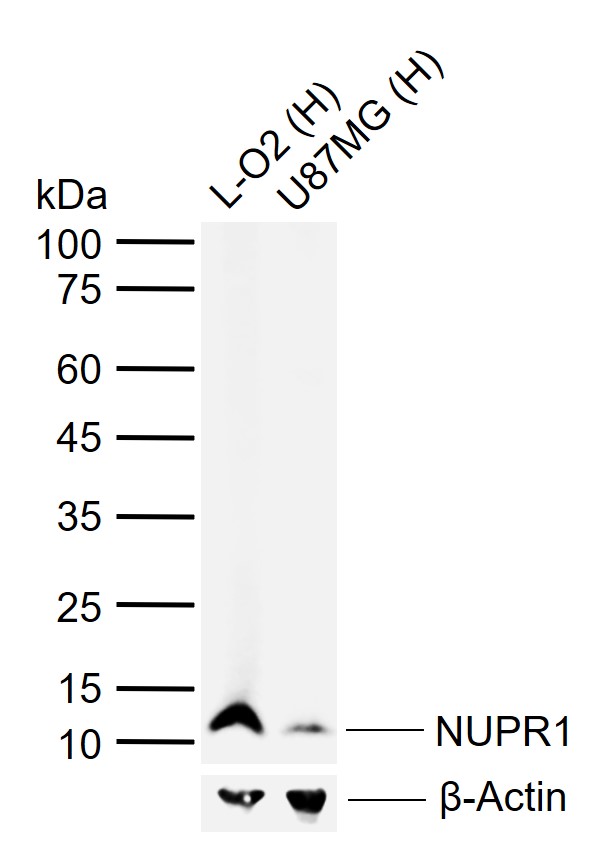
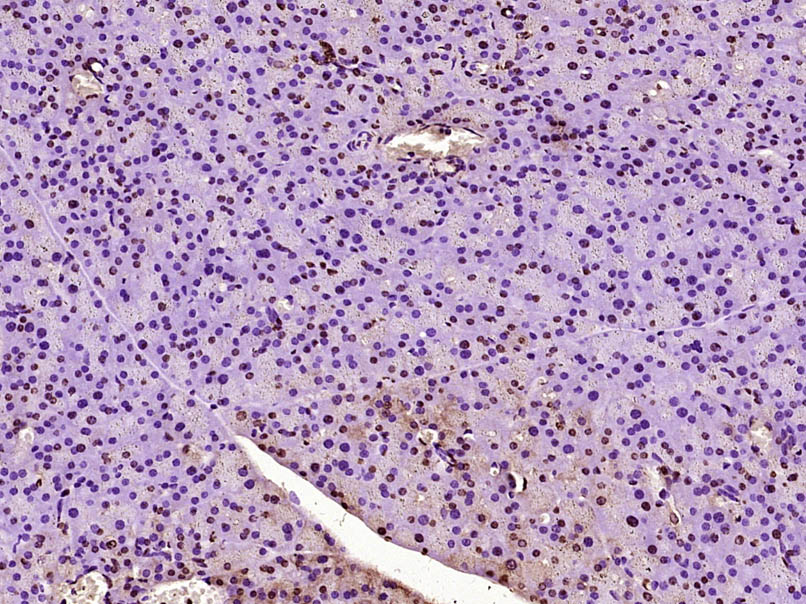
- 产品详情
- 实验流程
- 背景知识
Application 
| WB, IHC-P, IHC-F, IF |
|---|---|
| Primary Accession | O60356 |
| Reactivity | Human, Mouse |
| Predicted | Rat |
| Host | Rabbit |
| Clonality | Polyclonal |
| Calculated MW | 8873 Da |
| Physical State | Liquid |
| Immunogen | KLH conjugated synthetic peptide derived from human NUPR1/p8 |
| Epitope Specificity | 31-82/82 |
| Isotype | IgG |
| Purity | affinity purified by Protein A |
| Buffer | 0.01M TBS (pH7.4) with 1% BSA, 0.02% Proclin300 and 50% Glycerol. |
| SUBCELLULAR LOCATION | Nucleus. Cytoplasm. Cytoplasm, perinuclear region. |
| Important Note | This product as supplied is intended for research use only, not for use in human, therapeutic or diagnostic applications. |
| Background Descriptions | Could participate in the response to proapoptotic stimuli and promotes cellular growth in a way that helps the tissue counteract diverse injuries. May contribute to the metastatic phenotype.Tissue specificity: Highly expressed in pancreas. |
| Gene ID | 26471 |
|---|---|
| Other Names | Nuclear protein 1, Candidate of metastasis 1, Protein p8, NUPR1 (HGNC:29990), COM1 |
| Dilution | WB=1:500-2000,IHC-P=1:100-500,IHC-F=1:100-500,IF=1:100-500 |
| Storage | Store at -20 °C for one year. Avoid repeated freeze/thaw cycles. When reconstituted in sterile pH 7.4 0.01M PBS or diluent of antibody the antibody is stable for at least two weeks at 2-4 °C. |
For Research Use Only. Not For Use In Diagnostic Procedures.
| Name | NUPR1 (HGNC:29990) |
|---|---|
| Synonyms | COM1 |
| Function | Transcription regulator that converts stress signals into a program of gene expression that empowers cells with resistance to the stress induced by a change in their microenvironment. Thereby participates in the regulation of many processes namely cell-cycle, apoptosis, autophagy and DNA repair responses (PubMed:11056169, PubMed:11940591, PubMed:16300740, PubMed:16478804, PubMed:18690848, PubMed:19650074, PubMed:19723804, PubMed:20181828, PubMed:22565310, PubMed:22858377, PubMed:30451898). Controls cell cycle progression and protects cells from genotoxic stress induced by doxorubicin through the complex formation with TP53 and EP300 that binds CDKN1A promoter leading to transcriptional induction of CDKN1A (PubMed:18690848). Protects pancreatic cancer cells from stress-induced cell death by binding the RELB promoter and activating its transcription, leading to IER3 transactivation (PubMed:22565310). Negatively regulates apoptosis through interaction with PTMA (PubMed:16478804). Inhibits autophagy- induced apoptosis in cardiac cells through FOXO3 interaction, inducing cytoplasmic translocation of FOXO3 thereby preventing the FOXO3 association with the pro-autophagic BNIP3 promoter (PubMed:20181828). Inhibits cell growth and facilitates programmed cell death by apoptosis after adriamycin-induced DNA damage through transactivation of TP53 (By similarity). Regulates methamphetamine-induced apoptosis and autophagy through DDIT3-mediated endoplasmic reticulum stress pathway (By similarity). Participates in DNA repair following gamma-irradiation by facilitating DNA access of the transcription machinery through interaction with MSL1 leading to inhibition of histone H4 'Lys-16' acetylation (H4K16ac) (PubMed:19650074). Coactivator of PAX2 transcription factor activity, both by recruiting EP300 to increase PAX2 transcription factor activity and by binding PAXIP1 to suppress PAXIP1-induced inhibition on PAX2 (PubMed:11940591). Positively regulates cell cycle progression through interaction with COPS5 inducing cytoplasmic translocation of CDKN1B leading to the CDKN1B degradation (PubMed:16300740). Coordinates, through its interaction with EP300, the association of MYOD1, EP300 and DDX5 to the MYOG promoter, leading to inhibition of cell-cycle progression and myogenic differentiation promotion (PubMed:19723804). Negatively regulates beta cell proliferation via inhibition of cell-cycle regulatory genes expression through the suppression of their promoter activities (By similarity). Also required for LHB expression and ovarian maturation (By similarity). Exacerbates CNS inflammation and demyelination upon cuprizone treatment (By similarity). |
| Cellular Location | Nucleus. Cytoplasm Cytoplasm, perinuclear region |
| Tissue Location | Widely expressed, with high levels in liver, pancreas, prostate, ovary, colon, thyroid, spinal cord, trachea and adrenal gland, moderate levels in heart, placenta, lung, skeletal muscle, kidney, testis, small intestine, stomach and lymph node, and low levels in brain, spleen, thymus and bone marrow. Not detected in peripheral blood leukocytes. |
Research Areas
Application Protocols
Provided below are standard protocols that you may find useful for product applications.
BACKGROUND
This product as supplied is intended for research use only, not for use in human, therapeutic or diagnostic applications.

终于等到您。ABCEPTA(百远生物)抗体产品。
点击下方“我要评价 ”按钮提交您的反馈信息,您的反馈和评价是我们最宝贵的财富之一,
我们将在1-3个工作日内处理您的反馈信息。
如有疑问,联系:0512-88856768 tech-china@abcepta.com.


