


 癌症的基本特征包括细胞增殖、血管生成、迁移、凋亡逃避机制和细胞永生等。找到癌症发生过程中这些通路的关键标记物和对应的抗体用于检测至关重要。
 为您推荐一个泛素化位点预测神器——泛素化分析工具,可以为您的蛋白的泛素化位点作出预测和评分。
 细胞自噬受体图形绘图工具为你的蛋白的细胞受体结合位点作出预测和评分,识别结合到自噬通路中的蛋白是非常重要的,便于让我们理解自噬在正常生理、病理过程中的作用,如发育、细胞分化、神经退化性疾病、压力条件下、感染和癌症。
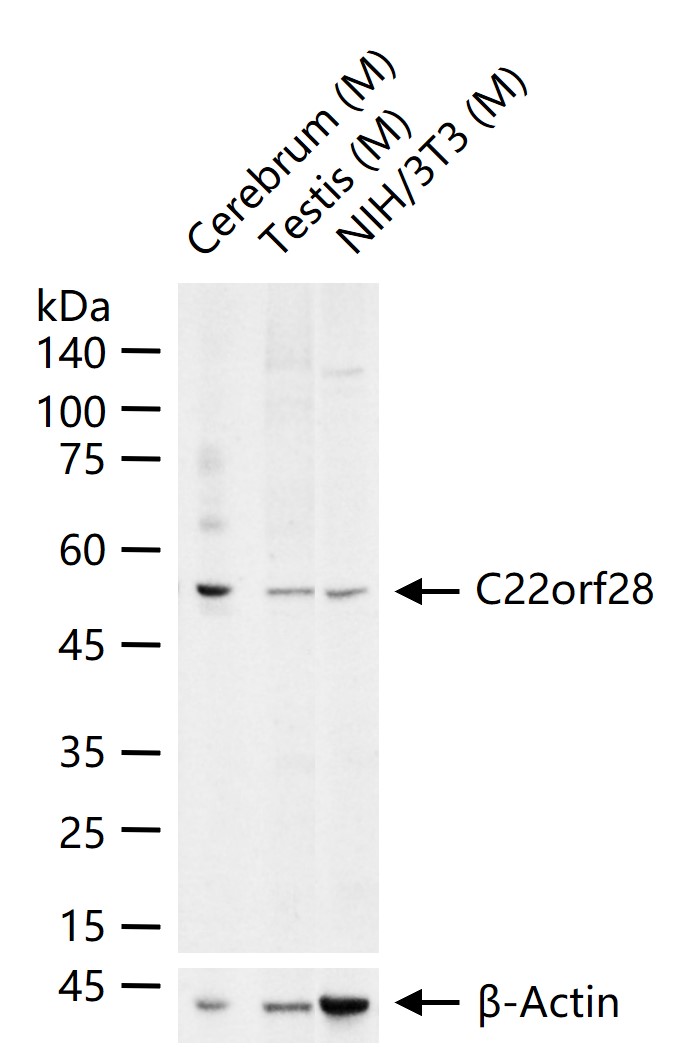
C22orf28 Rabbit pAb
C22orf28 Rabbit pAb
- 产品详情
- 实验流程
- 背景知识
Application 
| WB |
|---|---|
| Primary Accession | Q9Y3I0 |
| Reactivity | Mouse |
| Predicted | Rat, Pig, Human, Rabbit, Horse, Sheep |
| Host | Rabbit |
| Clonality | Polyclonal |
| Calculated MW | 55210 Da |
| Physical State | Liquid |
| Immunogen | KLH conjugated synthetic peptide derived from human HSPC117/C22orf28 |
| Epitope Specificity | 411-505/505 |
| Isotype | IgG |
| Purity | affinity purified by Protein A |
| Buffer | 0.01M TBS (pH7.4) with 1% BSA, 0.02% Proclin300 and 50% Glycerol. |
| SUBCELLULAR LOCATION | Cytoplasm. |
| Important Note | This product as supplied is intended for research use only, not for use in human, therapeutic or diagnostic applications. |
| Background Descriptions | HSPC117, also known as C22orf28, is a 505 amino acid protein that is encoded by a gene which maps to human chromosome 22. A highly homologous protein identified in rodents, FAAP (focal adhesion associated protein), encoded by murine D10Wsu52e gene, has been suggested to play a role in regulating cell adhesion dynamics. Chromosome 22 houses over 500 genes and is the second smallest human chromosome. Mutations in several of the genes that map to chromosome 22 are involved in the development of Phelan-McDermid syndrome, Neurofibromatosis type 2, autism and schizophrenia. Additionally, translocations between chromosomes 9 and 22 may lead to the formation of the Philadelphia Chromosome and the subsequent production of the novel fusion protein BCR-Abl, a potent cell proliferation activator found in several types of leukemias. |
| Gene ID | 51493 |
|---|---|
| Other Names | RNA-splicing ligase RTCB, 6.5.1.8 {ECO:0000255|HAMAP-Rule:MF_03144, ECO:0000269|PubMed:24870230}, 3'-phosphate/5'-hydroxy nucleic acid ligase {ECO:0000255|HAMAP-Rule:MF_03144, ECO:0000305}, RNA 2', 3'-cyclic phosphate and 5'-OH ligase {ECO:0000312|HGNC:HGNC:26935}, RTCB (HGNC:26935) |
| Dilution | WB=1:500-2000 |
| Storage | Store at -20 °C for one year. Avoid repeated freeze/thaw cycles. When reconstituted in sterile pH 7.4 0.01M PBS or diluent of antibody the antibody is stable for at least two weeks at 2-4 °C. |
For Research Use Only. Not For Use In Diagnostic Procedures.
| Name | RTCB (HGNC:26935) |
|---|---|
| Function | 3'-5' RNA ligase, catalytic subunit of the tRNA-splicing ligase complex (tRNA-LC), which is involved in the enzyme-dependent maturation of intron-containing pre-tRNAs. Functions downstream of the tRNA-splicing endonuclease that removes introns, ligating the two generated halves via phosphodiester bond formation (PubMed:40069351). The ligation reaction, which requires guanosine triphosphate (GTP) and Mn(2+), proceeds through three metal-dependent steps. The first step requires ZBTB8OS/Archease and involves the guanylylation of RTCB at its active site histidine, forming a covalent GMP-histidine intermediate. Before the second step, RTCB also hydrolyzes the 2',3'-cyclic phosphate (cP) at the 3' end of the 5' tRNA exon, typically generated by the tRNA-splicing endonuclease, producing a 3' phosphate. The covalently bound GMP is then transferred to this 3' phosphate to form an RNA(3')- P-P-(5')G intermediate. In the final step, the 5'-OH of the 3' exon attacks the activated 3' end of the 5' exon, forming a 3'-5' phosphodiester bond and releasing GMP (PubMed:24870230, PubMed:38493148). RTCB also functions in non-canonical, spliceosome- independent, cytoplasmic splicing of XBP1 mRNAs during the unfolded protein response (UPR). Upon endoplasmic reticulum (ER) stress, the endoribonuclease IRE1/ERN1 excises a short intron, generating free exon ends that are aligned by RNA-intrinsic, zipper-like stem-loop structures. These exon ends are then recognized and ligated by RTCB. This splicing event yields the active XBP1s transcription factor, which induces genes required to resolve protein folding defects in the endoplasmic reticulum (PubMed:25378478, PubMed:26483401, PubMed:38493148). |
| Cellular Location | Nucleus. Cytoplasm {ECO:0000255|HAMAP- Rule:MF_03144, ECO:0000269|PubMed:24608264, ECO:0000269|PubMed:25378478}. Note=Enters into the nucleus in case of active transcription while it accumulates in cytosol when transcription level is low. |
Research Areas
Application Protocols
Provided below are standard protocols that you may find useful for product applications.
BACKGROUND
This product as supplied is intended for research use only, not for use in human, therapeutic or diagnostic applications.

终于等到您。ABCEPTA(百远生物)抗体产品。
点击下方“我要评价 ”按钮提交您的反馈信息,您的反馈和评价是我们最宝贵的财富之一,
我们将在1-3个工作日内处理您的反馈信息。
如有疑问,联系:0512-88856768 tech-china@abcepta.com.
¥ 1,250.00
Cat# AP59455


