


 癌症的基本特征包括细胞增殖、血管生成、迁移、凋亡逃避机制和细胞永生等。找到癌症发生过程中这些通路的关键标记物和对应的抗体用于检测至关重要。
 为您推荐一个泛素化位点预测神器——泛素化分析工具,可以为您的蛋白的泛素化位点作出预测和评分。
 细胞自噬受体图形绘图工具为你的蛋白的细胞受体结合位点作出预测和评分,识别结合到自噬通路中的蛋白是非常重要的,便于让我们理解自噬在正常生理、病理过程中的作用,如发育、细胞分化、神经退化性疾病、压力条件下、感染和癌症。
Anti-RFWD3 Antibody
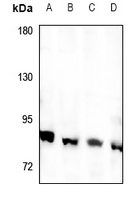
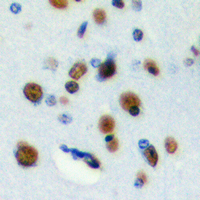
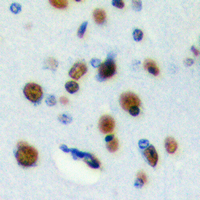
- 产品详情
- 实验流程
Application 
| WB, IHC |
|---|---|
| Primary Accession | Q6PCD5 |
| Reactivity | Human, Mouse, Rat |
| Host | Rabbit |
| Clonality | Polyclonal |
| Calculated MW | 85094 Da |
| Gene ID | 55159 |
|---|---|
| Other Names | RNF201; E3 ubiquitin-protein ligase RFWD3; RING finger and WD repeat domain-containing protein 3; RING finger protein 201 |
| Target/Specificity | KLH-conjugated synthetic peptide encompassing a sequence within the center region of human RFWD3. The exact sequence is proprietary. |
| Dilution | WB~~WB (1/500 - 1/1000) IHC~~WB (1/500 - 1/1000), IHC (1/100 - 1/200) |
| Format | Liquid in 0.42% Potassium phosphate, 0.87% Sodium chloride, pH 7.3, 30% glycerol, and 0.01% sodium azide. |
| Storage | Store at -20 °C.Stable for 12 months from date of receipt |
For Research Use Only. Not For Use In Diagnostic Procedures.
| Name | RFWD3 (HGNC:25539) |
|---|---|
| Function | E3 ubiquitin-protein ligase required for the repair of DNA interstrand cross-links (ICL) in response to DNA damage (PubMed:21504906, PubMed:21558276, PubMed:26474068, PubMed:28575657, PubMed:28575658, PubMed:33321094). Plays a key role in RPA-mediated DNA damage signaling and repair (PubMed:21504906, PubMed:21558276, PubMed:26474068, PubMed:28575657, PubMed:28575658, PubMed:28691929). Acts by mediating ubiquitination of the RPA complex (RPA1, RPA2 and RPA3 subunits) and RAD51 at stalled replication forks, leading to remove them from DNA damage sites and promote homologous recombination (PubMed:26474068, PubMed:28575657, PubMed:28575658). Also mediates the ubiquitination of p53/TP53 in the late response to DNA damage, and acts as a positive regulator of p53/TP53 stability, thereby regulating the G1/S DNA damage checkpoint (PubMed:20173098). May act by catalyzing the formation of short polyubiquitin chains on p53/TP53 that are not targeted to the proteasome (PubMed:20173098). In response to ionizing radiation, interacts with MDM2 and enhances p53/TP53 ubiquitination, possibly by restricting MDM2 from extending polyubiquitin chains on ubiquitinated p53/TP53 (PubMed:20173098). Required to translesion DNA synthesis across DNA-protein cross-link adducts by catalyzing ubiquitination of proteins on single-stranded DNA (ssDNA) (PubMed:33321094). |
| Cellular Location | Nucleus. Nucleus, PML body. Cytoplasm. Note=In undamaged cells, found both in the cytoplasm and in the nucleus, partially associated with PML nuclear bodies (PubMed:21558276). In response to replication block, such as that caused by hydroxyurea treatment, or to DNA damage caused by ionizing radiations or doxorubicin, recruited to the nucleus, to stalled replication forks or to sites of DNA repair (PubMed:21504906, PubMed:28575657). This recruitment depends upon RPA2 (PubMed:21504906) |
Research Areas
Application Protocols
Provided below are standard protocols that you may find useful for product applications.

终于等到您。ABCEPTA(百远生物)抗体产品。
点击下方“我要评价 ”按钮提交您的反馈信息,您的反馈和评价是我们最宝贵的财富之一,
我们将在1-3个工作日内处理您的反馈信息。
如有疑问,联系:0512-88856768 tech-china@abcepta.com.


