


 癌症的基本特征包括细胞增殖、血管生成、迁移、凋亡逃避机制和细胞永生等。找到癌症发生过程中这些通路的关键标记物和对应的抗体用于检测至关重要。
 为您推荐一个泛素化位点预测神器——泛素化分析工具,可以为您的蛋白的泛素化位点作出预测和评分。
 细胞自噬受体图形绘图工具为你的蛋白的细胞受体结合位点作出预测和评分,识别结合到自噬通路中的蛋白是非常重要的,便于让我们理解自噬在正常生理、病理过程中的作用,如发育、细胞分化、神经退化性疾病、压力条件下、感染和癌症。
ABCG2 Polyclonal Antibody
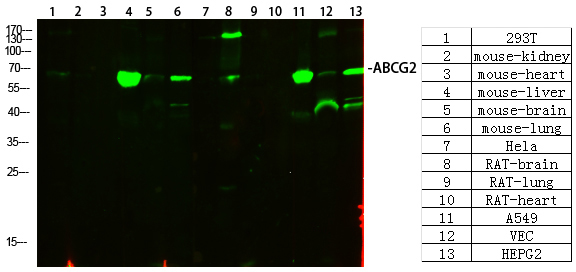
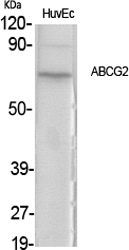
.jpg)
- 产品详情
- 实验流程
- 背景知识
Application 
| WB, IHC-P, IF, ICC, E |
|---|---|
| Primary Accession | Q9UNQ0 |
| Reactivity | Human, Rat, Mouse |
| Host | Rabbit |
| Clonality | Polyclonal |
| Calculated MW | 72314 Da |
| Gene ID | 9429 |
|---|---|
| Other Names | ABCG2; ABCP; BCRP; BCRP1; MXR; ATP-binding cassette sub-family G member 2; Breast cancer resistance protein; CDw338; Mitoxantrone resistance-associated protein; Placenta-specific ATP-binding cassette transporter; CD antigen CD338 |
| Dilution | WB~~Western Blot: 1/500 - 1/2000. Immunohistochemistry: 1/100 - 1/300. ELISA: 1/10000. Not yet tested in other applications. IHC-P~~1:50~200 IF~~1:50~200 ICC~~N/A E~~N/A |
| Format | Liquid in PBS containing 50% glycerol, 0.5% BSA and 0.09% (W/V) sodium azide. |
| Storage Conditions | -20℃ |
For Research Use Only. Not For Use In Diagnostic Procedures.
| Name | ABCG2 (HGNC:74) |
|---|---|
| Function | Broad substrate specificity ATP-dependent transporter of the ATP-binding cassette (ABC) family that actively extrudes a wide variety of physiological compounds, dietary toxins and xenobiotics from cells (PubMed:11306452, PubMed:12958161, PubMed:19506252, PubMed:20705604, PubMed:28554189, PubMed:30405239, PubMed:31003562). Involved in porphyrin homeostasis, mediating the export of protoporphyrin IX (PPIX) from both mitochondria to cytosol and cytosol to extracellular space, it also functions in the cellular export of heme (PubMed:20705604, PubMed:23189181). Also mediates the efflux of sphingosine-1-P from cells (PubMed:20110355). Acts as a urate exporter functioning in both renal and extrarenal urate excretion (PubMed:19506252, PubMed:20368174, PubMed:22132962, PubMed:31003562, PubMed:36749388). In kidney, it also functions as a physiological exporter of the uremic toxin indoxyl sulfate (By similarity). Also involved in the excretion of steroids like estrone 3-sulfate/E1S, 3beta-sulfooxy-androst-5-en-17-one/DHEAS, and other sulfate conjugates (PubMed:12682043, PubMed:28554189, PubMed:30405239). Mediates the secretion of the vitamins riboflavin and biotin into milk (By similarity). Involved in the excretion of the riboflavin-derived compound lumichrome into the intestinal lumen and in its secretion into milk (PubMed:39337371). Extrudes pheophorbide a, a phototoxic porphyrin catabolite of chlorophyll, reducing its bioavailability (By similarity). Plays an important role in the exclusion of xenobiotics from the brain (Probable). It confers to cells a resistance to multiple drugs and other xenobiotics including mitoxantrone, pheophorbide, camptothecin, methotrexate, azidothymidine, and the anthracyclines daunorubicin and doxorubicin, through the control of their efflux (PubMed:11306452, PubMed:12477054, PubMed:15670731, PubMed:18056989, PubMed:31254042). In placenta, it limits the penetration of drugs from the maternal plasma into the fetus (By similarity). May play a role in early stem cell self-renewal by blocking differentiation (By similarity). In inflammatory macrophages, exports itaconate from the cytosol to the extracellular compartment and limits the activation of TFEB-dependent lysosome biogenesis involved in antibacterial innate immune response (PubMed:38181789). Operates at apical membranes of polarized cells such as hepatocytes and intestinal epithelial cells, where it may contribute to the efflux of conjugated substrates from intestine and liver into the intestinal lumen as well as their enterohepatic recycling. Can transport estrogen and androgen substrates conjugated with glucuronate or sulfate at C-3, C-16 and C-17 positions. Among androgen glucuronates, appears to selectively transport dihydrotestosterone-17-glucuronate while displaying no transporter activity toward testosterone, androsterone and etiocholanolone glucuronates (PubMed:29175180, PubMed:30959153, PubMed:39993711). |
| Cellular Location | Cell membrane; Multi-pass membrane protein. Apical cell membrane; Multi-pass membrane protein. Mitochondrion membrane; Multi-pass membrane protein. Note=Enriched in membrane lipid rafts |
| Tissue Location | Highly expressed in placenta (PubMed:9850061). Low expression in small intestine, liver and colon (PubMed:9861027) Expressed in brain (at protein level) (PubMed:12958161) |
Provided below are standard protocols that you may find useful for product applications.
BACKGROUND
High-capacity urate exporter functioning in both renal and extrarenal urate excretion. Plays a role in porphyrin homeostasis as it is able to mediates the export of protoporhyrin IX (PPIX) both from mitochondria to cytosol and from cytosol to extracellular space, and cellular export of hemin, and heme. Xenobiotic transporter that may play an important role in the exclusion of xenobiotics from the brain. Appears to play a major role in the multidrug resistance phenotype of several cancer cell lines. Implicated in the efflux of numerous drugs and xenobiotics: mitoxantrone, the photosensitizer pheophorbide, camptothecin, methotrexate, azidothymidine (AZT), and the anthracyclines daunorubicin and doxorubicin.

终于等到您。ABCEPTA(百远生物)抗体产品。
点击下方“我要评价 ”按钮提交您的反馈信息,您的反馈和评价是我们最宝贵的财富之一,
我们将在1-3个工作日内处理您的反馈信息。
如有疑问,联系:0512-88856768 tech-china@abcepta.com.


