


 癌症的基本特征包括细胞增殖、血管生成、迁移、凋亡逃避机制和细胞永生等。找到癌症发生过程中这些通路的关键标记物和对应的抗体用于检测至关重要。
 为您推荐一个泛素化位点预测神器——泛素化分析工具,可以为您的蛋白的泛素化位点作出预测和评分。
 细胞自噬受体图形绘图工具为你的蛋白的细胞受体结合位点作出预测和评分,识别结合到自噬通路中的蛋白是非常重要的,便于让我们理解自噬在正常生理、病理过程中的作用,如发育、细胞分化、神经退化性疾病、压力条件下、感染和癌症。
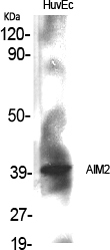
AIM2 Polyclonal Antibody
.jpg)
- 产品详情
- 实验流程
- 背景知识
Application 
| WB, IHC-P, IF, ICC, E |
|---|---|
| Primary Accession | O14862 |
| Reactivity | Human, Mouse, Rat |
| Host | Rabbit |
| Clonality | Polyclonal |
| Calculated MW | 38954 Da |
| Gene ID | 9447 |
|---|---|
| Other Names | AIM2; Interferon-inducible protein AIM2; Absent in melanoma 2 |
| Dilution | WB~~Western Blot: 1/500 - 1/2000. Immunohistochemistry: 1/100 - 1/300. Immunofluorescence: 1/200 - 1/1000. ELISA: 1/40000. Not yet tested in other applications. IHC-P~~1:50~200 IF~~1:50~200 ICC~~N/A E~~N/A |
| Format | Liquid in PBS containing 50% glycerol, 0.5% BSA and 0.09% (W/V) sodium azide. |
| Storage Conditions | -20℃ |
For Research Use Only. Not For Use In Diagnostic Procedures.
| Name | AIM2 {ECO:0000303|PubMed:9242382, ECO:0000312|HGNC:HGNC:357} |
|---|---|
| Function | Sensor component of the AIM2 inflammasome, which mediates inflammasome activation in response to the presence of double-stranded DNA (dsDNA) in the cytosol, leading to subsequent pyroptosis (PubMed:17726700, PubMed:19158675, PubMed:19158676, PubMed:19158679, PubMed:20566831, PubMed:23530044, PubMed:26197926, PubMed:26583071, PubMed:29440442, PubMed:33980849, PubMed:37364111). Inflammasomes are supramolecular complexes that assemble in the cytosol in response to pathogens and other damage-associated signals and play critical roles in innate immunity and inflammation (PubMed:17726700, PubMed:19158675, PubMed:19158676, PubMed:19158679, PubMed:20566831, PubMed:26197926, PubMed:29440442, PubMed:33980849). Acts as a recognition receptor (PRR): specifically recognizes and binds dsDNA in the cytosol, and mediates the formation of the inflammasome polymeric complex composed of AIM2, CASP1 and PYCARD/ASC (PubMed:17726700, PubMed:19158675, PubMed:19158676, PubMed:19158679, PubMed:20566831, PubMed:26197926, PubMed:29440442, PubMed:33980849). Recruitment of pro-caspase-1 (proCASP1) to the AIM2 inflammasome promotes caspase-1 (CASP1) activation, which subsequently cleaves and activates inflammatory cytokines IL1B and IL18 and gasdermin-D (GSDMD), promoting cytokine secretion (PubMed:17726700, PubMed:19158675, PubMed:19158676, PubMed:19158679, PubMed:20566831). In some cells, CASP1 activation mediates cleavage and activation of GSDMD, triggering pyroptosis without promoting cytokine secretion (PubMed:19158675, PubMed:19158676). Detects cytosolic dsDNA of viral and bacterial origin in a non-sequence-specific manner (PubMed:17726700, PubMed:19158675, PubMed:19158676, PubMed:19158679, PubMed:20566831, PubMed:26197926, PubMed:26583071, PubMed:29440442, PubMed:33980849). Involved in the DNA damage response caused by acute ionizing radiation by mediating pyroptosis of intestinal epithelial cells and bone marrow cells in response to double-strand DNA breaks (By similarity). Mechanistically, AIM2 senses DNA damage in the nucleus to mediate inflammasome assembly and inflammatory cell death (By similarity). Also acts as a regulator of neurodevelopment via its role in the DNA damage response: acts by promoting neural cell death in response to DNA damage in the developing brain, thereby purging genetically compromised cells of the central nervous system (By similarity). Pyroptosis mediated by the AIM2 inflammasome in response to DNA damage is dependent on GSDMD without involving IL1B and IL18 cytokine secretion (By similarity). Also acts as a mediator of pyroptosis, necroptosis and apoptosis (PANoptosis), an integral part of host defense against pathogens, in response to bacterial infection (By similarity). Can also trigger PYCARD/ASC- dependent, caspase-1-independent cell death that involves caspase-8 (CASP8) (By similarity). |
| Cellular Location | Cytoplasm. Inflammasome. Nucleus. Note=Activated inflammasomes can aggregate in the cytosol as speck-like particles (PubMed:19158675, PubMed:19158676, PubMed:19158679). Activated inflammasomes can also aggregate in the nucleus in response to DNA damage: AIM2 is recruited to double-strand DNA breaks and mediates activation of the AIM2 inflammasome (By similarity). {ECO:0000250|UniProtKB:Q91VJ1, ECO:0000269|PubMed:19158675, ECO:0000269|PubMed:19158676, ECO:0000269|PubMed:19158679} |
| Tissue Location | Expressed in spleen, small intestine, peripheral blood leukocytes, and testis. |
Provided below are standard protocols that you may find useful for product applications.
BACKGROUND
Involved in innate immune response by recognizing cytosolic double-stranded DNA and inducing caspase-1-activating inflammasome formation in macrophages. Upon binding to DNA is thought to undergo oligomerization and to associate with PYCARD initiating the recruitment of caspase-1 precusrsor and processing of interleukin-1 beta and interleukin-18. Detects cytosolic dsDNA of viral and bacterial origin in a non-sequence-specific manner. Can also trigger PYCARD-dependent, caspase-1-independent cell death that involves caspase-8 (By similarity). Tumor suppressor which may act by repressing NF-kappa-B transcriptional activity.

终于等到您。ABCEPTA(百远生物)抗体产品。
点击下方“我要评价 ”按钮提交您的反馈信息,您的反馈和评价是我们最宝贵的财富之一,
我们将在1-3个工作日内处理您的反馈信息。
如有疑问,联系:0512-88856768 tech-china@abcepta.com.


