


 癌症的基本特征包括细胞增殖、血管生成、迁移、凋亡逃避机制和细胞永生等。找到癌症发生过程中这些通路的关键标记物和对应的抗体用于检测至关重要。
 为您推荐一个泛素化位点预测神器——泛素化分析工具,可以为您的蛋白的泛素化位点作出预测和评分。
 细胞自噬受体图形绘图工具为你的蛋白的细胞受体结合位点作出预测和评分,识别结合到自噬通路中的蛋白是非常重要的,便于让我们理解自噬在正常生理、病理过程中的作用,如发育、细胞分化、神经退化性疾病、压力条件下、感染和癌症。
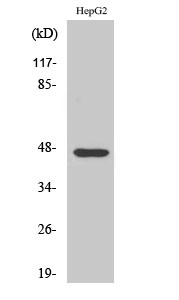
AKAP 79 Polyclonal Antibody
- 产品详情
- 实验流程
- 背景知识
Application 
| WB, IHC-P, IF, ICC, E |
|---|---|
| Primary Accession | P24588 |
| Reactivity | Human, Rat, Mouse |
| Host | Rabbit |
| Clonality | Polyclonal |
| Calculated MW | 47088 Da |
| Gene ID | 9495 |
|---|---|
| Other Names | AKAP5; AKAP79; A-kinase anchor protein 5; AKAP-5; A-kinase anchor protein 79 kDa; AKAP 79; H21; cAMP-dependent protein kinase regulatory subunit II high affinity-binding protein |
| Dilution | WB~~Western Blot: 1/500 - 1/2000. Immunohistochemistry: 1/100 - 1/300. Immunofluorescence: 1/200 - 1/1000. ELISA: 1/10000. Not yet tested in other applications. IHC-P~~1:50~200 IF~~1:50~200 ICC~~N/A E~~N/A |
| Format | Liquid in PBS containing 50% glycerol, 0.5% BSA and 0.09% (W/V) sodium azide. |
| Storage Conditions | -20℃ |
For Research Use Only. Not For Use In Diagnostic Procedures.
| Name | AKAP5 |
|---|---|
| Synonyms | AKAP79 |
| Function | Multivalent scaffold protein that anchors the cAMP-dependent protein kinase/PKA to cytoskeletal and/or organelle-associated proteins, targeting the signal carried by cAMP to specific intracellular effectors (PubMed:1512224). Association with the beta2- adrenergic receptor (beta2-AR) not only regulates beta2-AR signaling pathway, but also the activation by PKA by switching off the beta2-AR signaling cascade. Plays a role in long term synaptic potentiation by regulating protein trafficking from the dendritic recycling endosomes to the plasma membrane and controlling both structural and functional plasticity at excitatory synapses (PubMed:25589740). In hippocampal pyramidal neurons, recruits KCNK2/TREK-1 channel at postsynaptic dense bodies microdomains and converts it to a leak channel no longer sensitive to stimulation by arachidonic acid, acidic pH or mechanical stress, nor inhibited by Gq-coupled receptors but still under the negative control of Gs-coupled receptors (By similarity). Associates with ORAI1 pore-forming subunit of CRAC channels in Ca(2+) signaling microdomains where it recruits NFATC2/NFAT1 and couples store-operated Ca(2+) influx to calmodulin and calcineurin signaling and activation of NFAT-dependent transcriptional responses (PubMed:33941685). |
| Cellular Location | Postsynaptic recycling endosome membrane; Lipid- anchor. Cell projection, dendrite {ECO:0000250|UniProtKB:D3YVF0}. Postsynaptic cell membrane {ECO:0000250|UniProtKB:D3YVF0}; Lipid-anchor. Note=Associates with lipid rafts. |
| Tissue Location | Predominantly in the cerebral cortex and the postsynaptic densities of the forebrain, and to a lesser extent in adrenal medulla, lung and anterior pituitary |
Research Areas
Application Protocols
Provided below are standard protocols that you may find useful for product applications.
BACKGROUND
May anchor the PKA protein to cytoskeletal and/or organelle-associated proteins, targeting the signal carried by cAMP to specific intracellular effectors. Association with to the beta2-adrenergic receptor (beta2-AR) not only regulates beta2-AR signaling pathway, but also the activation by PKA by switching off the beta2-AR signaling cascade.

终于等到您。ABCEPTA(百远生物)抗体产品。
点击下方“我要评价 ”按钮提交您的反馈信息,您的反馈和评价是我们最宝贵的财富之一,
我们将在1-3个工作日内处理您的反馈信息。
如有疑问,联系:0512-88856768 tech-china@abcepta.com.
¥ 1,250.00
Cat# AP68350


