


 癌症的基本特征包括细胞增殖、血管生成、迁移、凋亡逃避机制和细胞永生等。找到癌症发生过程中这些通路的关键标记物和对应的抗体用于检测至关重要。
 为您推荐一个泛素化位点预测神器——泛素化分析工具,可以为您的蛋白的泛素化位点作出预测和评分。
 细胞自噬受体图形绘图工具为你的蛋白的细胞受体结合位点作出预测和评分,识别结合到自噬通路中的蛋白是非常重要的,便于让我们理解自噬在正常生理、病理过程中的作用,如发育、细胞分化、神经退化性疾病、压力条件下、感染和癌症。
AZI1 Polyclonal Antibody
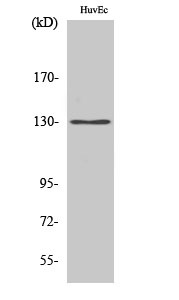
- 产品详情
- 实验流程
- 背景知识
Application 
| WB, IHC-P, IF, ICC, E |
|---|---|
| Primary Accession | Q9UPN4 |
| Reactivity | Human, Rat, Mouse |
| Host | Rabbit |
| Clonality | Polyclonal |
| Calculated MW | 122149 Da |
| Gene ID | 22994 |
|---|---|
| Other Names | AZI1; CEP131; KIAA1118; 5-azacytidine-induced protein 1; Centrosomal protein of 131 kDa; Cep131; Pre-acrosome localization protein 1 |
| Dilution | WB~~Western Blot: 1/500 - 1/2000. Immunohistochemistry: 1/100 - 1/300. ELISA: 1/40000. Not yet tested in other applications. IHC-P~~1:50~200 IF~~1:50~200 ICC~~N/A E~~N/A |
| Format | Liquid in PBS containing 50% glycerol, 0.5% BSA and 0.09% (W/V) sodium azide. |
| Storage Conditions | -20℃ |
For Research Use Only. Not For Use In Diagnostic Procedures.
| Name | CEP131 |
|---|---|
| Synonyms | AZI1, KIAA1118 |
| Function | Component of centriolar satellites contributing to the building of a complex and dynamic network required to regulate cilia/flagellum formation (PubMed:17954613, PubMed:24185901). In proliferating cells, MIB1-mediated ubiquitination induces its sequestration within centriolar satellites, precluding untimely cilia formation initiation (PubMed:24121310). In contrast, during normal and ultraviolet or heat shock cellular stress-induced ciliogenesis, its non-ubiquitinated form is rapidly displaced from centriolar satellites and recruited to centrosome/basal bodies in a microtubule- and p38 MAPK-dependent manner (PubMed:24121310, PubMed:26616734). Also acts as a negative regulator of BBSome ciliary trafficking (PubMed:24550735). Plays a role in sperm flagellar formation; may be involved in the regulation of intraflagellar transport (IFT) and/or intramanchette (IMT) trafficking, which are important for axoneme extension and/or cargo delivery to the nascent sperm tail (By similarity). Required for optimal cell proliferation and cell cycle progression; may play a role in the regulation of genome stability in non-ciliogenic cells (PubMed:22797915, PubMed:26297806). Involved in centriole duplication (By similarity). Required for CEP152, WDR62 and CEP63 centrosomal localization and promotes the centrosomal localization of CDK2 (PubMed:26297806). Essential for maintaining proper centriolar satellite integrity (PubMed:30804208). |
| Cellular Location | Cytoplasm, cytoskeleton, microtubule organizing center, centrosome. Cytoplasm, cytoskeleton, microtubule organizing center, centrosome, centriolar satellite. Cytoplasm, cytoskeleton, microtubule organizing center, centrosome, centriole. Cytoplasm, cytoskeleton, cilium basal body. Cytoplasmic vesicle, secretory vesicle, acrosome {ECO:0000250|UniProtKB:Q62036}. Note=Colocalized with pericentriolar material protein PCM1 at centriolar satellites. During spermiogenesis, becomes enriched with nephrocystin NPHP1 at the transition zone, a structure at the base of the ciliary axoneme important for regulating traffic into the ciliary compartment. Traffics towards and away from the centrosome/basal body and the transition zone of the ciliary axoneme in a microtubule-dependent manner. Localized at the Golgi- derived acrosome and the centrosome-containing head-tail coupling apparatus (HTCA) (By similarity). Ubiquitinated form is sequestered and colocalized with BBS4, CEP290, PCM1 and PCNT at centriolar satellites in proliferating cells. Colocalized with the pericentriolar material protein PCM1 at centrosome. Traffics towards and away from centriolar satellites and centrosome in a microtubule- and dynein-dependent manner in interphase cells. Displaced from centriolar satellites but still remains associated with the centrosome in response to cellular stress, such as ultraviolet light (UV) radiation or heat shock, in a process that requires p38 MAPK signaling (PubMed:26616734). {ECO:0000250, ECO:0000269|PubMed:26616734} |
Provided below are standard protocols that you may find useful for product applications.
BACKGROUND
Component of centriolar satellites contributing to the building of a complex and dynamic network required to regulate cilia/flagellum formation (PubMed:17954613, PubMed:24185901). In proliferating cells, MIB1-mediated ubiquitination induces its sequestration within centriolar satellites, precluding untimely cilia formation initiation (PubMed:24121310). In contrast, during normal and ultraviolet or heat shock cellular stress-induced ciliogenesis, its non-ubiquitinated form is rapidly displaced from centriolar satellites and recruited to centrosome/basal bodies in a microtubule- and p38 MAPK-dependent manner (PubMed:24121310, PubMed:26616734). Acts also as a negative regulator of BBSome ciliary trafficking (PubMed:24550735). Plays a role in sperm flagellar formation; may be involved in the regulation of intraflagellar transport (IFT) and/or intramanchette (IMT) trafficking, which are important for axoneme extension and/or cargo delivery to the nascent sperm tail (By similarity). Required for optimal cell proliferation and cell cycle progression; may play a role in the regulation of genome stability in non- ciliogenic cells (PubMed:22797915, PubMed:26297806). Involved in centriole duplication (By similarity). Required for CEP152, WDR62 and CEP63 centrosomal localization and promotes the centrosomal localization of CDK2 (PubMed:26297806).

终于等到您。ABCEPTA(百远生物)抗体产品。
点击下方“我要评价 ”按钮提交您的反馈信息,您的反馈和评价是我们最宝贵的财富之一,
我们将在1-3个工作日内处理您的反馈信息。
如有疑问,联系:0512-88856768 tech-china@abcepta.com.


