


 癌症的基本特征包括细胞增殖、血管生成、迁移、凋亡逃避机制和细胞永生等。找到癌症发生过程中这些通路的关键标记物和对应的抗体用于检测至关重要。
 为您推荐一个泛素化位点预测神器——泛素化分析工具,可以为您的蛋白的泛素化位点作出预测和评分。
 细胞自噬受体图形绘图工具为你的蛋白的细胞受体结合位点作出预测和评分,识别结合到自噬通路中的蛋白是非常重要的,便于让我们理解自噬在正常生理、病理过程中的作用,如发育、细胞分化、神经退化性疾病、压力条件下、感染和癌症。
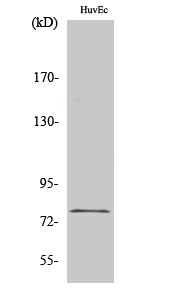
KCNQ4 Polyclonal Antibody
- 产品详情
- 实验流程
- 背景知识
Application 
| WB, E, IHC-P |
|---|---|
| Primary Accession | P56696 |
| Reactivity | Human, Mouse |
| Host | Rabbit |
| Clonality | Polyclonal |
| Calculated MW | 77101 Da |
| Gene ID | 9132 |
|---|---|
| Other Names | KCNQ4; Potassium voltage-gated channel subfamily KQT member 4; KQT-like 4; Potassium channel subunit alpha KvLQT4; Voltage-gated potassium channel subunit Kv7.4 |
| Dilution | WB~~Western Blot: 1/500 - 1/2000. ELISA: 1/5000. Not yet tested in other applications. E~~N/A IHC-P~~1:50~200 |
| Format | Liquid in PBS containing 50% glycerol, 0.5% BSA and 0.09% (W/V) sodium azide. |
| Storage Conditions | -20℃ |
For Research Use Only. Not For Use In Diagnostic Procedures.
| Name | KCNQ4 (HGNC:6298) |
|---|---|
| Function | Pore-forming subunit of the voltage-gated potassium (Kv) channel involved in the regulation of sensory cells excitability in the cochlea (PubMed:10025409, PubMed:34767770). KCNQ4/Kv7.4 channel is composed of 4 pore-forming subunits assembled as tetramers (PubMed:34767770). Promotes the outflow of potassium ions in the repolarization phase of action potential which plays a role in regulating membrane potential of excitable cells (PubMed:10025409, PubMed:11245603, PubMed:34767770). The channel conducts a slowly activating and deactivating current (PubMed:10025409, PubMed:11245603). Current often shows some inward rectification at positive potentials (PubMed:10025409). Channel may be selectively permeable in vitro to other cations besides potassium, in decreasing order of affinity K(+) = Rb(+) > Cs(+) > Na(+) (PubMed:10025409). Important for normal physiological function of inner ear such as sensory perception of sound (PubMed:10025409, PubMed:10369879). |
| Cellular Location | Basal cell membrane {ECO:0000250|UniProtKB:Q9JK96}; Multi-pass membrane protein. Note=Situated at the basal membrane of cochlear outer hair cells. {ECO:0000250|UniProtKB:Q9JK96} |
| Tissue Location | Expressed in the outer, but not the inner, sensory hair cells of the cochlea (PubMed:10025409). Slightly expressed in heart, brain and skeletal muscle (PubMed:10025409) |
Provided below are standard protocols that you may find useful for product applications.
BACKGROUND
Probably important in the regulation of neuronal excitability. May underlie a potassium current involved in regulating the excitability of sensory cells of the cochlea. KCNQ4 channels are blocked by linopirdin, XE991 and bepridil, whereas clofilium is without significant effect. Muscarinic agonist oxotremorine-M strongly suppress KCNQ4 current in CHO cells in which cloned KCNQ4 channels were coexpressed with M1 muscarinic receptors.

终于等到您。ABCEPTA(百远生物)抗体产品。
点击下方“我要评价 ”按钮提交您的反馈信息,您的反馈和评价是我们最宝贵的财富之一,
我们将在1-3个工作日内处理您的反馈信息。
如有疑问,联系:0512-88856768 tech-china@abcepta.com.


