


 癌症的基本特征包括细胞增殖、血管生成、迁移、凋亡逃避机制和细胞永生等。找到癌症发生过程中这些通路的关键标记物和对应的抗体用于检测至关重要。
 为您推荐一个泛素化位点预测神器——泛素化分析工具,可以为您的蛋白的泛素化位点作出预测和评分。
 细胞自噬受体图形绘图工具为你的蛋白的细胞受体结合位点作出预测和评分,识别结合到自噬通路中的蛋白是非常重要的,便于让我们理解自噬在正常生理、病理过程中的作用,如发育、细胞分化、神经退化性疾病、压力条件下、感染和癌症。
Melanopsin Polyclonal Antibody
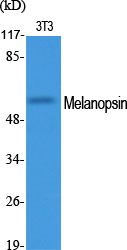
.jpg)
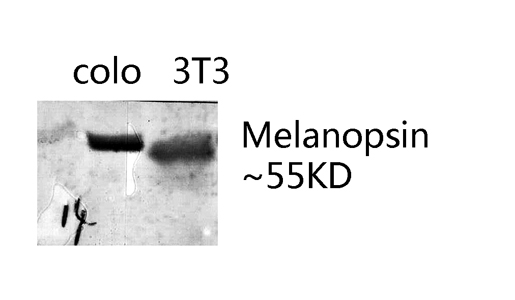
- 产品详情
- 实验流程
- 背景知识
Application 
| WB, E, IHC-P |
|---|---|
| Primary Accession | Q9UHM6 |
| Reactivity | Human, Rat, Mouse |
| Host | Rabbit |
| Clonality | Polyclonal |
| Calculated MW | 52635 Da |
| Gene ID | 94233 |
|---|---|
| Other Names | OPN4; MOP; Melanopsin; Opsin-4 |
| Dilution | WB~~Western Blot: 1/500 - 1/2000. Immunofluorescence: 1/200 - 1/1000. ELISA: 1/5000. Not yet tested in other applications. E~~N/A IHC-P~~1:50~200 |
| Format | Liquid in PBS containing 50% glycerol, 0.5% BSA and 0.09% (W/V) sodium azide. |
| Storage Conditions | -20℃ |
For Research Use Only. Not For Use In Diagnostic Procedures.
| Name | OPN4 (HGNC:14449) |
|---|---|
| Synonyms | MOP |
| Function | G protein-coupled photoreceptor that signals through the G(q/11) family of G proteins in response to light in intrinsically photosensitive retinal ganglion cells (ipRGCs) (By similarity). Can also activate other G proteins, including G(i/o) and G(s), depending on the cell type, leading to either activation or inhibition of adenylate cyclase and cAMP-dependent signaling (PubMed:35274137). Activation occurs when opsin-bound cis-retinal chromophore absorbs a photon and isomerizes to all-trans-retinal, inducing a conformational change in the opsin that triggers a G protein-mediated phototransduction cascade (PubMed:15674244). Acts as a bistable protein, allowing photoreversible regeneration of the cis-retinal chromophore after stimulation (PubMed:15674244). Contributes to non-image-forming visual response to light in ipRGCs, including the pupillary light reflex and the regulation of circadian rhythms (By similarity). In M1 ipRGCs (non- image forming) subtypes, activates a G(q)-phospholipase C (PLC) signaling cascade leading to depolarization through opening of TRPC6/7 channels and decreased intrisic excitability (By similarity). Mediates phototransduction in M4 ipRGCs (image forming) subtypes across dim to bright light conditions via G(q)-PLC signaling, resulting in increased intrisic excitability through closure of potassium leak channels (most likely TASK channels), thereby enhancing contrast sensitivity (By similarity). At bright light intensities, further enhances depolarization in M4 ipRGCs via activation of TRPC channels (By similarity). May be involved in the optokinetic visual tracking response. May also play a role in regulating retinal hyaloid vessel growth and regression (By similarity). |
| Cellular Location | Cell membrane; Multi-pass membrane protein. Cell projection, axon {ECO:0000250|UniProtKB:Q9QXZ9}. Cell projection, dendrite {ECO:0000250|UniProtKB:Q9QXZ9}. Perikaryon {ECO:0000250|UniProtKB:Q9QXZ9} |
| Tissue Location | Expressed in the retina. |
Research Areas
Application Protocols
Provided below are standard protocols that you may find useful for product applications.
BACKGROUND
Photoreceptor required for regulation of circadian rhythm. Contributes to pupillar reflex and other non-image forming responses to light. May be able to isomerize covalently bound all- trans retinal back to 11-cis retinal (By similarity).

终于等到您。ABCEPTA(百远生物)抗体产品。
点击下方“我要评价 ”按钮提交您的反馈信息,您的反馈和评价是我们最宝贵的财富之一,
我们将在1-3个工作日内处理您的反馈信息。
如有疑问,联系:0512-88856768 tech-china@abcepta.com.


