


 癌症的基本特征包括细胞增殖、血管生成、迁移、凋亡逃避机制和细胞永生等。找到癌症发生过程中这些通路的关键标记物和对应的抗体用于检测至关重要。
 为您推荐一个泛素化位点预测神器——泛素化分析工具,可以为您的蛋白的泛素化位点作出预测和评分。
 细胞自噬受体图形绘图工具为你的蛋白的细胞受体结合位点作出预测和评分,识别结合到自噬通路中的蛋白是非常重要的,便于让我们理解自噬在正常生理、病理过程中的作用,如发育、细胞分化、神经退化性疾病、压力条件下、感染和癌症。
Polyclonal Antibody to Thrombospondin 1 (THBS1)
Thrombospondin 1
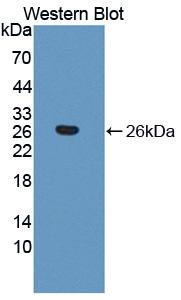
- 产品详情
- 实验流程
Application 
| WB |
|---|---|
| Primary Accession | Q28178 |
| Host | Rabbit |
| Clonality | Polyclonal |
| Calculated MW | 129534 Da |
| Gene ID | 281530 |
|---|---|
| Other Names | TSP1; Thrombospondin-1p180 |
| Target/Specificity | Bos taurus; Bovine (Cattle) |
| Dilution | WB~~Western blotting: 0.2-2 µg/mL;1:250-2500
Immunohistochemistry: 5-20 µg/mL;1:25-100 Immunocytochemistry: 5-20 µg/mL;1:25-100 Optimal working dilutions must be determined by end user. |
| Format | PBS, pH7.4, containing 0.02% NaN3, 50% glycerol. |
| Storage | Store at -20 °C.Stable for 12 months from date of receipt |
For Research Use Only. Not For Use In Diagnostic Procedures.
| Name | THBS1 |
|---|---|
| Synonyms | TSP-1, TSP1 |
| Function | Adhesive glycoprotein that mediates cell-to-cell and cell-to- matrix interactions. Multifunctional, involved in inflammation, angiogenesis, wound healing, reactive oxygen species (ROS) signaling, nitrous oxide (NO) signaling, apoptosis, senescence, aging, cellular self-renewal, stemness, and cardiovascular and metabolic homeostasis. Negatively modulates dendritic cell activation and cytokine release, as part of an autocrine feedback loop, contributing to the resolution of inflammation and immune homeostasis. Ligand for receptor CD47 (By similarity). Modulates nitrous oxide (NO) signaling via CD47, hence playing a role as a pressor agent, supporting blood pressure (By similarity). Plays a role in endothelial cell senescence, acting via CD47, by increasing the abundance and activation of NADPH oxidase NOX1, and so generating excess ROS (By similarity). Inhibits stem cell self- renewal, acting via CD47 signaling, probably by regulation of the stem cell transcription factors POU5F1/OCT4, SOX2, MYC/c-Myc and KLF4. Negatively modulates wound healing, acting via CD47 (By similarity). Ligand for receptor CD36 (By similarity). Involved in inducing apoptosis in podocytes in response to elevated free fatty acids, acting via CD36 (By similarity). Plays a role in suppressing angiogenesis, acting, depending on context, via CD36 or CD47. Promotes cellular senescence in a TP53-CDKN1A-RB1 signaling-dependent manner. Ligand for immunoglobulin-like cell surface receptor SIRPA. Involved in ROS signaling in non-phagocytic cells, stimulating NADPH oxidase-derived ROS production, acting via interaction with SIRPA (By similarity). Plays a role in metabolic dysfunction in diet-induced obesity, perhaps acting by exacerbating adipose inflammatory activity; its effects may be mediated, at least in part, through enhanced adipocyte proliferation. Plays a role in ER stress response, via its interaction with the activating transcription factor 6 alpha (ATF6) which produces adaptive ER stress response factors (By similarity). May be involved in age-related conditions, including metabolic dysregulation, during normal aging (By similarity). |
| Cellular Location | Secreted {ECO:0000250|UniProtKB:P07996}. Cell surface {ECO:0000250|UniProtKB:P07996}. Secreted, extracellular space, extracellular matrix {ECO:0000250|UniProtKB:P07996}. Endoplasmic reticulum {ECO:0000250|UniProtKB:P35441}. Sarcoplasmic reticulum {ECO:0000250|UniProtKB:P35441}. Note=Secreted by thrombin-activated platelets and binds to the cell surface in the presence of extracellular Ca(2+). Incorporated into the extracellular matrix (ECM) of fibroblasts. The C-terminal region in trimeric form is required for retention in the ECM (By similarity). Also detected in the endoplasmic reticulum and sarcoplasmic reticulum where it plays a role in the ER stress response (By similarity). {ECO:0000250|UniProtKB:P07996, ECO:0000250|UniProtKB:P35441} |
| Tissue Location | Odontoblasts.. |
Research Areas
Application Protocols
Provided below are standard protocols that you may find useful for product applications.

终于等到您。ABCEPTA(百远生物)抗体产品。
点击下方“我要评价 ”按钮提交您的反馈信息,您的反馈和评价是我们最宝贵的财富之一,
我们将在1-3个工作日内处理您的反馈信息。
如有疑问,联系:0512-88856768 tech-china@abcepta.com.


