


 癌症的基本特征包括细胞增殖、血管生成、迁移、凋亡逃避机制和细胞永生等。找到癌症发生过程中这些通路的关键标记物和对应的抗体用于检测至关重要。
 为您推荐一个泛素化位点预测神器——泛素化分析工具,可以为您的蛋白的泛素化位点作出预测和评分。
 细胞自噬受体图形绘图工具为你的蛋白的细胞受体结合位点作出预测和评分,识别结合到自噬通路中的蛋白是非常重要的,便于让我们理解自噬在正常生理、病理过程中的作用,如发育、细胞分化、神经退化性疾病、压力条件下、感染和癌症。
> 首页 > 产品 > 一抗 > 其他 > Polyclonal Antibody to Fragile X Mental Retardation Syndrome Related Protein 1 (FXR1)
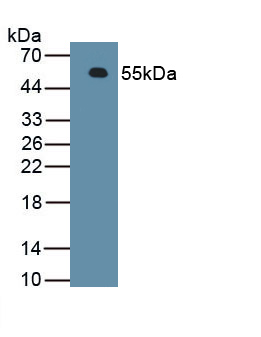
Polyclonal Antibody to Fragile X Mental Retardation Syndrome Related Protein 1 (FXR1)
Fragile X Mental Retardation Syndrome Related Protein 1
- 产品详情
- 实验流程
Application 
| WB |
|---|---|
| Primary Accession | Q5XI81 |
| Reactivity | Rat |
| Host | Rabbit |
| Clonality | Polyclonal |
| Calculated MW | 63947 Da |
| Gene ID | 361927 |
|---|---|
| Other Names | Fragile X mental retardation syndrome-related protein 1, Fxr1 {ECO:0000250|UniProtKB:P51114} |
| Target/Specificity | Rattus norvegicus (Rat) |
| Dilution | WB~~Western blotting: 0.5-2 µg/mL<br/>Immunohistochemistry: 5-20 µg/mL<br/>Immunocytochemistry: 5-20 µg/mL<br/>Optimal working dilutions must be determined by end user. |
| Format | PBS, pH7.4, containing 0.02% NaN3, 50% glycerol. |
| Storage | Store at -20 °C.Stable for 12 months from date of receipt |
For Research Use Only. Not For Use In Diagnostic Procedures.
| Name | Fxr1 {ECO:0000312|RGD:1311733} |
|---|---|
| Function | mRNA-binding protein that acts as a regulator of mRNAs translation and/or stability, and which is required for various processes, such as neurogenesis, muscle development and spermatogenesis. Specifically binds to AU-rich elements (AREs) in the 3'-UTR of target mRNAs. Promotes formation of some phase-separated membraneless compartment by undergoing liquid-liquid phase separation upon binding to AREs-containing mRNAs, leading to assemble mRNAs into cytoplasmic ribonucleoprotein granules that concentrate mRNAs with associated regulatory factors. Required to activate translation of stored mRNAs during late spermatogenesis: acts by undergoing liquid- liquid phase separation to assemble target mRNAs into cytoplasmic ribonucleoprotein granules that recruit translation initiation factor EIF4G3 to activate translation of stored mRNAs in late spermatids (By similarity). Promotes translation of MYC transcripts by recruiting the eIF4F complex to the translation start site. Acts as a negative regulator of inflammation in response to IL19 by promoting destabilization of pro-inflammatory transcripts (By similarity). Also acts as an inhibitor of inflammation by binding to TNF mRNA, decreasing TNF protein production. Acts as a negative regulator of AMPA receptor GRIA2/GluA2 synthesis during long-lasting synaptic potentiation of hippocampal neurons by binding to GRIA2/GluA2 mRNA, thereby inhibiting its translation. Regulates proliferation of adult neural stem cells by binding to CDKN1A mRNA and promoting its expression. Acts as a regulator of sleep and synaptic homeostasis by regulating translation of transcripts in neurons. Required for embryonic and postnatal development of muscle tissue by undergoing liquid-liquid phase separation to assemble target mRNAs into cytoplasmic ribonucleoprotein granules (By similarity). Involved in the nuclear pore complex localization to the nuclear envelope by preventing cytoplasmic aggregation of nucleoporins: acts by preventing ectopic phase separation of nucleoporins in the cytoplasm via a microtubule-dependent mechanism (By similarity). Plays a role in the stabilization of PKP2 mRNA and therefore protein abundance, via its interaction with PKP3 (By similarity). May also do the same for PKP2, PKP3 and DSP via its interaction with PKP1 (By similarity). Forms a cytoplasmic messenger ribonucleoprotein (mRNP) network by packaging long mRNAs, serving as a scaffold that recruits proteins and signaling molecules. This network facilitates signaling reactions by maintaining proximity between kinases and substrates, crucial for processes like actomyosin reorganization (By similarity). |
| Cellular Location | Cytoplasm, Cytoplasmic ribonucleoprotein granule {ECO:0000250|UniProtKB:Q61584}. Cytoplasm, Stress granule {ECO:0000250|UniProtKB:P51114}. Cytoplasm {ECO:0000250|UniProtKB:Q61584}. Cell projection, dendrite {ECO:0000250|UniProtKB:Q61584}. Cell projection, dendritic spine {ECO:0000250|UniProtKB:Q61584}. Cell projection, axon {ECO:0000250|UniProtKB:Q61584}. Nucleus envelope {ECO:0000250|UniProtKB:P51114}. Postsynapse {ECO:0000250|UniProtKB:Q61584}. Note=Specifically localizes to cytoplasmic ribonucleoprotein membraneless compartments (By similarity). Localizes to stress granules following phosphorylation at Ser-449 by PAK1 (By similarity). Adjacent to Z-lines in muscles (By similarity). {ECO:0000250|UniProtKB:P51114, ECO:0000250|UniProtKB:Q61584} |
Research Areas
Application Protocols
Provided below are standard protocols that you may find useful for product applications.

终于等到您。ABCEPTA(百远生物)抗体产品。
点击下方“我要评价 ”按钮提交您的反馈信息,您的反馈和评价是我们最宝贵的财富之一,
我们将在1-3个工作日内处理您的反馈信息。
如有疑问,联系:0512-88856768 tech-china@abcepta.com.
¥ 1,250.00
Cat# AP74778


