


 癌症的基本特征包括细胞增殖、血管生成、迁移、凋亡逃避机制和细胞永生等。找到癌症发生过程中这些通路的关键标记物和对应的抗体用于检测至关重要。
 为您推荐一个泛素化位点预测神器——泛素化分析工具,可以为您的蛋白的泛素化位点作出预测和评分。
 细胞自噬受体图形绘图工具为你的蛋白的细胞受体结合位点作出预测和评分,识别结合到自噬通路中的蛋白是非常重要的,便于让我们理解自噬在正常生理、病理过程中的作用,如发育、细胞分化、神经退化性疾病、压力条件下、感染和癌症。
NR1D1 Rabbit mAb
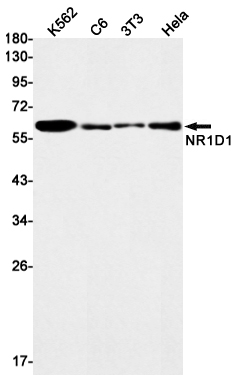
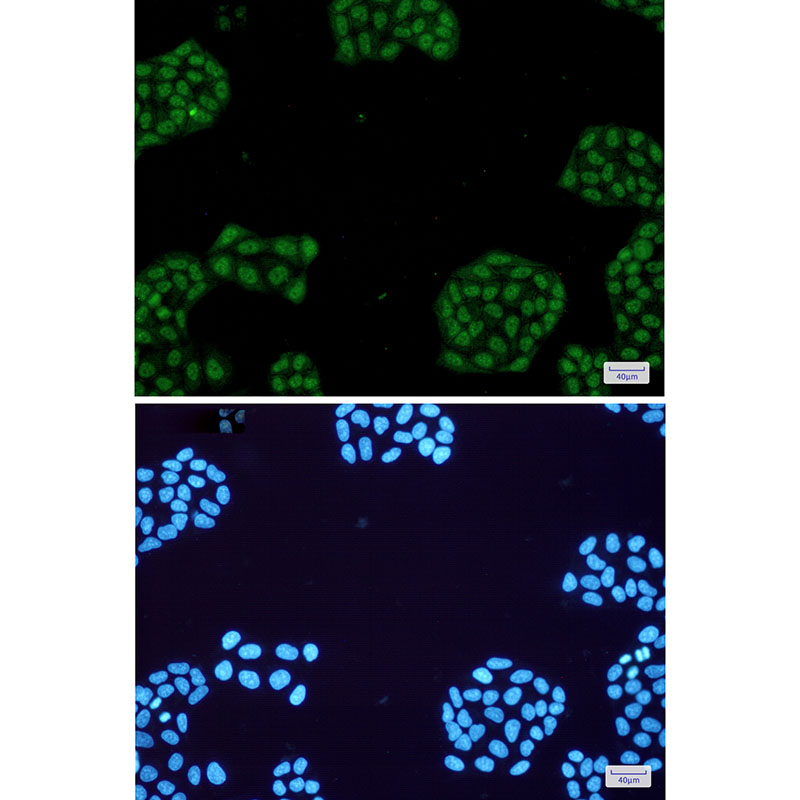
- 产品详情
- 实验流程
- 背景知识
Application 
| WB, IHC-P, FC |
|---|---|
| Primary Accession | P20393 |
| Reactivity | Rat, Human, Mouse |
| Host | Rabbit |
| Clonality | Monoclonal Antibody |
| Isotype | IgG |
| Conjugate | Unconjugated |
| Purification | Affinity Purified |
| Calculated MW | 66805 Da |
| Gene ID | 9572 |
|---|---|
| Other Names | NR1D1 |
| Dilution | WB~~1:1000-1:5000 IHC-P~~1:50~200 FC~~1:20-1:50 |
| Format | Liquid in 50mM Tris-Glycine(pH 7.4), 0.15M NaCl, 40%Glycerol, 0.01% sodium azide and 0.05% BSA. |
| Storage | Store at 4°C short term. Aliquot and store at -20°C long term. Avoid freeze/thaw cycles. |
For Research Use Only. Not For Use In Diagnostic Procedures.
| Name | NR1D1 |
|---|---|
| Synonyms | EAR1, HREV, THRAL |
| Function | Transcriptional repressor which coordinates circadian rhythm and metabolic pathways in a heme-dependent manner. Integral component of the complex transcription machinery that governs circadian rhythmicity and forms a critical negative limb of the circadian clock by directly repressing the expression of core clock components BMAL1, CLOCK and CRY1. Also regulates genes involved in metabolic functions, including lipid and bile acid metabolism, adipogenesis, gluconeogenesis and the macrophage inflammatory response. Acts as a receptor for heme which stimulates its interaction with the NCOR1/HDAC3 corepressor complex, enhancing transcriptional repression. Recognizes two classes of DNA response elements within the promoter of its target genes and can bind to DNA as either monomers or homodimers, depending on the nature of the response element. Binds as a monomer to a response element composed of the consensus half-site motif 5'-[A/G]GGTCA-3' preceded by an A/T-rich 5' sequence (RevRE), or as a homodimer to a direct repeat of the core motif spaced by two nucleotides (RevDR-2). Acts as a potent competitive repressor of ROR alpha (RORA) function and regulates the levels of its ligand heme by repressing the expression of PPARGC1A, a potent inducer of heme synthesis. Regulates lipid metabolism by repressing the expression of APOC3 and by influencing the activity of sterol response element binding proteins (SREBPs); represses INSIG2 which interferes with the proteolytic activation of SREBPs which in turn govern the rhythmic expression of enzymes with key functions in sterol and fatty acid synthesis. Regulates gluconeogenesis via repression of G6PC1 and PEPCK and adipocyte differentiation via repression of PPARG. Regulates glucagon release in pancreatic alpha- cells via the AMPK-NAMPT-SIRT1 pathway and the proliferation, glucose- induced insulin secretion and expression of key lipogenic genes in pancreatic-beta cells. Positively regulates bile acid synthesis by increasing hepatic expression of CYP7A1 via repression of NR0B2 and NFIL3 which are negative regulators of CYP7A1. Modulates skeletal muscle oxidative capacity by regulating mitochondrial biogenesis and autophagy; controls mitochondrial biogenesis and respiration by interfering with the STK11-PRKAA1/2-SIRT1-PPARGC1A signaling pathway. Represses the expression of SERPINE1/PAI1, an important modulator of cardiovascular disease and the expression of inflammatory cytokines and chemokines in macrophages. Represses gene expression at a distance in macrophages by inhibiting the transcription of enhancer-derived RNAs (eRNAs). Plays a role in the circadian regulation of body temperature and negatively regulates thermogenic transcriptional programs in brown adipose tissue (BAT); imposes a circadian oscillation in BAT activity, increasing body temperature when awake and depressing thermogenesis during sleep. In concert with NR2E3, regulates transcriptional networks critical for photoreceptor development and function. In addition to its activity as a repressor, can also act as a transcriptional activator. In the ovarian granulosa cells acts as a transcriptional activator of STAR which plays a role in steroid biosynthesis. In collaboration with SP1, activates GJA1 transcription in a heme-independent manner. Represses the transcription of CYP2B10, CYP4A10 and CYP4A14 (By similarity). Represses the transcription of CES2 (By similarity). Represses and regulates the circadian expression of TSHB in a NCOR1- dependent manner (By similarity). Negatively regulates the protein stability of NR3C1 and influences the time-dependent subcellular distribution of NR3C1, thereby affecting its transcriptional regulatory activity (By similarity). Plays a critical role in the circadian control of neutrophilic inflammation in the lung; under resting, non- stress conditions, acts as a rhythmic repressor to limit inflammatory activity whereas in the presence of inflammatory triggers undergoes ubiquitin-mediated degradation thereby relieving inhibition of the inflammatory response (By similarity). Plays a key role in the circadian regulation of microglial activation and neuroinflammation; suppresses microglial activation through the NF-kappaB pathway in the central nervous system (By similarity). Plays a role in the regulation of the diurnal rhythms of lipid and protein metabolism in the skeletal muscle via transcriptional repression of genes controlling lipid and amino acid metabolism in the muscle (By similarity). |
| Cellular Location | Nucleus {ECO:0000250|UniProtKB:Q3UV55}. Cytoplasm {ECO:0000250|UniProtKB:Q3UV55}. Cell projection, dendrite {ECO:0000250|UniProtKB:Q3UV55}. Cell projection, dendritic spine {ECO:0000250|UniProtKB:Q3UV55}. Note=Localizes to the cytoplasm, dendrites and dendritic spine in the presence of OPHN1. Localizes predominantly to the nucleus at ZT8 whereas it is cytoplasmic at ZT20 Phosphorylation by CSNK1E enhances its cytoplasmic localization {ECO:0000250|UniProtKB:Q3UV55} |
| Tissue Location | Widely expressed. Expressed at high levels in the liver, adipose tissue, skeletal muscle and brain. Also expressed in endothelial cells (ECs), vascular smooth muscle cells (VSMCs) and macrophages. Expression oscillates diurnally in the suprachiasmatic nucleus (SCN) of the hypothalamus as well as in peripheral tissues Expression increases during the differentiation of pre-adipocytes into mature adipocytes. Expressed at high levels in some squamous carcinoma cell lines. |
Provided below are standard protocols that you may find useful for product applications.
BACKGROUND
This gene encodes a transcription factor that is a member of the nuclear receptor subfamily 1. The encoded protein is a ligand-sensitive transcription factor that negatively regulates the expression of core clock proteins. In particular this protein represses the circadian clock transcription factor aryl hydrocarbon receptor nuclear translocator-like protein 1 (ARNTL). This protein may also be involved in regulating genes that function in metabolic, inflammatory and cardiovascular processes.

终于等到您。ABCEPTA(百远生物)抗体产品。
点击下方“我要评价 ”按钮提交您的反馈信息,您的反馈和评价是我们最宝贵的财富之一,
我们将在1-3个工作日内处理您的反馈信息。
如有疑问,联系:0512-88856768 tech-china@abcepta.com.


