


 癌症的基本特征包括细胞增殖、血管生成、迁移、凋亡逃避机制和细胞永生等。找到癌症发生过程中这些通路的关键标记物和对应的抗体用于检测至关重要。
 为您推荐一个泛素化位点预测神器——泛素化分析工具,可以为您的蛋白的泛素化位点作出预测和评分。
 细胞自噬受体图形绘图工具为你的蛋白的细胞受体结合位点作出预测和评分,识别结合到自噬通路中的蛋白是非常重要的,便于让我们理解自噬在正常生理、病理过程中的作用,如发育、细胞分化、神经退化性疾病、压力条件下、感染和癌症。
OGT Rabbit mAb
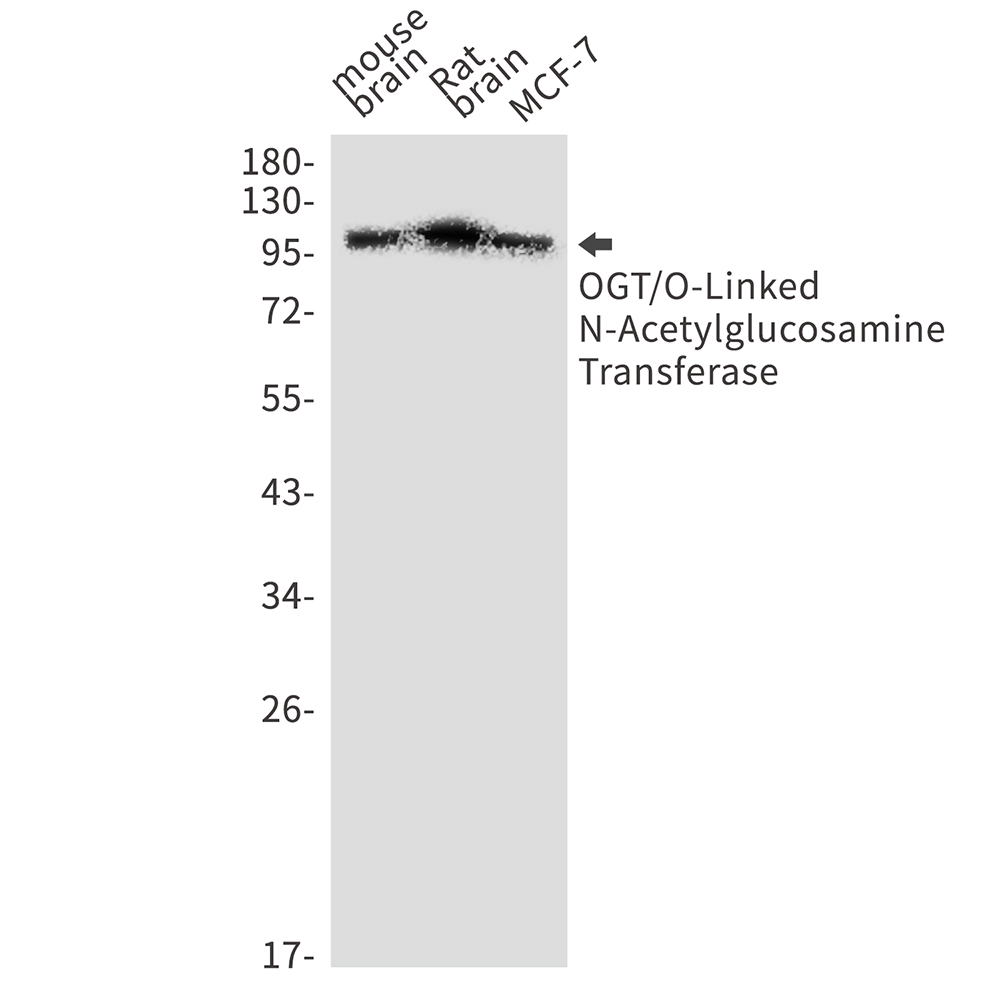
- 产品详情
- 实验流程
- 背景知识
Application 
| WB, IHC-P, FC |
|---|---|
| Primary Accession | O15294 |
| Reactivity | Rat, Human, Mouse |
| Host | Rabbit |
| Clonality | Monoclonal Antibody |
| Isotype | IgG |
| Conjugate | Unconjugated |
| Purification | Affinity Purified |
| Calculated MW | 116925 Da |
| Gene ID | 8473 |
|---|---|
| Other Names | OGT |
| Dilution | WB~~1:1000-1:5000 IHC-P~~1:50~200 FC~~1:10-1:100 |
| Format | Liquid in 50mM Tris-Glycine(pH 7.4), 0.15M NaCl, 40%Glycerol, 0.01% sodium azide and 0.05% BSA. |
| Storage | Store at 4°C short term. Aliquot and store at -20°C long term. Avoid freeze/thaw cycles. |
For Research Use Only. Not For Use In Diagnostic Procedures.
| Name | OGT {ECO:0000303|PubMed:11773972, ECO:0000312|HGNC:HGNC:8127} |
|---|---|
| Function | Catalyzes the transfer of a single N-acetylglucosamine from UDP-GlcNAc to a serine or threonine residue in cytoplasmic and nuclear proteins resulting in their modification with a beta-linked N- acetylglucosamine (O-GlcNAc) (PubMed:12150998, PubMed:15361863, PubMed:19451179, PubMed:20018868, PubMed:21240259, PubMed:21285374, PubMed:23103939, PubMed:26237509, PubMed:26369908, PubMed:26678539, PubMed:27713473, PubMed:37541260, PubMed:37962578). Glycosylates a large and diverse number of proteins including histone H2B, AKT1, AMPK, ATG4B, CAPRIN1, EZH2, FNIP1, GSDMD, KRT7, LMNA, LMNB1, LMNB2, RPTOR, HOXA1, PFKL, KMT2E/MLL5, MAPT/TAU, TET2, RBL2, RET, NOD2 and HCFC1 (PubMed:19451179, PubMed:20200153, PubMed:21285374, PubMed:22923583, PubMed:23353889, PubMed:24474760, PubMed:26237509, PubMed:26369908, PubMed:26678539, PubMed:27527864, PubMed:30699359, PubMed:34074792, PubMed:34667079, PubMed:37541260, PubMed:37962578). Can regulate their cellular processes via cross-talk between glycosylation and phosphorylation or by affecting proteolytic processing (PubMed:21285374). Involved in insulin resistance in muscle and adipocyte cells via glycosylating insulin signaling components and inhibiting the 'Thr-308' phosphorylation of AKT1, enhancing IRS1 phosphorylation and attenuating insulin signaling (By similarity). Involved in glycolysis regulation by mediating glycosylation of 6- phosphofructokinase PFKL, inhibiting its activity (PubMed:22923583). Plays a key role in chromatin structure by mediating O-GlcNAcylation of 'Ser-112' of histone H2B: recruited to CpG-rich transcription start sites of active genes via its interaction with TET proteins (TET1, TET2 or TET3) (PubMed:22121020, PubMed:23353889). As part of the NSL complex indirectly involved in acetylation of nucleosomal histone H4 on several lysine residues (PubMed:20018852). O-GlcNAcylation of 'Ser-75' of EZH2 increases its stability, and facilitating the formation of H3K27me3 by the PRC2/EED-EZH2 complex (PubMed:24474760). Stabilizes KMT2E/MLL5 by mediating its glycosylation, thereby preventing KMT2E/MLL5 ubiquitination (PubMed:26678539). Regulates circadian oscillation of the clock genes and glucose homeostasis in the liver (By similarity). Stabilizes clock proteins BMAL1 and CLOCK through O-glycosylation, which prevents their ubiquitination and subsequent degradation (By similarity). Promotes the CLOCK-BMAL1-mediated transcription of genes in the negative loop of the circadian clock such as PER1/2 and CRY1/2. O-glycosylates HCFC1 and regulates its proteolytic processing and transcriptional activity (PubMed:21285374, PubMed:28302723, PubMed:28584052). Component of a THAP1/THAP3-HCFC1-OGT complex that is required for the regulation of the transcriptional activity of RRM1 (PubMed:20200153). Regulates mitochondrial motility in neurons by mediating glycosylation of TRAK1 (By similarity). Promotes autophagy by mediating O-glycosylation of ATG4B (PubMed:27527864). Acts as a regulator of mTORC1 signaling by mediating O-glycosylation of RPTOR and FNIP1: O-GlcNAcylation of RPTOR in response to glucose sufficiency promotes activation of the mTORC1 complex (PubMed:30699359, PubMed:37541260). |
| Cellular Location | Nucleus. Cytoplasm. Note=Predominantly localizes to the nucleus (PubMed:26678539). Translocates into the nucleus via association with importin KPNA1 (PubMed:27713473) [Isoform 3]: Cytoplasm. Nucleus. Cell membrane {ECO:0000250|UniProtKB:P56558}. Mitochondrion membrane {ECO:0000250|UniProtKB:P56558}. Cell projection {ECO:0000250|UniProtKB:P56558}. Note=Mostly in the nucleus. Retained in the nucleus via interaction with HCFC1 (PubMed:21285374). After insulin induction, translocated from the nucleus to the cell membrane via phosphatidylinositide binding. Colocalizes with AKT1 at the plasma membrane. TRAK1 recruits this protein to mitochondria. In the absence of TRAK1, localizes in cytosol and nucleus (By similarity) {ECO:0000250|UniProtKB:P56558, ECO:0000269|PubMed:21285374} |
| Tissue Location | Highly expressed in pancreas and to a lesser extent in skeletal muscle, heart, brain and placenta. Present in trace amounts in lung and liver. |
Research Areas
Application Protocols
Provided below are standard protocols that you may find useful for product applications.
BACKGROUND
Addition of nucleotide-activated sugars directly onto the polypeptide through O-glycosidic linkage with the hydroxyl of serine or threonine. Mediates the O-glycosylation of MLL5 and HCFC1. Promotes proteolytic maturation of HCFC1.

终于等到您。ABCEPTA(百远生物)抗体产品。
点击下方“我要评价 ”按钮提交您的反馈信息,您的反馈和评价是我们最宝贵的财富之一,
我们将在1-3个工作日内处理您的反馈信息。
如有疑问,联系:0512-88856768 tech-china@abcepta.com.
¥ 1,250.00
Cat# AP75839


